
Clover burnet
Zygaena trifolii
Description
How to identify
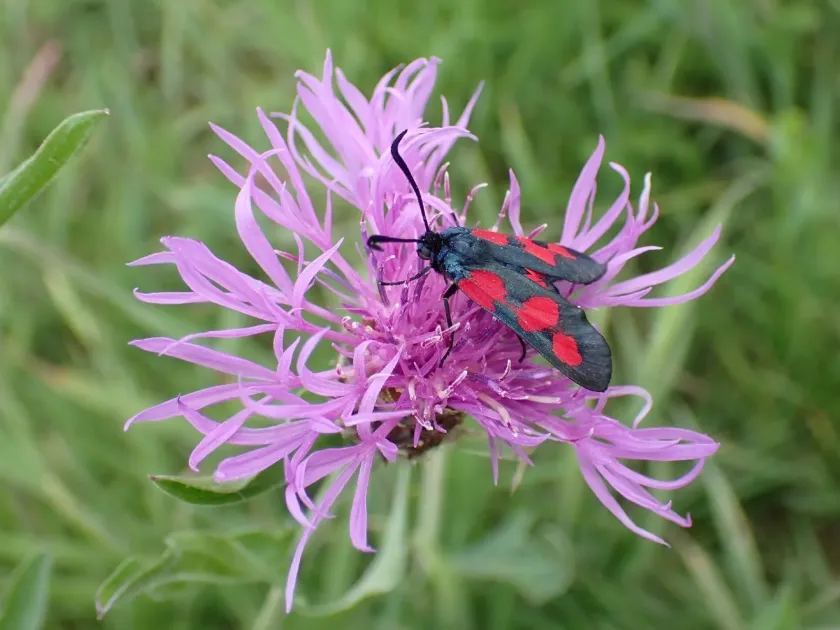
The clover burnet is a moth species belonging to the family Zygaenidae. The adult moth is characterized by dark, metallic green-blue forewings adorned with bright red spots, which serve as a warning to potential predators.
Larvae are typically short and stout, displaying a yellow-green coloration with distinct black spots along their bodies. They are generally slow-moving and remain on their host plants throughout the larval stage.
Pupation occurs within a tough, elongated, parchment-like cocoon. These cocoons are typically attached to the stems of clover or other herbaceous plants, often near the base of the plant.
Adults are day-flying insects that are most active during warm, sunny weather, which facilitates mating and the subsequent egg-laying process.
The species completes one generation per year. Larvae overwinter in the soil or among plant debris at the base of the stem, resuming their development as soon as spring temperatures rise.
What it damages
The clover burnet primarily affects plants belonging to the Fabaceae (legume) family. Its main agricultural impact is seen in red clover and white clover fields.
Secondary hosts may include various wild legumes found in surrounding pastures or field margins, which can serve as a reservoir for the pest.
Damage is exclusively caused by larvae, which feed voraciously on the foliage. Young larvae often skeletonize leaves, while older larvae consume entire leaves, leaving only the midribs.
Heavy infestations lead to a significant reduction in green biomass, which directly affects the nutritional quality and yield of forage crops intended for livestock.
The weakened state of infested plants makes them more susceptible to opportunistic pathogens, potentially shortening the lifespan of clover stands.
When it appears
Adult moths are typically observed on the wing from June to August. This period is critical for the reproductive cycle of the population.
Eggs are deposited in small batches on the undersides of host plant leaves. The incubation period lasts for several weeks until the first-instar larvae hatch.
Larval activity spans two phases: an initial feeding period in late summer and an intensive growth phase during the following spring.
By late spring, the larvae have reached full maturity and move to the stems to spin their cocoons, transitioning into the pupal stage.
The pupal stage lasts approximately two to three weeks, after which the new generation of adult moths emerges to begin the cycle anew.
Signs of infestation
Early signs of infestation include the appearance of irregular holes or skeletonized leaf tissue on clover foliage during the spring growing season.
The presence of parchment-like white or yellowish cocoons on the stems is a definitive sign that the larvae have recently completed their development.
Visual identification of the yellow-green larvae on the lower parts of clover plants confirms active grazing, especially during morning or evening hours.
Accumulation of larval frass (droppings) on the leaves beneath the feeding sites is a classic indicator of high larval activity in the crop.
Reduced vigor and patchiness in the clover stand may indicate hidden damage caused by larval feeding, especially if the infestation is spread unevenly.
Control measures
Cultural control practices, such as maintaining a proper crop rotation and mowing field margins, are highly effective in limiting local populations.
Early harvesting of clover for hay or silage is a standard mechanical method to interrupt the larval feeding cycle, leading to high mortality rates of the pest.
Minimizing the presence of wild legume hosts in the vicinity of clover fields reduces the likelihood of colonization by adult moths.
Biological control involves supporting natural enemies, such as parasitoid wasps, which are known to predate or parasitize Zygaena larvae effectively.
Chemical intervention should be considered only as a last resort and must follow strict guidelines regarding pesticide selection to protect non-target beneficial insects.
Taxonomy
- Latin name
- Zygaena trifolii
- Order
- Lepidoptera (butterflies)
- Family
- Zygaenidae
- EPPO code
- ZYGATR
Discussion
No discussions yet — be the first.