
Six-spot burnet
Zygaena filipendulae
Description
How to identify
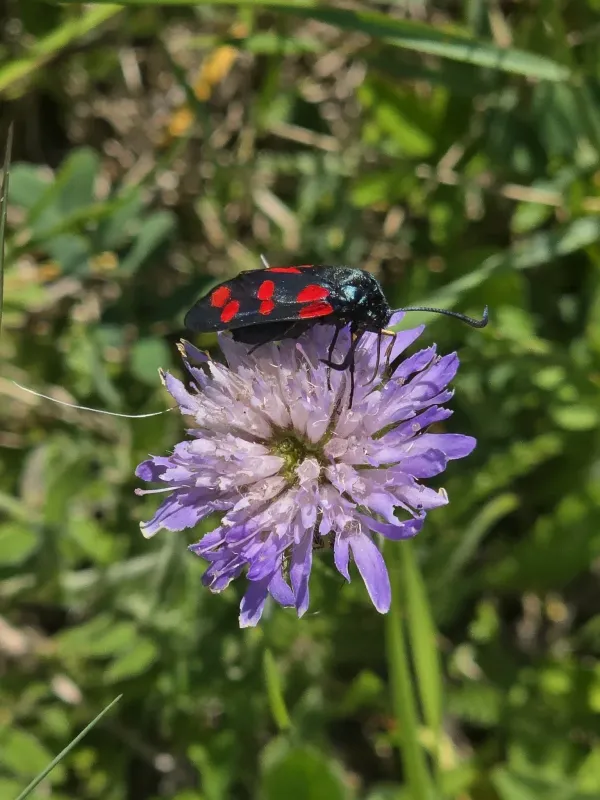
The six-spot burnet (Zygaena filipendulae) is a moth belonging to the family Zygaenidae, order Lepidoptera. The adult is easily identified by its black forewings, which feature six vibrant red spots and a distinct metallic sheen.
It possesses a robust, thickened body and clubbed antennae, which are key diagnostic features for this family. When at rest, the moth folds its wings tightly against its body, resembling a tent or roof shape.
The larvae are yellowish-green with rows of black lateral spots. They are generally slow-moving and possess a degree of chemical protection, making them unpalatable to many avian predators.
The pupal stage occurs within a papery, spindle-shaped cocoon, which is typically spun on the stems of host plants, usually low to the ground for protection.
The species completes one generation per year, and the winter period is spent in the larval stage, hiding deep within the base of vegetation or in the soil debris.
What it damages
The primary host plants for this species include various legumes, such as clovers, bird's-foot trefoil, and vetches, which are frequently grown as fodder crops.
Larval feeding causes the loss of leaf tissue, leading to decreased photosynthetic capacity and potentially stunted plant growth if the infestation is severe.
Economic damage is primarily seen in the reduction of biomass, which negatively affects the quality and volume of hay production in forage systems.
The larvae consume the leaves, often leaving the midribs intact or creating irregular, skeletonized patterns that are easily visible during field scouting.
While the six-spot burnet is not always a major pest, high populations can cause significant stress to young legume plants, making them more susceptible to drought and secondary pathogens.
When it appears
Adult moths are most active during the warmest summer months, typically from June to August, when they can be seen feeding on nectar and mating in fields.
Their activity is highly dependent on sunshine; on overcast or rainy days, they remain relatively inactive, hiding among the foliage where they are difficult to observe.
Larval development begins in early spring as the temperature rises, with the larvae actively consuming fresh young growth from the legume crops.
Pupation occurs in mid-summer, after which the next generation of adults emerges to continue the cycle, ensuring the species persists throughout the region.
As autumn arrives, the smaller larvae cease feeding and move to the base of the plants to enter dormancy, staying protected until the following spring.
Signs of infestation
The most common indicator of presence is the appearance of leaf damage, specifically holes or missing edges on the foliage of legume crops near the base of the plant.
Observing the vibrant adult moths on flowers in or around the field during June and July acts as a warning sign for potential egg-laying activity in the area.
The discovery of the characteristic yellow-to-white cocoons attached to stems is a clear sign that the population has successfully completed a stage of its development.
- Irregular bite marks and holes on clover leaves.
- Presence of larval frass on leaves or soil surface.
- Visible stunted development of legume patches.
In cases of heavy infestation, infected plants may show signs of wilting and yellowing due to the loss of leaf area and the stress caused by the feeding larvae.
Control measures
Cultural control via crop rotation remains one of the most effective strategies to prevent the buildup of pest populations within a specific field location.
Mowing field borders and managing weeds can significantly reduce the available habitats for the larvae, effectively limiting their spread into the main crop area.
Chemical control should only be considered if thresholds for economic damage are exceeded, using selective insecticides that are safe for the surrounding environment.
Encouraging natural biological control, such as supporting parasitoid wasps and ground beetles, helps maintain the population at a level that rarely requires intervention.
Field monitoring using light traps or systematic visual inspections during the adult flight period is crucial for timely decision-making and optimal management.
Taxonomy
- Latin name
- Zygaena filipendulae
- Order
- Lepidoptera (butterflies)
- Family
- Zygaenidae
- EPPO code
- ZYGAFI
Discussion
No discussions yet — be the first.