
White's Thrush
Zoothera dauma
Description
How to identify
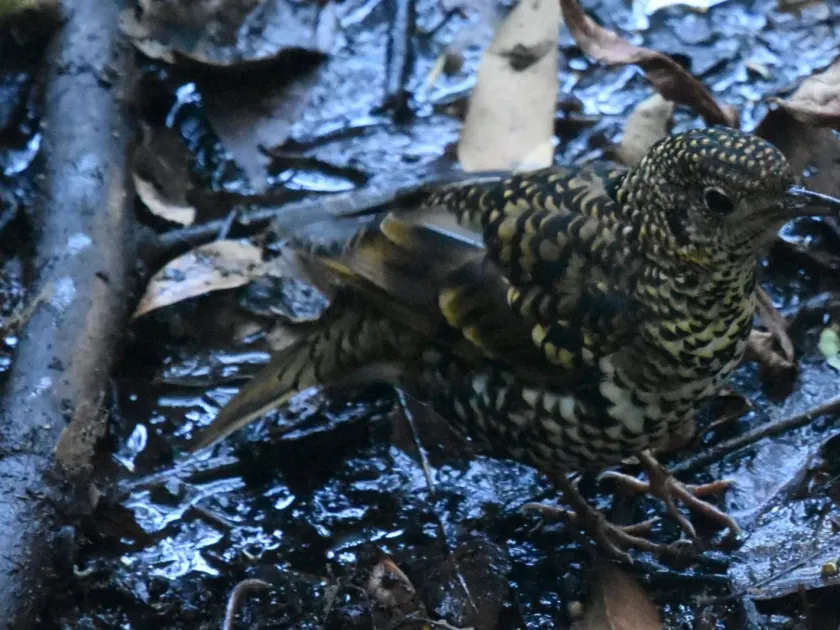
White's Thrush (Zoothera dauma) is a member of the thrush family (Turdidae) within the order Passeriformes. It is easily identified by its unique, golden-buff plumage with black crescent-shaped spots, creating a distinctive scaly appearance.
The bird measures approximately 27–30 centimeters in length, making it a medium-sized species that is quite adept at navigating through dense garden foliage.
It possesses a strong, dark beak capable of piercing fruit skins, which is the primary trait that makes it an agricultural pest during the harvest season.
While naturally forest-dwelling, these birds are highly opportunistic and often expand their foraging grounds into orchards and berry patches when natural food is scarce.
Their behavior is elusive, yet they congregate in groups when they locate a stable and abundant food source, such as a garden with ripening berries.
What it damages
White's Thrush primarily damages berry crops, including strawberries, raspberries, blackberries, honeysuckle, and currants, often consuming large portions of the yield.
Stone fruits, such as cherries and sour cherries, are also frequent targets, as the birds puncture the skin of the fruit to reach the succulent flesh inside.
This damage significantly degrades the quality of the fruit, rendering it unmarketable and susceptible to secondary infections like mold and fungal rot.
Large groups of these birds can strip a small orchard or berry field of its produce in a matter of days if the plants are not adequately protected.
In early spring, before fruits are available, they have been known to damage young buds and delicate shoots, hindering the development of the plants for the upcoming season.
When it appears
The peak activity period for this pest coincides with the ripening of early to mid-summer berries, typically spanning from June to July.
During autumn migrations, the risk of infestation persists if late-season crops remain in the garden, as the birds actively seek out energy-rich food sources.
Foraging activity is most intense during the early morning and late evening hours, during which the birds exhibit high levels of feeding aggression.
The exact timing of their presence can vary based on the specific climatic conditions of the year and the availability of wild food in nearby forest habitats.
A sudden change in weather, such as heavy rain or cold fronts, can often force these birds to abandon their natural habitats in favor of sheltered gardens.
Signs of infestation
The most evident sign of damage is the presence of fruit with visible beak marks, often accompanied by decay or mold developing in the punctures.
Discarded fruit fragments and droppings around the base of bushes are clear indicators that the site has been visited by a foraging flock.
Sudden gaps in the harvest on specific trees or rows of berry bushes indicate recent bird activity, especially if the fruit was ripening just yesterday.
The birds often produce sharp alarm calls when disturbed, providing an auditory cue for the gardener to take notice of their presence.
Visual confirmation of the birds in the upper canopy or hidden within the foliage of berry bushes is a standard sign of an ongoing pest problem.
Control measures
The most effective strategy for preventing damage is the installation of fine-mesh exclusion netting, which prevents the birds from accessing the berries directly.
Temporary deterrents such as reflective tapes or motion-activated visual devices can be used but are less effective long-term due to the birds' ability to habituate.
- Installing high-quality bird netting over crops.
- Utilizing ultrasonic sound emitters.
- Ensuring prompt harvesting of mature crops.
- Deploying bioacoustic distress call systems.
Integrated management is essential, as relying on a single method usually results in the birds finding ways to bypass the protection measures over time.
Taxonomy
- Latin name
- Zoothera dauma
- Family
- Turdidae
- EPPO code
- ZOOHDA
Discussion
No discussions yet — be the first.