
Pine needle sheathminer
Zelleria haimbachi
Description
How to identify
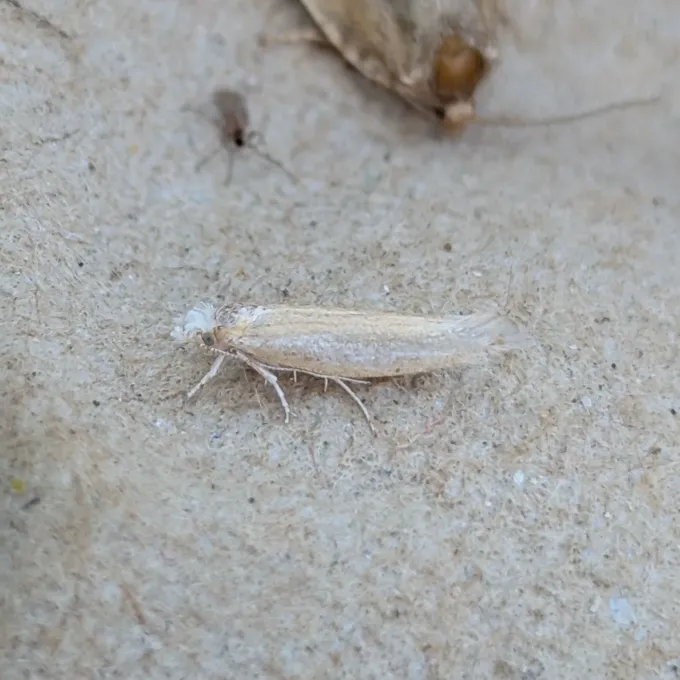
The pine needle sheathminer (Zelleria haimbachi) is a small moth belonging to the family Yponomeutidae. It is a specialized pest primarily targeting pine trees in forest nurseries and ornamental plantations.
The adult moth is relatively small, with a wingspan of approximately 10–12 mm. Its coloration is typically greyish-brown, which provides excellent camouflage against the rough texture of pine bark.
The larvae are small, slender caterpillars that feed internally on the pine needles. They have a green body, which makes them difficult to distinguish from the host foliage.
Pupation occurs within a loose silken cocoon, usually constructed between needles or near the bud, making it hard to detect during casual inspections of the canopy.
The species typically completes one generation per year, with the life cycle closely tied to the flushing and growth periods of the host pine trees.
What it damages
This pest mainly attacks various pine species, including Scots pine and Eastern white pine. It is especially damaging to young trees where rapid height growth is critical.
Larvae consume the interior of the current year's needles, causing them to turn yellow or brown and eventually drop. This results in significant loss of foliage and photosynthetic capacity.
The larvae often attack the terminal buds and newly expanding shoots, leading to stunted growth, twisting, and sometimes the death of the main leader shoot.
Severe infestations can cause premature needle drop, which significantly weakens the tree, making it susceptible to secondary pests like bark beetles.
In nursery settings, damage to the leader shoot can deform the entire growth habit of the seedling, rendering it unsuitable for sale or reforestation purposes.
When it appears
Adult moths emerge and are active during the mid-summer period. Mating and egg-laying occur at this time, with eggs deposited singly on needles or shoot surfaces.
The species overwinters in the egg stage. This phase is highly resistant to cold weather, ensuring a high survival rate through the winter months.
Larvae hatch in the spring, coinciding with the rapid growth of new pine needles. This is the period of maximum feeding activity and damage to the host plant.
Pupation typically takes place by mid-summer. The pupal stage lasts for several weeks before the adult moths emerge to restart the cycle.
Environmental factors, particularly spring temperatures, play a crucial role in determining the exact timing of larval emergence and the subsequent management window.
Signs of infestation
The most visible sign of infestation is the presence of discolored, withered needle tips. These needles are often hollowed out and fragile to the touch.
Fine webbing spun by the larvae around the shoots, often mixed with small pellets of frass, provides a clear diagnostic indicator of the presence of the moth.
Deformation of the new growth, such as curling or bending of the shoot, indicates that the larvae have interfered with the development of the primary meristem tissue.
A heavy infestation can give the entire crown of the tree a scorched, reddish-brown appearance, which is particularly evident in late spring or early summer.
The presence of small, yellowish-green caterpillars among the needles, combined with damaged foliage, confirms an active infestation of Zelleria haimbachi.
Control measures
For small-scale or individual tree management, manual removal of infested shoots can effectively reduce the population density if performed early in the season.
Biological control using Bacillus thuringiensis (Bt) based products is highly recommended, as it is effective against young larvae while minimizing impact on non-target species.
Systemic insecticides may be utilized in severe infestations or in commercial nurseries where economic threshold levels are exceeded, provided they are applied during the susceptible larval stage.
Pheromone traps are essential tools for monitoring adult activity, allowing for the precise timing of control measures to ensure maximum efficiency.
Maintaining tree vigor through proper site selection and irrigation can help pine trees recover from the damage and tolerate low-level infestations more effectively.
Taxonomy
- Latin name
- Zelleria haimbachi
- Order
- Lepidoptera (butterflies)
- Family
- Yponomeutidae
- EPPO code
- ZELLHA
Discussion
No discussions yet — be the first.