
Willow ermine moth
Yponomeuta rorella
Description
How to identify
The Willow ermine moth (Yponomeuta rorella) is a lepidopteran insect belonging to the family Yponomeutidae, known for its distinct aesthetic appearance.
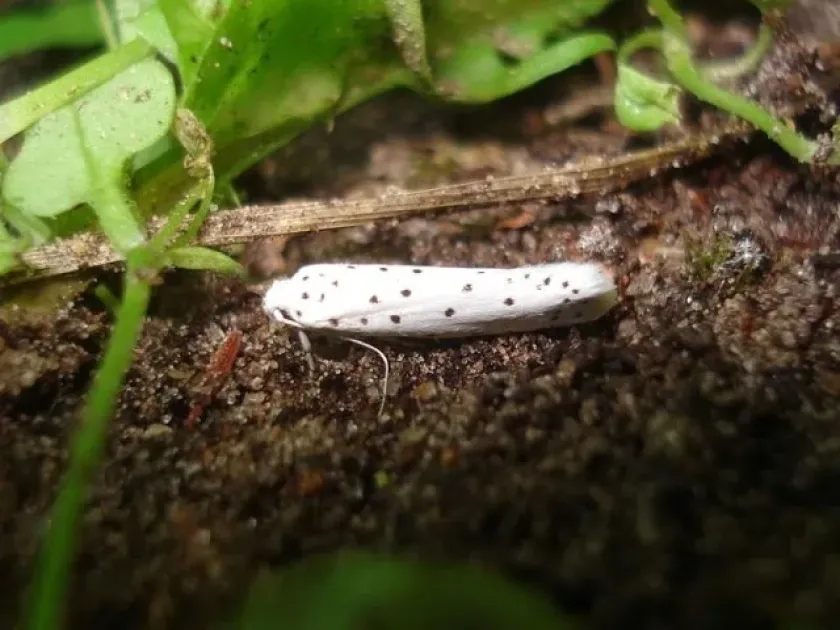
Adult moths have a wingspan of approximately 20–25 mm, featuring white or cream-colored forewings covered with orderly rows of small black spots.
The larvae, or caterpillars, are yellowish-grey with rows of black markings on their sides and possess a dark-colored head capsule.
These larvae are social insects, living in colonies and constructing large, dense silk webs that enclose the leaves and shoots of the host tree.
Pupation occurs within groups of spindle-shaped white cocoons, which are woven together inside the common web nest.
What it damages
The primary hosts for this pest are willow species, with the moth demonstrating a clear preference for white willow and crack willow varieties.
Larvae feed gregariously, skeletonizing the leaves by consuming the parenchyma while leaving only the tougher veins and midribs intact.
Heavy infestations can lead to total defoliation of the tree, which significantly impairs its ability to synthesize nutrients for winter survival.
In ornamental landscaping, the presence of these massive silk webs and skeletonized foliage drastically reduces the aesthetic value of the trees.
While mature trees can usually withstand periodic defoliation, repeated annual attacks can weaken the plant, making it susceptible to secondary pathogens.
When it appears
The lifecycle begins with adult moths laying eggs in late summer, which the female covers with a protective secretion that hardens into a shield.
Larvae hatch in autumn but remain beneath the protective shield in the first instar stage throughout the winter months.
As spring approaches and temperatures rise, the young caterpillars emerge to begin feeding on the newly unfurling willow buds and leaves.
The peak feeding period occurs during late spring and early summer, after which the larvae congregate to spin their communal silken cocoons.
The adult moths emerge in mid-summer, typically from July to August, and immediately begin the mating and egg-laying process for the next generation.
Signs of infestation
The most prominent sign of an infestation is the appearance of extensive silk webbing that drapes over branches like a translucent veil.
Leaves within the webs appear withered, transparent, and skeletonized, eventually turning brown and falling off the tree prematurely.
Accumulation of fine black granular frass (excrement) on the ground beneath the canopy indicates a large colony of larvae feeding overhead.
The presence of hard, shiny, shield-like deposits on young twigs during the winter confirms that the tree will be a site for larvae in the spring.
In cases of severe infestation, the sheer volume of webbing can physically distort the growth of young shoots and restrict air circulation.
Control measures
Mechanical control is highly effective for small trees; it involves pruning and burning the infested branches while the larvae are still contained in webs.
Biological control using formulations based on Bacillus thuringiensis is an excellent, eco-friendly option for treating infested trees in urban areas.
Chemical intervention should target the early larval stages when they are most vulnerable to contact or systemic insecticides.
Maintaining the overall health of the willow trees through proper irrigation and fertilization improves the tree's natural resilience against insect pests.
Encouraging the presence of natural predators, such as parasitic wasps, can help keep the population levels of the Willow ermine moth in check.
Taxonomy
- Latin name
- Yponomeuta rorella
- Order
- Lepidoptera (butterflies)
- Family
- Yponomeutidae
- EPPO code
- HYPNRO
Discussion
No discussions yet — be the first.