
Apple ermine moth
Yponomeuta podella
Description
How to identify
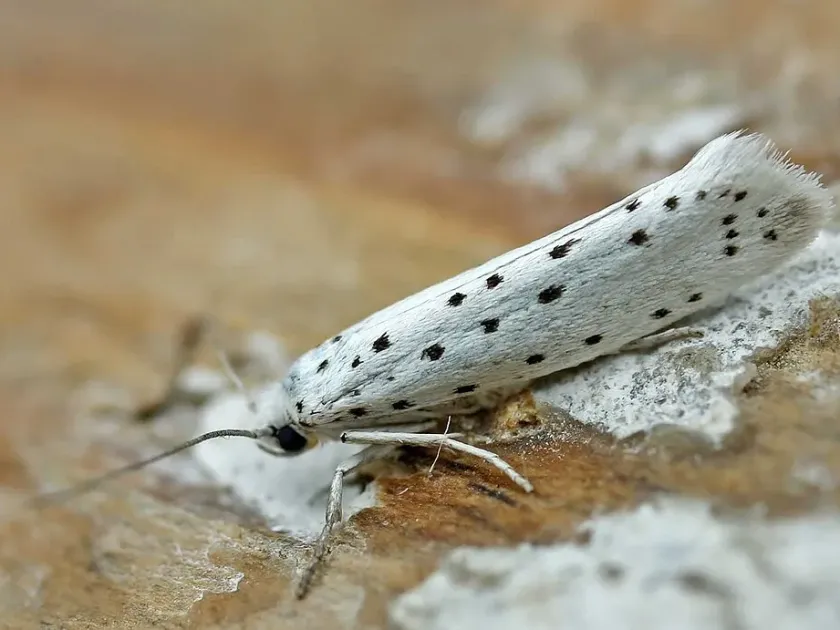
The apple ermine moth (Yponomeuta padella) is a member of the Yponomeutidae family within the order Lepidoptera. The adult moth has a wingspan of approximately 20 millimeters, with white forewings decorated with three rows of characteristic black spots.
The larvae, or caterpillars, progress through several growth stages. Mature larvae are about 15–18 millimeters long, featuring a yellowish-grey body with two distinct rows of black spots along their sides, which serves as a primary diagnostic feature.
These pests overwinter as first-instar larvae protected by a silk shield created by the female on the tree bark. This shield effectively matches the color of the bark, making detection during the dormant season exceptionally difficult.
The moth completes one generation per year. Pupation typically occurs in early summer, where larvae congregate to spin a communal silk web containing numerous white cocoons clustered together.
For population monitoring, agronomists utilize pheromone traps installed within the tree canopy during mid-summer. This timing aligns with the peak flight and mating season of the adult moths.
What it damages
The apple ermine moth primarily targets pome fruit trees, with a strong preference for apple trees. In cases of high population density, the larvae can cause significant damage to the plant's foliage.
Damage occurs as the larvae feed on the leaf tissue, consuming the mesophyll while leaving the veins intact. This process, known as skeletonization, leaves the leaves translucent and brittle.
Severe infestations can lead to complete defoliation of branches. Such loss of photosynthetic surface area weakens the tree, resulting in reduced vigor and impaired fruit bud formation for the following growing season.
Impact on yield is often substantial, as the tree redirects energy from fruit development to foliage recovery. In extreme cases, the fruit remains underdeveloped, undersized, and of poor commercial quality.
The stress caused by repeated infestations makes trees more susceptible to secondary environmental pressures, including drought and opportunistic fungal infections of the damaged bark or leaves.
Signs of infestation
The most prominent indicator of an infestation is the presence of extensive silk webs that envelop foliage and branches. These nests house large colonies of gregarious larvae feeding in unison.
Early spring damage is indicated by the destruction of developing buds and young leaves. The larvae bore into these tissues, leading to premature wilting and the browning of the expanding canopy.
By early summer, the skeletonized leaves become highly visible, creating a lace-like appearance. These leaves eventually wither and abscise prematurely, giving the tree a sickly, thin appearance.
The formation of dense clusters of white silk cocoons on the branches is a definitive sign that the larval stage has concluded and pupation is occurring, often covering large areas of the trunk or limbs.
- Extensive silk webbing in the canopy.
- Skeletonized leaves showing only veins.
- Presence of large larval colonies.
- Premature leaf yellowing and shedding.
- Clusters of white cocoons on bark.
Control measures
Mechanical control is highly effective in home orchards; it involves pruning and destroying the silk webs and the contained larvae before they move to the pupation stage.
Chemical intervention is most effective when synchronized with the emergence of larvae from their overwintering shields, usually corresponding with the bud-burst stage of the apple trees.
Biological control methods, including the use of B.t. (Bacillus thuringiensis) based sprays, provide a targeted way to reduce larval populations without harming beneficial insects and local pollinators.
Encouraging natural predators, such as ichneumonid wasps, plays a vital role in long-term population management. These parasitoids can significantly reduce moth numbers over several seasons.
Cultural practices, such as winter inspection of branches for silk shields, allow for the manual removal of overwintering populations, significantly reducing the initial pressure in the following spring.
Taxonomy
- Latin name
- Yponomeuta podella
- Order
- Lepidoptera (butterflies)
- Family
- Yponomeutidae
- EPPO code
- HYPNPO
Discussion
No discussions yet — be the first.