
Fruit ermine moth
Yponomeuta plumbella
Description
How to identify
The fruit ermine moth (Yponomeuta plumbella) is a member of the Yponomeutidae family within the order Lepidoptera. It is a small moth known for causing significant defoliation in various orchard trees.
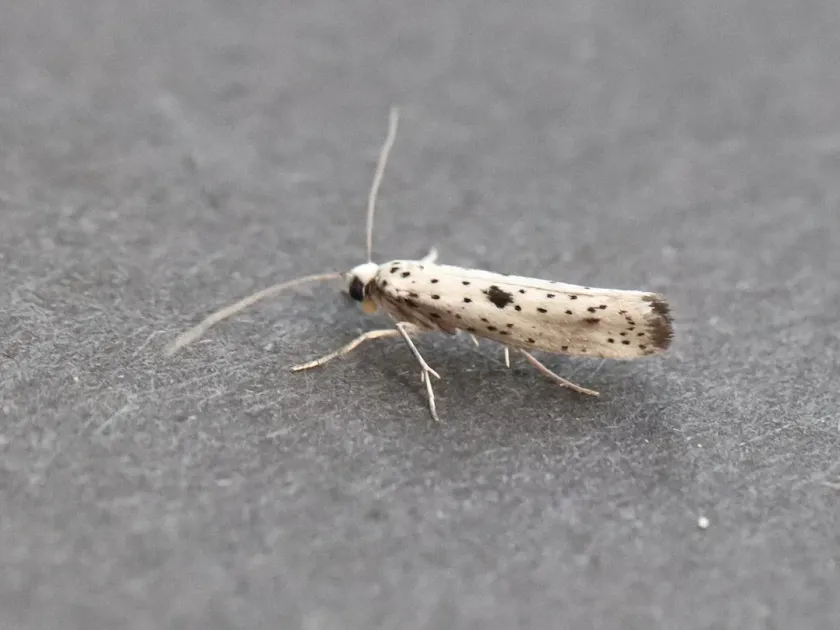
Adult moths feature white forewings decorated with multiple rows of black dots, creating a distinctive pattern. Their wingspan typically measures approximately 20 millimeters.
The larvae are greyish-yellow caterpillars with a series of black spots along their sides and a black head. They are highly social and work together to construct large silk webs for protection.
Pupation occurs within dense white cocoons aggregated inside the silk webs. These "nests" are the most characteristic indicator of an infestation within the foliage of the host tree.
The life cycle consists of one generation per year. The overwintering stage is the first-instar larva, which remains protected under a hardened shield on the bark of twigs.
What it damages
This pest primarily attacks trees in the Rosaceae family, including apple, cherry, plum, and apricot trees. Heavy infestations can cause severe damage to the tree's canopy.
Larvae feed on the leaf tissue, skeletonizing the foliage by consuming the green matter and leaving only the leaf veins. This process significantly reduces the tree's photosynthetic capacity.
A mass outbreak can result in total defoliation of the tree. This stress severely weakens the tree, making it more susceptible to environmental factors and secondary diseases.
Fruit quality is directly impacted by the damage, leading to smaller, deformed, or premature fruit drop. Overall yield can be drastically reduced during the year of high infestation.
The social behavior of the caterpillars allows a single colony to rapidly destroy large sections of a branch, making the damage visible and widespread within a short timeframe.
When it appears
Larvae emerge from their overwintering sites in early spring, synchronized with the bud burst of the host trees. They immediately begin feeding on the emerging foliage.
Peak feeding activity and the formation of extensive silk nests occur during May and June. This is the period when the damage becomes most apparent in the canopy.
Pupation typically takes place throughout June and July. After a pupal stage lasting several weeks, the adult moths emerge and fly during the remainder of the summer months.
Females lay eggs on the bark of twigs, covering them with a protective secretion that hardens into a shield. These shields are exceptionally well-camouflaged against the tree bark.
Embryonic development is completed before autumn, but the young larvae enter diapause and remain beneath their protective shields until the next spring season.
Signs of infestation
Early symptoms include bud browning and stunted growth in spring, caused by young larvae feeding inside the newly opened buds and tender leaves.
Large, dense silk webs enclosing dry, skeletonized leaves are the primary diagnostic sign. These nests are often found on the ends of branches or across the foliage.
The presence of fine, granular black excrement trapped within the silk webs or scattered on the leaves underneath the nests is a clear indicator of active feeding colonies.
Premature leaf drop and a sparse canopy during mid-summer are classic signs of a significant infestation that may have gone unnoticed during the early spring stages.
Small, greyish, hardened shields on twigs, often visible during winter pruning, indicate the next generation's overwintering sites and potential future outbreaks.
Control measures
Mechanical control is effective in small gardens: physically removing and destroying the silk nests by hand before the larvae mature is highly recommended.
Chemical control should be timed to coincide with the larval emergence in spring. Applying systemic or contact insecticides when larvae begin feeding ensures maximum efficacy.
Biological control methods, such as utilizing B.t. (Bacillus thuringiensis) based sprays, are safer for beneficial insects and effectively manage moth populations.
Encouraging natural predators and parasitoids, such as ichneumon wasps, can help keep moth populations in check without the need for constant chemical interventions.
Proper orchard sanitation, including regular pruning to remove infested branches and promoting general tree vigor through fertilization, reduces the suitability of trees for infestation.
Taxonomy
- Latin name
- Yponomeuta plumbella
- Order
- Lepidoptera (butterflies)
- Family
- Yponomeutidae
- EPPO code
- HYPNPL
Discussion
No discussions yet — be the first.