
Orchard ermine moth
Yponomeuta padella
Description
How to identify
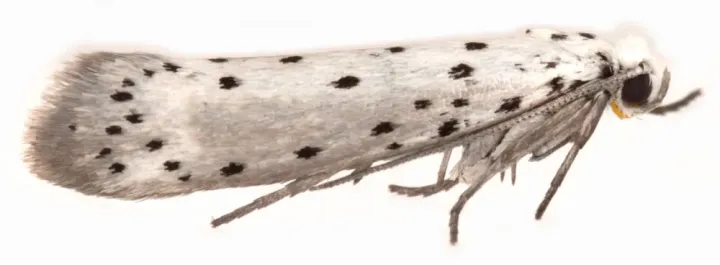
The orchard ermine moth (Yponomeuta padella) is a small moth belonging to the Yponomeutidae family. The adult moth is easily identified by its snowy-white forewings, which are covered in several rows of distinct black dots, spanning about 20 mm.
The larvae, or caterpillars, are yellowish-grey and grow to approximately 15–18 mm in length. They are characterized by two parallel rows of large black spots along their bodies and have black heads, often covered with sparse light hairs.
The insect follows a single generation cycle per year. It overwinters as first-instar larvae beneath protective shields (egg masses) laid on the bark of young twigs by the female in late summer.
In spring, the larvae emerge from beneath their shields just as the buds begin to burst. They initially mine the leaf buds, causing them to wither before they can even fully open.
As they develop, the larvae form dense, communal silk webs that enclose leaves and branches. Inside these webs, they are protected from environmental hazards and natural predators, feeding extensively on foliage.
What it damages
The primary hosts of the orchard ermine moth include various Rosaceae species, with a strong preference for apple trees. It also frequently attacks pear, plum, cherry, blackthorn, and hawthorn trees.
The damage is caused by the caterpillars feeding on the leaf tissues. They skeletonize the leaves, eating the soft green tissue and leaving only the veins intact, which eventually leads to the death of the foliage.
Massive infestations can result in total defoliation of the tree. This loss of leaves significantly disrupts photosynthesis, causing severe stress to the tree and draining its energy reserves.
The fruit quality is severely compromised, often resulting in stunted growth and a significant reduction in total harvest. Heavily affected trees show poor vitality and may struggle to produce fruit in subsequent seasons.
Weakened trees become susceptible to frost damage during the winter months and may exhibit reduced growth rates or even branch dieback if the infestation occurs for several consecutive years.
When it appears
Larval emergence coincides with the "green tip" stage of apple buds, typically occurring in late April or May, depending on the local spring climate and temperature progression.
Active feeding and web construction occur throughout May and June. During this time, the larvae grow rapidly, and the white silk nests become increasingly prominent within the tree canopy.
Pupation takes place inside the silk webs in late June or early July. The white cocoons are often clustered closely together, creating visible white patches on the infested branches.
Adult moths emerge from July to August. During this flight period, they mate and lay eggs on the bark of thin twigs, covering them with a secretion that hardens into a protective shield.
The eggs undergo embryonic development by autumn, but the young larvae remain dormant under the protective shield throughout the winter, waiting for the return of favorable spring conditions.
Signs of infestation
Early signs include the presence of small, oval-shaped shields on the bark of one- or two-year-old twigs. These shields are very similar in color to the bark, making them difficult to spot.
The most obvious sign of infestation is the appearance of silk webs on the branches. As the larvae feed, these nests grow larger, encompassing entire clusters of leaves and twigs.
Leaves within the nests appear yellow, withered, and scorched. Beneath the nests, one may observe an accumulation of black, sand-like frass (droppings) which confirms the presence of active caterpillars.
A "skeletonized" appearance of the foliage is a hallmark sign of a moth outbreak. When large parts of the canopy are affected, the tree appears sickly and stripped of its healthy green color.
In mid-summer, the remnants of the white silk cocoons remain on the branches. These look like tiny, clustered white structures that are easily visible against the darker wood of the twigs.
Control measures
Effective management requires a combination of early monitoring and targeted intervention to prevent the population from reaching damaging levels.
- Manually prune and destroy infested branches or silk webs in late spring before the caterpillars pupate.
- Apply contact insecticides during the early larval stage, coinciding with the green bud phase, to catch them before they build protective webs.
- Utilize biological insecticides containing Bacillus thuringiensis, which target the larvae specifically while being safe for beneficial insects.
- Encourage natural enemies, such as parasitic wasps, which can significantly reduce the moth population in natural orchard ecosystems.
- Maintain tree vigor through proper pruning and fertilizing to help trees recover from occasional defoliation events.
Taxonomy
- Latin name
- Yponomeuta padella
- Order
- Lepidoptera (butterflies)
- Family
- Yponomeutidae
- EPPO code
- HYPNPA
Discussion
No discussions yet — be the first.