
Orchard ermine moth
Yponomeuta mahalebella
Description
How to identify
The orchard ermine moth (Yponomeuta mahalebella) belongs to the Yponomeutidae family, a group known for its distinctive social behavior. The adult moth is small, with a wingspan of approximately 20 mm and white forewings marked by rows of black dots.
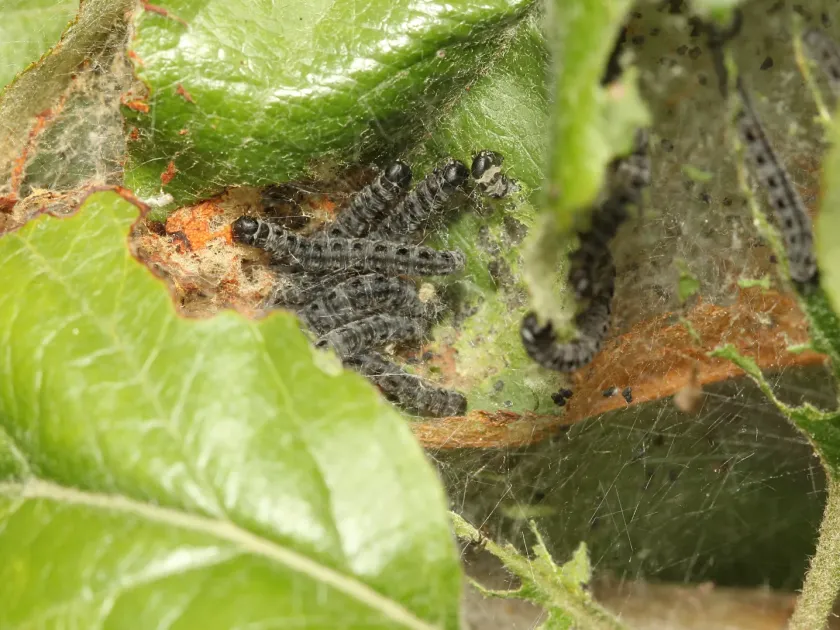
The larvae, or caterpillars, are gregarious, meaning they live together in large colonies. They construct dense, conspicuous silk webs or "tents" over the branches of host trees, providing protection while they feed on the foliage.
The life cycle involves overwintering as first-instar larvae under protective shields on the bark. In spring, they emerge to feed on developing buds and leaves, eventually spinning cocoons within the shared web to pupate.
Adult moths emerge in mid-summer, mate, and lay eggs on the bark of host trees. These eggs are covered by protective scales, which blend in with the bark, ensuring the survival of the next generation through the winter months.
The species is highly specialized, typically infesting members of the Rosaceae family. Its ability to create large communal webs makes it one of the most recognizable pests in neglected or poorly managed orchards.
What it damages
The primary hosts of this moth include cherries and the Mahaleb cherry (Prunus mahaleb), from which it derives its specific name. It can also affect other orchard trees, causing significant concern for fruit growers.
Larvae consume the leaf tissue entirely, leaving only the veins behind. This process, known as skeletonization, significantly reduces the leaf surface area available for photosynthesis, weakening the tree's overall vigor.
Heavy infestations can lead to premature defoliation. When a tree loses its leaves in mid-summer, it fails to store enough carbohydrates for the winter, making it susceptible to cold damage and frost during the following season.
The aesthetic and physical impact of the webs is severe. The mass of webbing covers entire branches, preventing light and air from reaching the inner canopy and potentially leading to twig dieback.
In addition to immediate damage, the reduction in energy reserves leads to reduced fruit set and poor growth in subsequent years. Repeated annual attacks can significantly shorten the productive lifespan of fruit-bearing trees.
Signs of infestation
The first sign of an orchard ermine moth infestation is damage to opening buds in early spring. As the larvae grow, the most obvious sign is the appearance of large, thick white silk webs covering branches.
If you observe trees with leaves tied together in dried-out, webbed bundles, the colony is present. Inside these tents, dozens of grey, black-spotted caterpillars can be found feeding on the remaining leaf fragments.
Skeletonized leaves are a major indicator of high pest pressure. By late spring or early summer, entire limbs may appear to have been stripped bare, leaving only brown, vein-riddled leaves hanging within the webbing.
Fecal matter accumulation within the webs is a common sign of a large, mature colony. This waste can sometimes lead to localized fungal growth on the bark underneath the tent.
After the larvae pupate and the adults emerge, small, oval-shaped shields remain on the bark. These are the egg-laying sites for the next generation and are a sign that the infestation will likely return the following year.
Control measures
Successful management begins with monitoring. Early detection is crucial, as the communal webs are easier to manage when the colonies are still small and localized on individual branches.
Manual removal of the webs is the most effective and eco-friendly control method for home gardeners. By pruning and destroying the webbed branches early in the season, the population can be effectively suppressed without chemicals.
For large-scale infestations, systemic insecticides or biological control agents like Bacillus thuringiensis (Bt) should be applied. Treatment must be timed carefully to coincide with the period of active larval feeding before pupation.
Cultural practices such as removing dead bark and maintaining tree health through proper fertilization and watering can help trees recover from feeding damage and increase their resistance to further attacks.
- Encouraging natural predators such as parasitic wasps and predatory beetles.
- Using pheromone traps for timing the application of control measures.
- Ensuring good orchard hygiene by removing heavily infested wood during dormant pruning.
Taxonomy
- Latin name
- Yponomeuta mahalebella
- Order
- Lepidoptera (butterflies)
- Family
- Yponomeutidae
- EPPO code
- HYPNMH
Discussion
No discussions yet — be the first.