
Spindle ermine moth
Yponomeuta irrorella
Description
How to identify
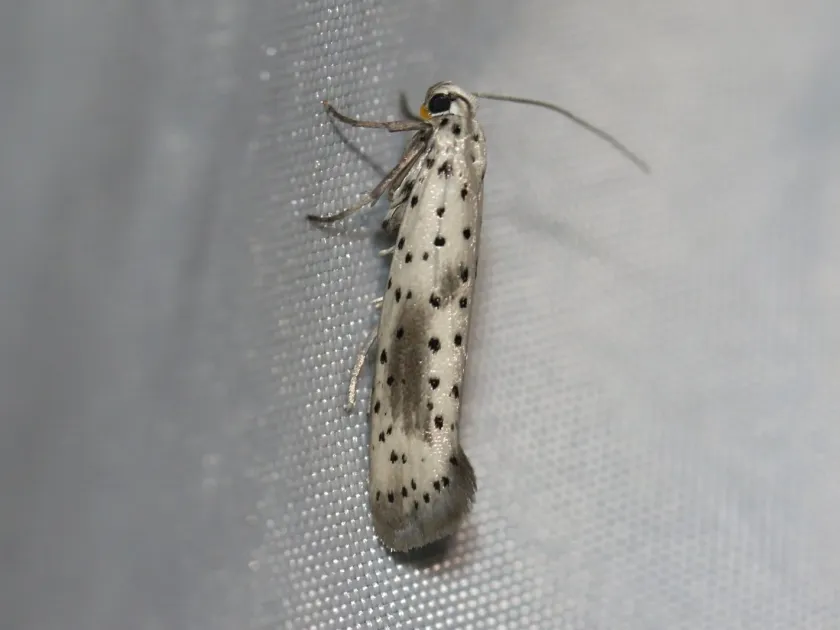
The spindle ermine moth (Yponomeuta irrorella) is a member of the Yponomeutidae family. The adult moth is easily identified by its white or grayish-white forewings, which are marked with several rows of distinct black spots.
The wingspan of the adult moth usually ranges from 20 to 25 millimeters. When at rest, the moth adopts a narrow, cylindrical resting posture, which helps it blend in with the thin twigs and branches of its host plants.
The larvae, or caterpillars, reach a length of 15–20 mm. They exhibit a yellowish-gray body color with two rows of black spots along each side and a characteristic black head, which serves as a key feature for field identification.
This species is highly prolific, and its development consists of complete metamorphosis. The most recognizable stage for gardeners is the larval stage, characterized by communal living within thick webs.
Pupation occurs within white silk cocoons, which are often grouped together in large, dense silken tents that provide protection from both predators and environmental fluctuations.
What it damages
The primary host plant for this species is the European spindle (Euonymus europaeus). During outbreaks, the larvae can cause total defoliation of these shrubs across entire gardens and landscape areas.
Larvae feed gregariously, initially skeletonizing the leaves and subsequently consuming the entire leaf blade, leaving only the primary veins behind. This leads to the rapid loss of the plant's photosynthetic capacity.
Heavy infestations significantly weaken the host plant, resulting in reduced vigor, stunted shoot growth, and an increased susceptibility to secondary infections and winter damage.
The presence of unsightly, dirty-looking silken webs that envelope entire branches makes the shrubs unattractive, which is a major concern for homeowners and landscapers.
If left unmanaged over several successive seasons, the infestation can lead to the death of younger or already stressed plants, as they lose their ability to store necessary nutrients for the winter.
When it appears
The spindle ermine moth has a univoltine life cycle, meaning it produces only one generation per year. Larvae overwinter in their first instar beneath protective scales on the bark of the host tree.
In the spring, synchronized with the bud burst of the spindle tree, the larvae emerge from their winter shelters and begin feeding on the young foliage, immediately starting the construction of their communal webs.
The peak period of larval activity and web expansion occurs from May through June. During this time, the larvae grow rapidly, stripping the host plant of its leaves to support their development.
Pupation takes place within the webs during June and early July. The pupal stage lasts approximately two to three weeks, depending on temperature, before the adult moths emerge to mate.
The adult flight period typically spans from mid-July to August. After mating, the females lay their eggs on the bark of twigs, which are then covered with a protective secretion, where they remain until the following spring.
Signs of infestation
The most prominent sign of infestation is the appearance of extensive silken webs covering the branches. These webs often contain dozens of caterpillars and large amounts of frass.
Accumulation of black, granular caterpillar droppings beneath the canopy is a clear indicator that a colony is actively feeding in the upper parts of the shrub.
Partial or total defoliation of the spindle tree in late spring and early summer, while surrounding non-host plants remain green and intact, is a definitive diagnostic sign of ermine moth activity.
Careful inspection of branches in early spring may reveal the presence of overwintering larval scales, which look like small, inconspicuous bumps on the bark.
Observations of nocturnal moth flight around spindle bushes in mid-summer indicate that a new generation has emerged, signaling the need for monitoring in the upcoming season.
Control measures
Manual removal of webbed branches is a highly effective control measure, especially when the infestation is detected early and is limited to only a few spots on the shrub.
Systemic insecticides applied early in the season, just as the larvae emerge from their wintering sites, can effectively reduce the population before extensive damage occurs.
Biological control using formulations based on Bacillus thuringiensis is an environmentally friendly alternative that targets the caterpillars while preserving the garden's beneficial insect population.
Regular monitoring of host plants in the spring is essential to ensure early detection, which allows for the implementation of control measures before the larvae reach their most destructive stage.
Maintaining the health of the plants through adequate watering and fertilization helps the shrubs withstand the stress caused by the moths and supports faster recovery after an infestation.
Taxonomy
- Latin name
- Yponomeuta irrorella
- Order
- Lepidoptera (butterflies)
- Family
- Yponomeutidae
- EPPO code
- HYPNIR
Discussion
No discussions yet — be the first.