
Six-spotted ermine moth
Yponomeuta hexabola
Description
How to identify
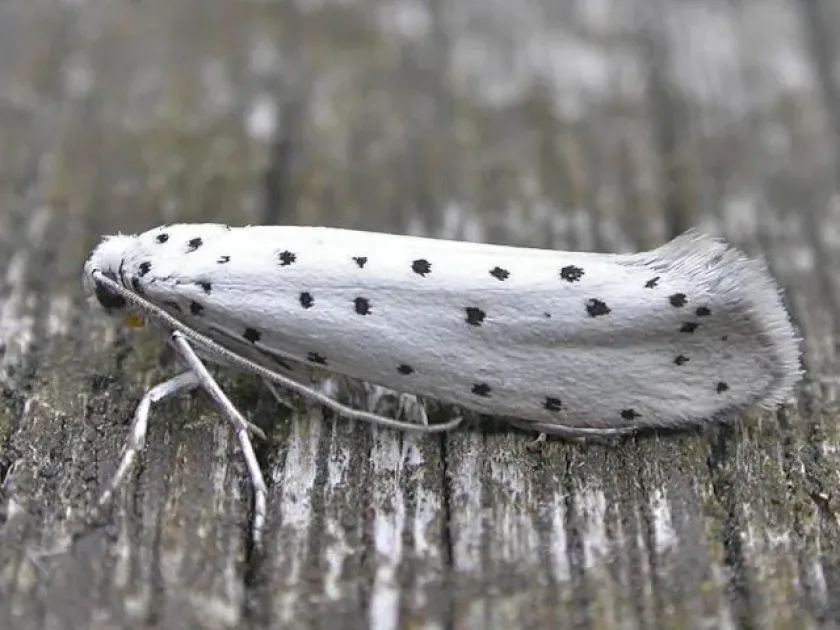
The six-spotted ermine moth (Yponomeuta hexabola) belongs to the family Yponomeutidae within the order Lepidoptera. Adult moths are typically white with distinctive dark spots arranged in several neat rows on their forewings.
The larvae are social insects that live in communal colonies. They build prominent, thick silk web nests that envelop parts of the tree canopy, providing protection from external factors.
Caterpillars have a greyish or yellowish body with conspicuous black spots along the sides. These markings are essential for identifying the species during field inspections of infested trees.
As nocturnal insects, adult moths are rarely seen during the day. The species produces one generation per year, and eggs are laid on the bark of thin twigs, covered by a protective substance that hardens to form a shield.
Larvae overwinter under these shields. Upon the arrival of spring temperatures, they emerge to feed on developing buds and young leaves, marking the start of the visible growth cycle.
What it damages
This pest primarily attacks broad-leaved trees and shrubs, showing a strong preference for the Rosaceae family. Fruit trees are particularly vulnerable to infestations, which can lead to significant crop loss.
The caterpillars consume the soft tissues of leaves, leaving behind only the veins. In cases of high population density, trees can be completely defoliated in a very short period.
Extensive defoliation impairs photosynthesis, leading to reduced tree vigor, increased susceptibility to frost, and a significant decrease in the formation of fruit buds for the following season.
The dense silk webs also restrict airflow and light penetration within the canopy, creating a favorable microclimate for the development of secondary fungal diseases.
When defoliation occurs, the tree is forced to deplete its energy reserves to push new growth, resulting in physiological exhaustion and long-term stunted development.
When it appears
The life cycle of the moth is closely synchronized with the phenological phases of its host plants. Activity begins in early spring, coinciding with the swelling of leaf buds.
May and June represent the period of peak larval growth and activity. During these months, the silk nests expand significantly, becoming very easy to detect in the tree canopy.
Pupation occurs within the silk webs, typically in June or July. The pupal stage is a critical time when the insects are highly vulnerable to natural predators and parasitic wasps.
The adult moth flight season occurs from mid-summer to August. During this phase, mating takes place, followed by egg-laying on the bark, where the eggs remain dormant until the following spring.
Because the moth has only one generation per year, intervention during the early spring stage is most effective for preventing population explosions and minimizing seasonal damage.
Signs of infestation
The most visible indicator of an infestation is the appearance of silk webbing at the tips of shoots. Over time, these nests grow and cover large branches or entire sections of the tree.
Skeletal leaves, which look like brown lace or netting, appear around the feeding sites as the caterpillars move away from the nests to graze on the surrounding foliage.
Accumulations of larval frass (excrement) visible inside the webs or beneath the tree canopy are clear evidence that a large colony is actively damaging the plant.
Premature leaf drop is a classic sign of infestation. Trees lose their leaves earlier than expected, reducing their ability to store carbohydrates for winter dormancy.
Close inspection of the bark in late summer may reveal small, hard, smooth shields that protect the egg masses, allowing for early detection and targeted removal before the next season.
Control measures
Cultural control methods involve pruning and destroying infested branches as soon as the nests become visible, which effectively removes the majority of the caterpillar population.
In smaller gardens, manual removal of the nests and caterpillars is highly effective. Additionally, brushing the bark can help remove overwintering egg masses before they hatch.
Chemical control is most successful when applied shortly after larvae emerge from the egg shields. Systemic insecticides are generally preferred as they penetrate the foliage.
Biological control using Bacillus thuringiensis is an excellent, environmentally friendly option that selectively targets larvae while protecting beneficial insects and pollinators.
Encouraging the presence of natural enemies, such as ichneumonid wasps and predatory insects, can help maintain moth populations at a low level, reducing the need for chemical intervention.
Taxonomy
- Latin name
- Yponomeuta hexabola
- Order
- Lepidoptera (butterflies)
- Family
- Yponomeutidae
- EPPO code
- HYPNHE
Discussion
No discussions yet — be the first.