
Bird-cherry ermine moth
Yponomeuta evonymella
Description
How to identify
The bird-cherry ermine moth (Yponomeuta evonymella) is a small moth belonging to the Yponomeutidae family, known for its significant impact on specific deciduous trees.
Adult moths have a wingspan of approximately 20–25 mm, with distinctive white or creamy forewings decorated with rows of small black spots, resembling ermine fur.
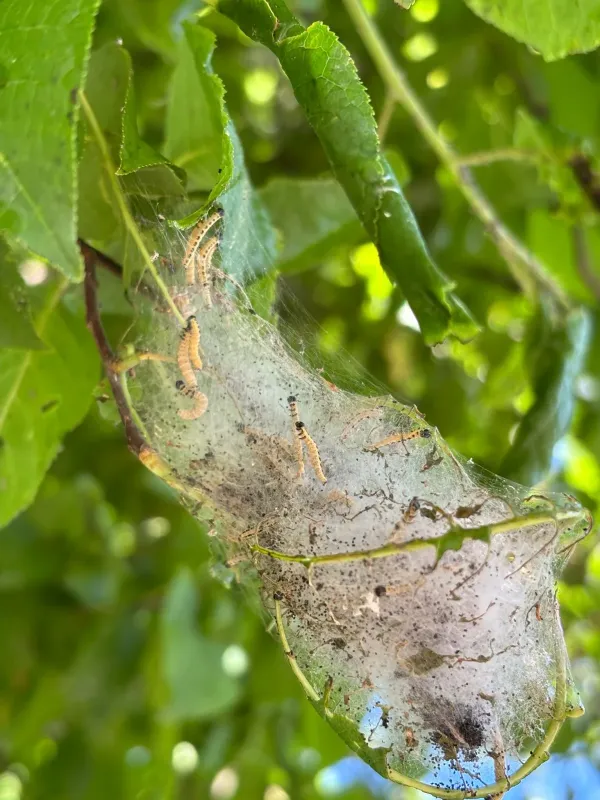
The larvae are small, yellowish-green caterpillars with black dots arranged in longitudinal rows along their bodies, often found in large, dense colonies.
This species completes one generation per year, with the larvae overwintering under a protective silken shield secreted by the female during the previous autumn.
Pupation occurs within white, spindle-shaped cocoons that are grouped together inside thick silk webs, providing safety during their transformation into adults.
What it damages
The primary host for this pest is the bird cherry tree (Prunus padus), but it frequently attacks other Prunus species, including various garden cherry and plum varieties.
The larvae are responsible for the damage, as they feed on the leaves in massive numbers, often stripping a tree entirely of its foliage in a short period.
The presence of dense webbing, which envelops the branches, interferes with the tree's health and reduces its aesthetic appeal in landscape settings.
As the caterpillars consume the leaf tissue, they cause premature defoliation, which severely stresses the tree and prevents it from storing enough energy for winter.
Repeated annual infestations can lead to significant dieback of branches and can eventually cause the death of weakened or mature trees that lack the resilience to recover.
When it appears
The larval activity begins in spring, synchronized with the bud burst, as the caterpillars emerge to start feeding on the young, nutritious leaves.
During May and June, the larvae grow rapidly, spinning their iconic silk webs to protect themselves from predators and harsh environmental conditions.
By late June, the larvae reach maturity and begin the process of pupation within the nests, remaining there for about two to three weeks.
Adult moths emerge in July and early August, seeking mates and depositing eggs on the bark of host trees to begin the cycle for the next year.
After hatching in late summer, the first-instar larvae settle under protective coverings, where they enter a state of dormancy until the following spring.
Signs of infestation
The most visible indicator of an infestation is the appearance of large, conspicuous silk nests or "tents" stretched across the branches of the host trees.
Leaves inside or near the silk nests become skeletonized, turning brown and shrivelled as the larvae systematically consume all the green tissue.
A heavy accumulation of caterpillar droppings (frass) may be observed on the ground beneath the tree, signalling an active and large population feeding above.
In cases of severe infestation, the tree canopy may appear completely stripped, creating a winter-like appearance in the middle of the summer growing season.
- Large, sheet-like silk webs covering branches.
- Skeletonized leaves turning brown and crispy.
- Premature loss of foliage in summer months.
- Visible white moths with black spots in mid-summer.
Control measures
Mechanical control is highly effective for individual trees; manually pruning and burning the silk nests before the larvae mature can stop the infestation.
Biological insecticides, specifically those containing Bacillus thuringiensis, provide an eco-friendly way to target larvae without harming beneficial pollinators.
Chemical intervention should be timed carefully, targeting the young larvae before they build heavy webs that make the application of sprays ineffective.
Maintaining tree vigor through proper watering, fertilizing, and pruning helps the tree recover more effectively if an infestation occurs in the future.
Monitoring for adult flight using pheromone traps can help garden managers determine the exact timing for preventative measures in the upcoming season.
Taxonomy
- Latin name
- Yponomeuta evonymella
- Order
- Lepidoptera (butterflies)
- Family
- Yponomeutidae
- EPPO code
- HYPNEV
Discussion
No discussions yet — be the first.