
Ermine moth
Yponomeuta
Description
How to identify
The Ermine moth, belonging to the Yponomeutidae family of the order Lepidoptera, is a small, striking insect. The adult moth has a wingspan of about 20 mm, featuring white forewings decorated with neat black spots.
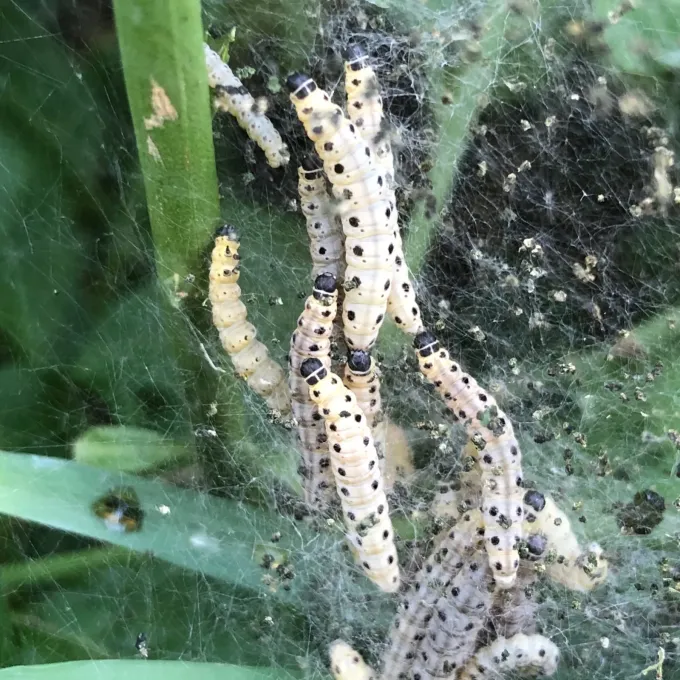
The larvae are small caterpillars, growing up to 20 mm in length. Their bodies are typically yellowish-grey with two distinctive rows of black dots, complemented by a jet-black head.
Female moths lay eggs in clusters, covering them with a secretion that hardens into a shield. This protective layer matches the bark of the host tree, making the eggs extremely difficult to detect.
Their life cycle consists of the egg, larval, pupal, and adult stages. In most climates, there is only one generation per year, though they can be highly destructive due to their colonial behavior.
The insects overwinter as first-instar larvae, sheltered safely beneath the hardened egg shield until spring temperatures trigger their emergence.
##damage##Ermine moths primarily target apple trees but are also frequently found on cherry, plum, rowan, almond trees, and ornamental spindle shrubs.
A massive infestation often leads to total defoliation of the tree by early summer, which severely taxes the plant's physiological reserves and stunts growth.
Weakened trees become susceptible to winter kill and various secondary pathogens due to the stress of premature leaf loss during the peak growing season.
Fruit quality and yield suffer drastically; fruit becomes undersized or drops prematurely as the tree prioritizes survival over energy-intensive fruit production.
If left uncontrolled, the pest can quickly spread throughout an entire orchard, creating interconnected webs that damage every tree in their path.
When it appears
Spring activity begins as soon as the buds start to swell and burst, marking the moment when the young larvae break out of their winter shelters.
The feeding period is intense throughout May and early June, during which the larvae rapidly consume foliage and expand their silk webs.
Pupation takes place in mid-June within the communal silk nests, where the larvae transition through the pupal stage protected by their own webbing.
Adult moths emerge in July and August, at which point they mate and lay eggs on the thin branches to prepare for the following year's cycle.
By late summer, the new generation is already settled in its overwintering state, dormant under the camouflaged shields until the next spring season.
Signs of infestation
Early spring infestation is identified by small, brown, mine-like blotches on the leaves, which are created by the young larvae feeding inside the leaf tissue.
The most recognizable sign is the appearance of large, dense silk webs draped over branches, which serve as communal housing for the larvae.
As the infestation progresses, the trees appear shrouded in a ghostly, white silk veil that covers entire branches, making it impossible to ignore the pest presence.
When disturbed, the caterpillars may drop from the branches on fine silk threads, a clear indication of a significant population density that requires attention.
Dead, dried-up foliage skeletalized by the caterpillars is a common sight by the time the larvae reach their final instar and prepare to pupate.
Control measures
Effective management requires applying contact insecticides early in the spring, specifically during the bud-burst phase, before the larvae are protected by thick silk nests.
For smaller gardens, manual removal of the nests and infested branches is a highly effective, eco-friendly method if performed before the larvae emerge.
Biological control using Bacillus thuringiensis is an excellent option for organic orchards, as it targets the larvae specifically without harming beneficial pollinators.
Promoting a healthy ecosystem by encouraging predatory insects and birds can help keep the Ermine moth population below the economic damage threshold.
- Apply insecticides during the green-tip growth stage.
- Prune and destroy webbed nests by burning or burying.
- Deploy pheromone traps to monitor and confuse mating adults.
- Use biological control agents to manage larval populations.
Taxonomy
- Latin name
- Yponomeuta
- Order
- Lepidoptera (butterflies)
- Family
- Yponomeutidae
- EPPO code
- HYPNSP
Discussion
No discussions yet — be the first.