
Typhlodromips
Typhlodromips
Description
How to identify
Typhlodromips is a genus of predatory mites belonging to the Phytoseiidae family, order Mesostigmata. These tiny organisms are highly valued in modern agriculture as biological control agents against various greenhouse pests.
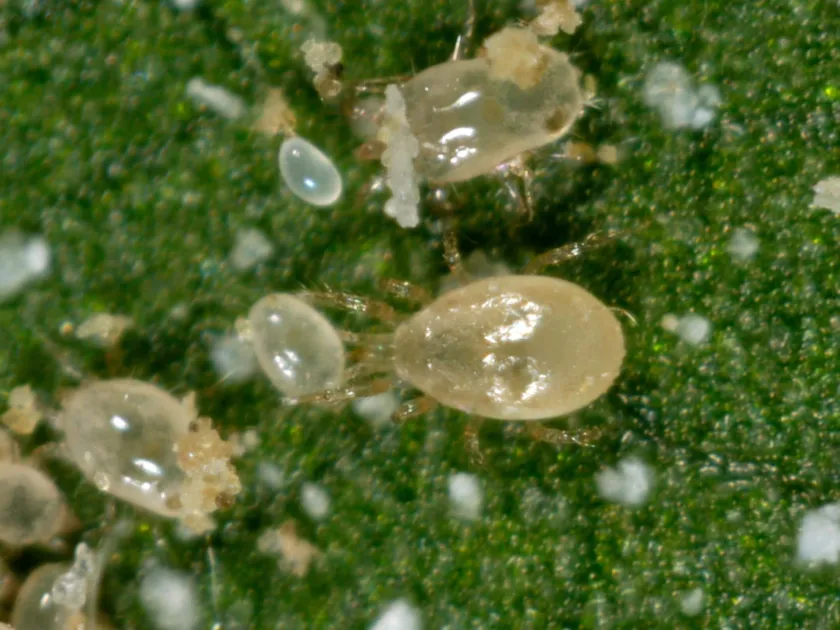
Adult mites are typically small, measuring between 0.3 and 0.5 mm in length. Their body coloration ranges from translucent white to light tan, and they are characterized by rapid, darting movements across the foliage.
The life cycle of Typhlodromips includes egg, larva, protonymph, deutonymph, and adult stages. Females lay their eggs on the underside of leaves, ensuring that the next generation has immediate access to prey.
Identification at the species level requires microscopic examination of specific morphological features, such as the shape of the dorsal setae and the structure of the spermatheca.
Due to their high predatory efficiency and ability to survive on alternative food sources like pollen, they are preferred choices for integrated pest management (IPM) programs worldwide.
What it damages
It is crucial to emphasize that Typhlodromips is not a pest but a beneficial predator. It does not damage plants; instead, it provides natural protection by feeding on harmful mites and insects.
Their primary diet includes larvae of western flower thrips, whiteflies, and several species of spider mites. This predatory behavior makes them essential for high-value crops like greenhouse peppers, cucumbers, and tomatoes.
When prey populations are low, these mites exhibit opportunistic feeding, consuming pollen or plant exudates. This biological trait allows the predator population to persist in the crop even when the target pest is scarce.
They prefer to dwell on the undersides of leaves, which coincides with the habitat of many plant-damaging pests, increasing their effectiveness as a biological solution.
By keeping pest levels below economic injury thresholds, Typhlodromips protects the vegetative and reproductive health of the plants, ultimately securing yield quality.
When it appears
Typhlodromips thrives in warm conditions, with an optimal temperature range of 20°C to 30°C. They are highly active in greenhouse environments where such microclimates are maintained consistently.
High relative humidity, ideally between 65% and 75%, is necessary for their successful development and egg-laying. While they can endure fluctuations, stable conditions lead to better colonization and faster population growth.
In commercial greenhouse operations, they are released preventatively to establish a colony before pest pressure becomes significant. This proactive approach is a hallmark of successful IPM.
While they are less active in cooler temperatures, modern greenhouse climate control allows for year-round usage, making them a versatile tool in the grower's arsenal.
Early season introductions are often the most successful, providing the predatory mites with the head start needed to manage potential pest outbreaks as the plants mature.
Signs of infestation
The primary sign of successful Typhlodromips activity is a reduction in pest populations (thrips, whitefly) that would otherwise compromise the crop. Since the mites are microscopic, direct visual confirmation requires a magnifying glass or stereomicroscope.
When inspecting the plants, growers should focus on the underside of leaves and along the veins, where the predators are most likely to be found actively hunting their prey.
The absence of typical pest damage symptoms, such as silvering of leaves, stippling, or honeydew secretions, indicates that the predators are working efficiently to keep the pests in check.
Sometimes, these mites can be found on sticky yellow traps, which serves as a secondary indicator that the predatory population is present within the greenhouse canopy.
A stable or declining trend in the number of thrips larvae trapped during routine monitoring is a key evidence of successful predation by Typhlodromips.
Control measures
Control is achieved through the systematic release of predatory mite colonies, usually contained in specialized slow-release sachets that are hung on the crop foliage.
It is vital to maintain a pest-free environment from the perspective of toxic chemicals. Pesticides, especially broad-spectrum insecticides, are often fatal to these mites and should be avoided or replaced with compatible alternatives.
If disease control is necessary, growers should select fungicides that have been tested and verified as harmless to the predatory mite populations.
- Regular monitoring of predatory mite and pest population ratios.
- Adhering to recommended release rates and intervals.
- Maintaining optimal humidity to facilitate egg hatching.
- Using only IPM-compatible plant protection products.
By incorporating Typhlodromips into the greenhouse management strategy, producers can significantly reduce chemical usage, leading to safer, more sustainable crop production practices.
Taxonomy
- Latin name
- Typhlodromips
- Order
- Mites
- Family
- Phytoseiidae
- EPPO code
- TYHLSP
Discussion
No discussions yet — be the first.