
Amblydromalus
Amblydromalus
Description
How to identify
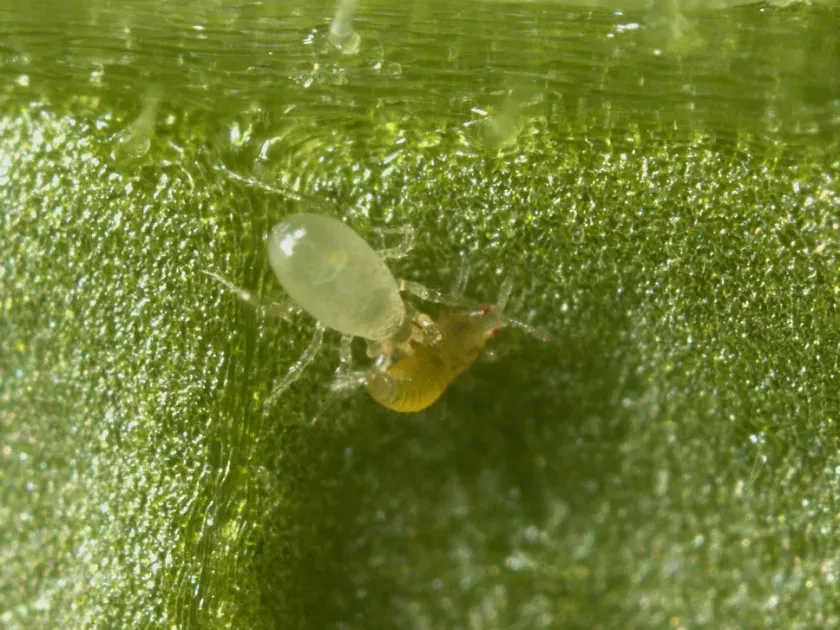
Amblydromalus is a genus of predatory mites belonging to the Phytoseiidae family. These beneficial organisms are microscopic in size, measuring just a fraction of a millimeter.
They generally have a light-colored, pear-shaped body. Due to their small stature, they are virtually invisible to the naked eye, making them difficult to detect without a microscope.
These mites are exceptionally active predators. They spend their time moving across the surface of leaves, searching for prey such as thrips larvae or whitefly nymphs.
Identification at the species level requires specialized taxonomic knowledge and laboratory equipment, as they share morphological similarities with other phytoseiid mites.
In a professional setting, growers release these mites as part of an Integrated Pest Management (IPM) program to ensure a healthy and balanced ecosystem within the greenhouse.
What it damages
It is crucial to clarify that Amblydromalus is not a plant pest. It is a highly beneficial organism that does not cause any damage to the foliage, flowers, or fruit of plants.
The diet of this mite consists exclusively of small arthropod pests. It primarily targets the larvae of Western flower thrips, whiteflies, and certain species of spider mites.
By feeding on the immature stages of these pests, Amblydromalus effectively disrupts their life cycle. This prevents pest populations from reaching levels that would cause economic damage.
The use of these mites reduces the need for synthetic insecticides, which in turn minimizes chemical residues on crops and preserves the surrounding environment.
Therefore, their role in agriculture is exclusively positive, serving as a biological weapon against invasive and destructive insect populations in controlled environments.
When it appears
In greenhouse conditions, Amblydromalus can remain active throughout the entire year, provided that optimal environmental conditions are maintained consistently.
The ideal temperature range for their development is typically between 20 and 30 degrees Celsius. In these conditions, their reproductive cycle is accelerated.
Humidity is a vital factor for their survival. High relative humidity levels, usually exceeding 60 percent, are necessary to ensure that the eggs hatch successfully.
During the spring and summer seasons, when pest pressure is naturally higher, the population of Amblydromalus can expand rapidly to meet the demand for food.
Throughout the winter, if supplemental lighting and heating are employed to support crop growth, the predator population will continue its protective function.
Signs of infestation
The primary sign of successful Amblydromalus activity is a steady decline in pest counts, such as thrips numbers detected on sticky yellow cards.
You may also notice a reduction in visible feeding damage on leaves, such as silvery patches typically associated with thrips infestations. Healthy, undamaged growth is the best indicator.
If you examine the undersides of leaves with a magnifying lens, you may find the mites themselves as they move about in search of prey. This confirms their presence on the crop.
If pest populations do not show a downward trend, it may indicate that the environmental conditions are unsuitable for the mites or that pest pressure is too high to control.
Integrated management reports will show that as the predator establishes itself, the reliance on external chemical interventions decreases significantly over time.
Control measures
Managing the efficacy of Amblydromalus involves maintaining the right greenhouse climate. Stability in temperature and humidity is the key to a thriving predatory population.
Growers must be very cautious when using chemical pesticides, as many can be toxic to these beneficial mites. Always check the compatibility list before applying any product.
Implementing a strict hygiene protocol and ensuring proper crop monitoring will allow the predatory mites to reach their maximum potential in controlling target pests.
- Maintain relative humidity levels above 60%.
- Choose pesticide products with low toxicity to beneficial insects.
- Perform regular scouting for both pests and beneficial predators.
- Ensure uniform distribution of the predatory mites during release.
By integrating Amblydromalus into the cultivation cycle, growers can produce high-quality, pesticide-free crops while maintaining natural biological balance.
Taxonomy
- Latin name
- Amblydromalus
- Order
- Mites
- Family
- Phytoseiidae
- EPPO code
- AMDRSP
Discussion
No discussions yet — be the first.