
Amblyseius andersoni
Amblyseius andersoni
Description
How to identify
Amblyseius andersoni belongs to the Phytoseiidae family of predatory mites. It is a microscopic organism that is often mistaken for a pest due to its high level of activity on the foliage of agricultural crops.
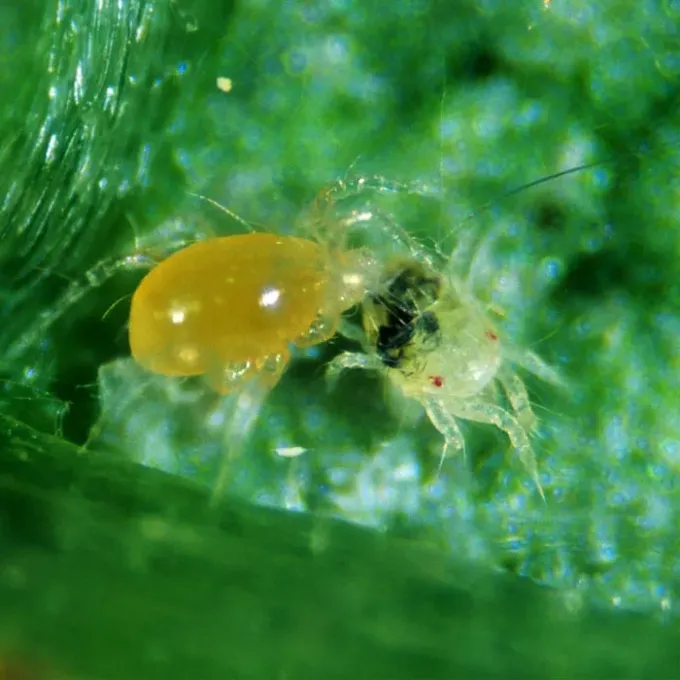
The mite has an oval-shaped body and ranges in color from light brown to yellowish. It is characterized by high mobility, which allows it to efficiently locate prey within dense plant canopies.
Its life cycle includes egg, larva, protonymph, deutonymph, and adult stages. The species thrives in moderate humidity and temperatures ranging from 20 to 30 degrees Celsius.
Unlike plant-feeding mites, Amblyseius andersoni possesses specialized mouthparts for predation. It is an active acari-predator that feeds exclusively on other small arthropods.
Correct identification is crucial: seeing these mites on your plants is an indicator of a healthy, functioning ecosystem rather than an impending crop failure.
What it damages
Technically, Amblyseius andersoni is not a plant pest. It is a highly beneficial entomophage that provides significant value to agricultural systems by regulating pest populations.
This mite does not puncture plant tissues or feed on sap; therefore, it does not cause any direct damage to leaves, stems, or fruits of the host plants.
When primary prey populations are low, this species can survive by feeding on alternative food sources such as plant pollen, nectar, or honeydew, ensuring its persistence in the field.
Misidentifying this mite as a pest and using chemical pesticides to eliminate it often leads to catastrophic outbreaks of spider mites or thrips, which are no longer controlled by their natural predator.
Incorporating this organism into an Integrated Pest Management (IPM) program is a proven way to reduce chemical reliance and maintain high crop yields.
When it appears
The population activity of this mite begins in early spring as temperatures rise and the first generations of prey mites emerge on the crops.
The peak of their reproductive cycle usually occurs during the warm summer months when prey populations are most abundant and growing rapidly.
As autumn approaches and light cycles decrease, the mites gradually enter diapause, seeking refuge in bark crevices or plant debris to overwinter safely.
In greenhouses with controlled environmental conditions, the reproduction of Amblyseius andersoni can continue throughout the year, providing continuous protection.
Seasonal dynamics are heavily dependent on prey availability; if the food supply is exhausted, the predatory mites will either migrate to adjacent plants or die off.
Control measures
Because Amblyseius andersoni is a beneficial organism, management efforts should focus entirely on conservation and augmentation rather than eradication.
It is vital to avoid broad-spectrum chemical pesticides, as these agents are generally non-selective and will kill the beneficial mites, disrupting the natural balance.
If fungicide or insecticide applications become necessary, practitioners should consult compatibility charts to select products that are least toxic to phytoseiid mites.
Enhancing the habitat by planting flower strips or nectar-producing vegetation helps support Amblyseius andersoni populations by providing alternative food sources when prey is scarce.
- Minimize the use of non-selective chemical sprays.
- Prioritize biological control over synthetic pesticides.
- Monitor pest levels closely before initiating any control measures.
Taxonomy
- Latin name
- Amblyseius andersoni
- Order
- Mites
- Family
- Phytoseiidae
- EPPO code
- AMBSAN
Discussion
No discussions yet — be the first.