
Amblydromalus rapax
Amblydromalus rapax
Description
How to identify
Amblydromalus rapax belongs to the Phytoseiidae family, within the Mesostigmata order. It is a highly efficient predatory mite used extensively in greenhouse horticulture.
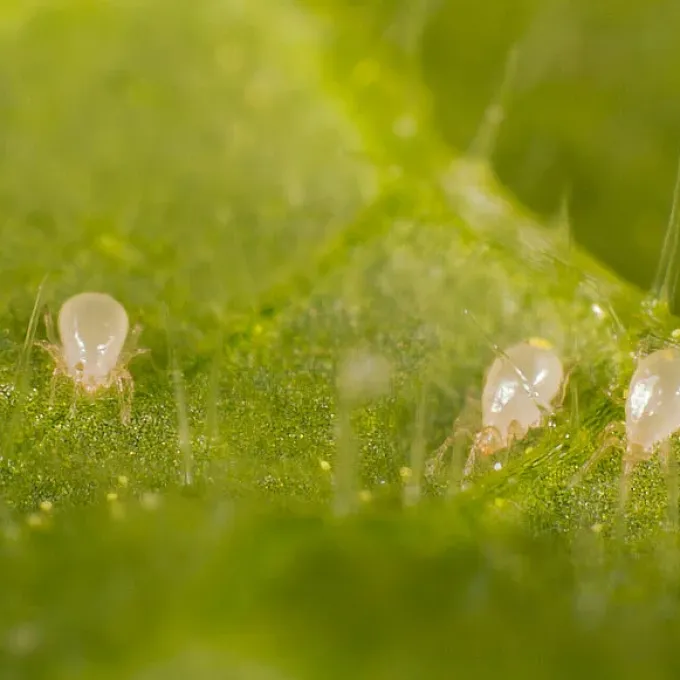
The adult mite is translucent to beige in color, often appearing slightly tinted based on the pigments of the prey it has recently consumed during its life cycle.
These mites possess long, slender legs that allow them to move rapidly across plant surfaces, making them highly effective hunters in complex foliage environments.
The life cycle involves several developmental stages, including eggs, larvae, protonymphs, deutonymphs, and adults, all occurring in a relatively short time frame.
In professional agriculture, this species is strictly classified as a beneficial organism, acting as a natural enemy to several plant-damaging insect species.
What it damages
It is crucial to clarify that Amblydromalus rapax does not feed on plants; it does not consume sap, damage leaves, or cause any tissue necrosis.
The mite is purely carnivorous, feeding on various small arthropods such as thrips larvae, whitefly eggs, and other mite species that truly threaten crop yields.
Farmers do not need to worry about the presence of this mite on their crops, as it does not cause stippling, chlorosis, or any other physiological plant stress.
The predatory activity of this mite helps keep pest populations below the economic injury level, ensuring the plant remains healthy and productive.
Any perceived damage in a field where this mite is present is always caused by the pests themselves, never by the predatory mite tasked with their control.
When it appears
Amblydromalus rapax is active during the growing season, particularly in warm and humid environments, which are typical for high-tech greenhouse operations.
Under controlled conditions, if a stable food source is available, the population can be sustained throughout the entire year without interruption.
The most favorable environment for their reproduction involves high relative humidity and temperatures that support both the mite and its primary prey.
In outdoor settings, their seasonal presence is usually linked to the appearance of prey populations during the warmer spring and summer months.
When environmental conditions become too dry or cold, the population growth rate significantly decreases, limiting their effectiveness in outdoor agroecosystems.
Signs of infestation
Evidence of Amblydromalus rapax is generally not visible to the naked eye; their presence requires professional scouting and microscopic identification of leaf samples.
An indirect sign of their successful activity is the stable or decreasing population density of thrips and whiteflies within a crop area.
Experienced agronomists check for these mites by examining the underside of leaves, especially near the veins where prey typically congregate.
Biological monitoring involving sticky cards and plant sampling is used to verify that the predatory mite is colonizing the crop successfully.
In healthy populations, these mites are typically found in high-prey areas, such as flowers or terminal shoots where insect pests are most common.
Control measures
Control of Amblydromalus rapax is essentially a strategy of conservation, aiming to preserve their existing population through wise chemical management.
The use of broad-spectrum insecticides must be avoided, as these agents are generally fatal to beneficial predatory mites and cause pest outbreaks.
Integrated Pest Management (IPM) protocols should be followed, prioritizing selective pesticides that are safe for the Phytoseiidae family.
Maintaining a balanced greenhouse environment with appropriate moisture levels is key to maximizing the efficiency of this predatory organism.
- Avoid the use of toxic, non-selective chemical pesticides.
- Monitor pest-to-predator ratios regularly before intervention.
- Use selective biological preparations when chemical control is required.
- Ensure adequate humidity levels to support mite reproduction.
Taxonomy
- Latin name
- Amblydromalus rapax
- Order
- Mites
- Family
- Phytoseiidae
- EPPO code
- AMBSRA
Discussion
No discussions yet — be the first.