
Typhlodromalus lailae
Typhlodromalus lailae
Description
How to identify
Typhlodromalus lailae is a predatory mite belonging to the family Phytoseiidae. These beneficial organisms are widely recognized for their role in biological pest control.
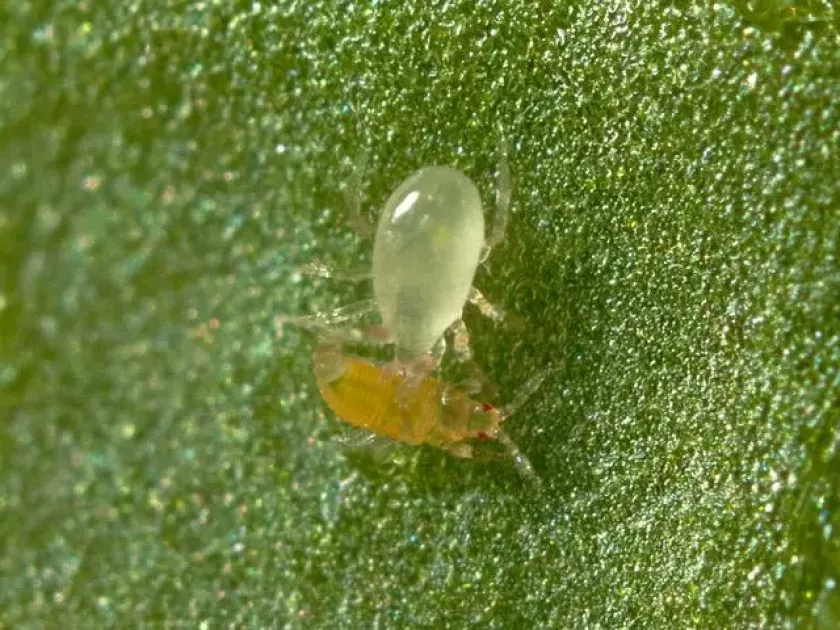
They possess a small, oval-shaped body, typical of the family, and are characterized by their amber to pale yellow color, which helps them blend in with foliage.
These mites are highly active and are frequently observed crawling on the undersides of leaves, where they search for prey to feed on.
From a taxonomic perspective, they are well-adapted to various agricultural environments, making them valuable tools for integrated pest management programs.
Their agility and predatory behavior allow them to effectively navigate complex leaf architectures to locate and suppress pest populations.
What it damages
It is crucial to clarify that Typhlodromalus lailae is not a crop pest but a beneficial predator that protects plants from herbivorous insects and mites.
Their primary diet consists of spider mites (Tetranychidae), which are notorious for damaging leaves and reducing the yield of various horticultural crops.
Furthermore, they are capable of preying upon the eggs and larval stages of thrips, providing an additional layer of protection against these common greenhouse threats.
By consuming these pests, Typhlodromalus lailae prevents the typical damage patterns such as chlorosis, necrosis, and leaf distortion.
Their presence helps maintain plant vigor, ensuring better growth rates and higher harvest quality in vegetables and ornamental plants.
When it appears
The activity level of Typhlodromalus lailae is highly dependent on environmental conditions, particularly temperature and relative humidity.
They thrive and reproduce most effectively within a temperature range of 20 to 28 degrees Celsius, combined with moderate to high humidity.
In greenhouse settings, they can remain active throughout the year as long as environmental parameters are consistently maintained.
In open field crops, their seasonal activity aligns with the presence of pest populations during the spring and summer growing months.
If conditions become suboptimal, their metabolic rate slows down, which is a natural physiological adaptation to changing environments.
Signs of infestation
The most reliable sign of Typhlodromalus lailae activity is a measurable reduction in the population density of target spider mite species.
One may notice a decrease in fine webbing on the leaves, which is a signature symptom of a heavy spider mite infestation that this predator helps eliminate.
Healthy plant development without signs of yellowing or spotted leaves in areas where the predator has been released indicates effective control.
Visual verification can be performed using a magnifying glass or a hand lens to spot the predators actively moving along the leaf veins.
A lack of rapid pest population rebound is a key indicator that the predator population is successfully established and functioning as intended.
Control measures
There are no control measures against Typhlodromalus lailae, as it is a beneficial insect-like mite that farmers aim to encourage and protect.
To preserve their population, it is essential to minimize or completely eliminate the use of broad-spectrum synthetic pesticides that are toxic to mites.
When chemical intervention against other pests is necessary, selective products that are safe for phytoseiid mites should always be preferred.
Proper biological control strategy involves systematic release of the mites according to the recommended application rates for specific crop types.
Maintaining a balanced environment with sufficient prey and appropriate climate control ensures the long-term success of these biological agents.
Taxonomy
- Latin name
- Typhlodromalus lailae
- Order
- Mites
- Family
- Phytoseiidae
- EPPO code
- TYPMLA
Discussion
No discussions yet — be the first.