
Mistle thrush
Turdus viscivorus
Description
How to identify
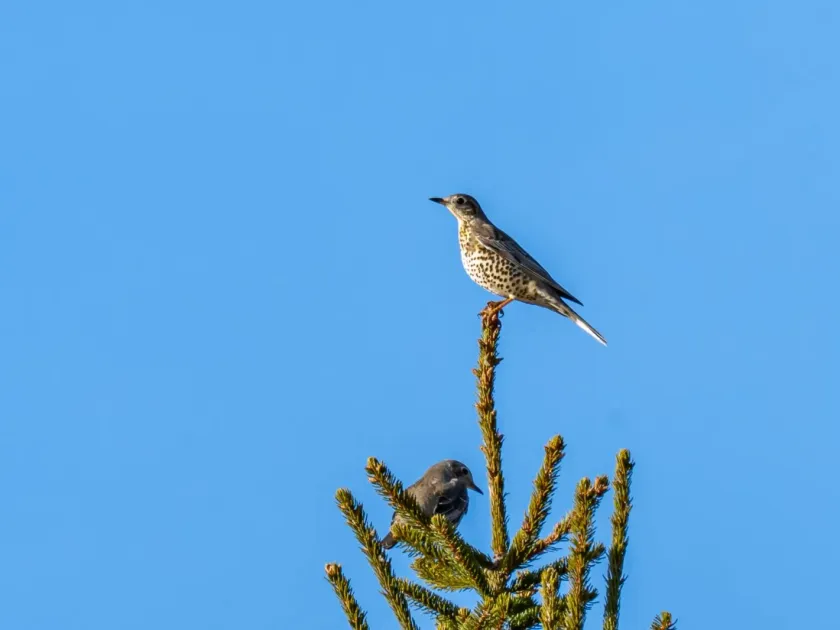
The Mistle thrush (Turdus viscivorus) is a large passerine bird belonging to the thrush family (Turdidae).
It is characterized by a grey-brown upper body and a pale underbelly heavily marked with dark, distinct spots.
The species is known for its bold and aggressive behavior, especially when defending its feeding territory from other birds.
Equipped with a sturdy bill and strong legs, the Mistle thrush is highly efficient at foraging both on the ground and within tree canopies.
Their song is composed of loud, dry, and rattling notes, which serve as a clear auditory marker of their presence in orchards.
What it damages
The Mistle thrush causes significant economic losses by feeding on berries, cherries, grapes, and other soft fruits as they ripen.
Birds frequently pierce the skin of fruits, leaving deep damage that promotes rapid spoilage, fermentation, and fungal decay.
In addition to direct consumption, their droppings contaminate the foliage and branches, potentially facilitating the spread of various plant diseases.
During early spring, when other food sources are scarce, they may feed on fruit buds, negatively impacting the tree's future yield potential.
In years with poor wild berry harvests, these thrushes congregate in cultivated orchards, leading to widespread destruction of high-value crops.
When it appears
Bird activity in orchards usually peaks during the ripening phase of soft fruits, starting in early summer and lasting until late autumn.
June and July are critical periods when cherries and early berries are at highest risk of being attacked by local populations.
Autumnal activity is especially high in vineyards, where the birds feed on maturing grapes before initiating their seasonal movements.
Springtime damage occurs when temperatures fluctuate, and birds resort to feeding on developing buds if alternative food is unavailable.
Understanding these seasonal patterns is essential for deploying protective measures just before the fruit begins to attract birds.
Signs of infestation
The most reliable sign of a Mistle thrush infestation is the presence of partially eaten fruits left hanging on branches or dropped on the ground.
Damage marks include distinct ragged holes or large gouges in the fruit flesh, which quickly darken as oxidation occurs.
White, chalky droppings found on the upper leaves and branches are a clear indicator of frequent bird presence and feeding activity.
Repeated, dry, rattling vocalizations coming from the orchard are typical signs that Mistle thrushes are actively feeding in the area.
Minor bark damage on young shoots may also occur as birds perch and inspect branches for food or nesting materials.
Control measures
The most reliable protection for fruit trees and bushes is the installation of fine-mesh bird exclusion netting.
Visual deterrents like reflective ribbons, inflatable predators, or rotating wind-powered devices can discourage birds from settling in the area.
Bioacoustic devices that play alarm calls of predatory birds are highly recommended for large-scale agricultural fruit production.
For maximum effectiveness, a multi-modal approach combining visual and auditory deterrents is advised to prevent bird habituation.
- Deploy exclusion netting over crops.
- Utilize bioacoustic bird deterrent systems.
- Install reflective and moving scare devices.
- Ensure prompt harvesting of ripening fruits.
Taxonomy
- Latin name
- Turdus viscivorus
- Family
- Turdidae
- EPPO code
- TURDVI
Discussion
No discussions yet — be the first.