
Song thrush
Turdus philomelos
Description
How to identify
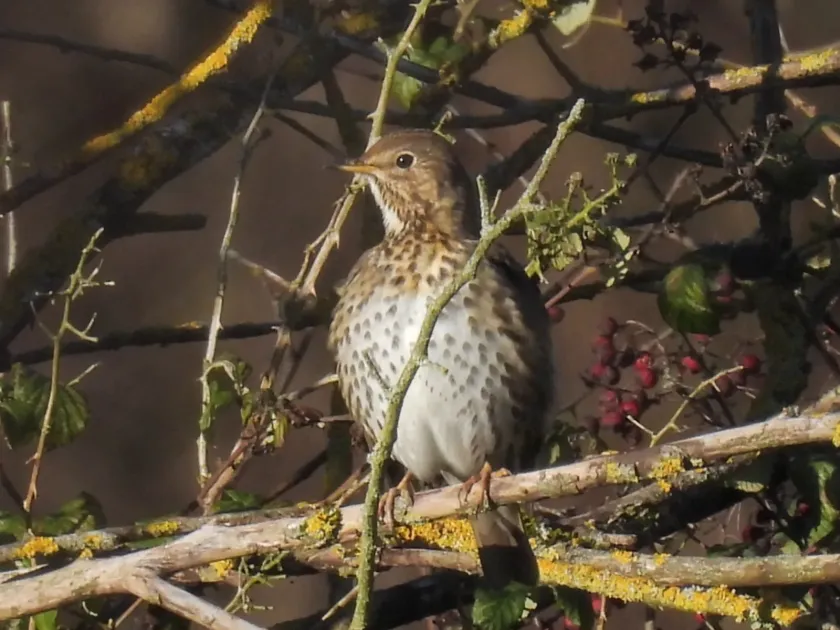
The song thrush (Turdus philomelos) is a member of the Turdidae family, known for its distinctive brown upperparts and cream-colored breast marked with dark, arrowhead-shaped spots. It is a common visitor to gardens and agricultural areas.
These birds are recognized by their beautiful, repetitive song and their habit of foraging for food in open spaces or shrubbery. Their adaptability makes them frequent residents in suburban gardens and orchards.
Biologically, the song thrush is an omnivore, feeding on insects, worms, and snails during the spring, but switching to a fruit-heavy diet as the summer progresses and berries begin to ripen.
They build nests in hedges, trees, or ivy-covered walls. Once the breeding season begins, the presence of nests nearby inevitably leads to increased feeding pressure on local orchards and berry patches.
Understanding their behavior is crucial for gardeners and farmers. Being highly alert and intelligent, these birds can quickly learn to navigate around simple human-made obstacles in their search for food.
What it damages
The song thrush is considered a pest primarily due to its impact on soft fruit crops, including strawberries, cherries, blueberries, and grapes. They have a particular fondness for high-sugar content fruits.
Damage occurs when the birds peck at the ripening fruit, leaving ragged holes and making the produce unsuitable for sale or consumption. Once damaged, the fruit is prone to rapid decay and fungal infections.
In vineyards, song thrushes can damage grapes by tearing the skin, which attracts wasps and other insects, further compounding the damage to the harvest and lowering overall yield quality.
In years with limited natural food sources, song thrushes can devastate an entire crop in a matter of days. For professional growers, this represents a significant economic threat to profitability.
Their feeding habits are not limited to just taking a few berries; they tend to visit the same patches repeatedly, ensuring that any fruit left unprotected is likely to be consumed or damaged.
When it appears
The risk of damage begins in late spring, specifically as soon as the first early-ripening berries appear. This corresponds with the time when parent birds are busy feeding their first or second brood of chicks.
July and August are the peak months for agricultural impact. During this period, the abundance of ripening stone fruits and late summer berries makes orchards a primary target for foraging thrush families.
Autumn brings a shift in diet towards fallen fruits and berries, although their impact on commercial orchards decreases as they prepare for seasonal migration or find food in wilder woodland areas.
Springtime activity is more focused on nesting and insect-hunting, though gardeners should remain vigilant as this is when local populations establish their presence within the orchard perimeter.
Monitoring the stages of fruit development and the arrival of birds is essential for timely deployment of protective measures. Early intervention is always more successful than reactive damage control.
Signs of infestation
The most evident sign of a song thrush infestation is the presence of fruit with peck marks or hollowed-out pulp. Damaged berries often remain on the branch or fall to the ground, surrounded by discarded skins.
The accumulation of bird droppings on leaves and branches is a clear indicator that a flock has been feeding in the area. This also creates a hygienic issue for the produce and the trees themselves.
A sudden increase in wasp and hornet activity around fruit bushes is often a secondary sign that birds have breached the harvest, as these insects are attracted to the juices from broken fruit.
Early morning bird calls and increased movement in the canopy are strong behavioral indicators. Observing the thrushes' flight paths can help locate their favorite feeding spots within the orchard.
- Ragged holes in ripening berries and fruits.
- Premature dropping of fruit to the orchard floor.
- Visible bird droppings on foliage and fruit clusters.
- Increased presence of wasps around the plants.
- Frequent morning activity and chirping in the orchard canopy.
Control measures
The most effective and reliable method to protect fruit is the installation of fine-mesh anti-bird netting. This physical barrier is the gold standard for ensuring 100% crop protection.
Acoustic deterrents that simulate the sounds of predatory birds can work for short periods, but they must be rotated or changed to prevent the thrushes from becoming habituated to the noise.
Visual deterrents, such as reflective ribbons, shiny tape, or moving predator decoys, are best used as supplementary measures. They need to be moved frequently to remain effective against intelligent birds.
Good agricultural practices, including prompt harvesting of fruit as it reaches maturity, minimize the time the produce is exposed to avian foragers. Removing fallen fruit also helps reduce secondary pest attraction.
Integrated pest management strategies, combining physical barriers like netting with randomized acoustic and visual deterrents, provide the most sustainable protection against song thrush damage.
Taxonomy
- Latin name
- Turdus philomelos
- Family
- Turdidae
- EPPO code
- TURDPH
Discussion
No discussions yet — be the first.