
Naumann's thrush
Turdus naumanni
Description
How to identify
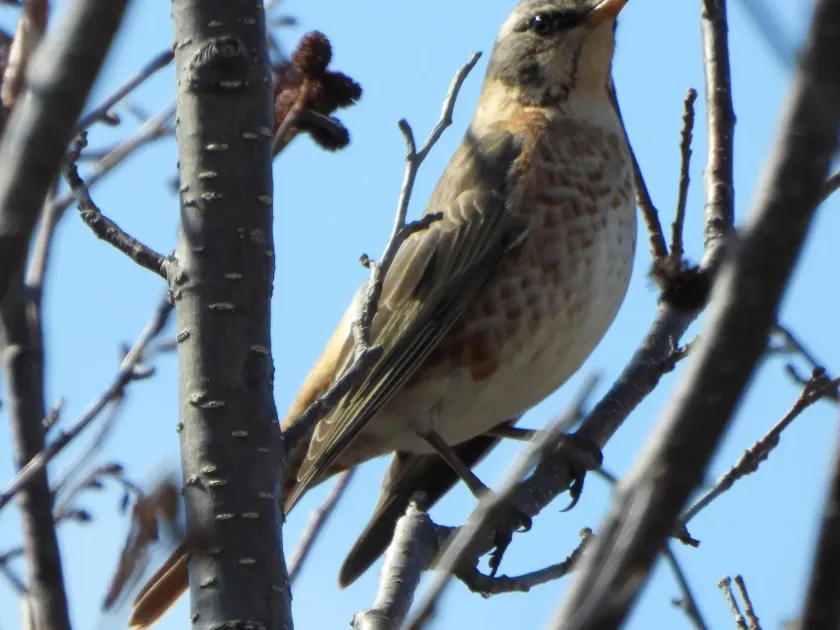
Naumann's thrush (Turdus naumanni) is a migratory bird of the order Passeriformes, belonging to the thrush family. The bird has a typical thrush build, with a body length of approximately 20–25 centimeters.
The plumage of the upper part of the body varies from grayish-brown to reddish-brown. The ventral side is light, decorated with dark spots, which often merge into distinct patches on the chest and flanks.
A distinctive feature of the species is the presence of reddish tones in the coloration of the underwings and rump, which is especially noticeable in flight. The bird's beak is dark and quite strong, adapted for both foraging for insects and eating fruit.
Young individuals are characterized by duller plumage and a less pronounced pattern on the lower body. In intensive agriculture, this species often forms flocks, which increases its impact on agroecosystems.
The bird is primarily diurnal, showing high activity in searching for food in open areas, gardens, and forest edges adjacent to agricultural land.
What it damages
The main damage to agricultural crops occurs during the ripening period when thrushes switch to a diet of fruit and berries. This makes them serious competitors for farmers specializing in horticulture.
Naumann's thrush actively damages the fruits of various stone and pome crops. The birds' diet includes cherries, plums, apples, and pears during their peak ripeness.
Of particular concern is the damage to berry patches, such as raspberries, strawberries, currants, and serviceberries. Flocks of birds can destroy a significant part of the harvest in a short period.
In addition to eating the fruit, the birds often deform them by pecking at the pulp, which leads to premature rotting of the crop directly on the branches. Damaged fruits lose their marketability and become unsuitable for storage and processing.
Damage also manifests in the destruction of fruit tree buds in early spring, if natural food sources are limited. This can negatively affect potential yields in the current season.
When it appears
The period of greatest damage coincides with the ripening phases of fruit in the summer. From late June to August, thrushes visit gardens en masse, attracted by juicy and sugary fruits.
In early spring, immediately after arrival, birds can damage ornamental and fruit plantations while searching for plant food before the mass emergence of insects.
In autumn, the activity of thrushes in garden plots increases as they begin to feed actively on late berry varieties and remaining fruits to accumulate fat reserves before migration.
The intensity of orchard visits depends on weather conditions and the availability of a natural food base in forests. In dry years, when the forest berry harvest is small, raids on garden plots become more massive.
The species' life cycle is closely linked to seasonal migration, so the maximum concentration of individuals in one area is observed during the peak harvest periods of fruit and berry crops.
Signs of infestation
The first sign of the pest's presence is the occurrence of a large number of pecked fruits hanging on branches or lying on the ground under the trees.
On berries and fruits, there are characteristic deep, through-holes made by the sharp beak. Often, traces of juice are visible around damaged fruits, which attract secondary pests such as wasps and flies.
In the garden, there is often increased bird activity, noisy behavior, and the presence of numerous droppings on branches, leaves, and the soil surface under the tree canopy.
The presence of flocks of Naumann's thrushes is easily determined visually during the morning and evening hours when the birds feed most intensively in the tree canopies and berry beds.
Characteristic sounds and the rapid movement of the flock between trees are also reliable indicators that the plantings are being attacked by this bird species.
Control measures
The most effective protection method is the installation of protective netting. Fine-mesh polymer netting stretched over tree canopies or berry beds completely prevents birds from accessing the crop.
The use of acoustic repellers broadcasting thrush alarm calls or the calls of predatory birds allows for a reduction in the number of individuals visiting the garden, although this requires periodic changes in signals to prevent habituation.
Visual protection means, such as reflective tapes, mirror elements, and silhouettes of predatory birds (hawks, falcons), provide a temporary effect and should be combined with other methods.
Agricultural practices include timely harvesting, avoiding over-ripening of fruit on branches, which reduces the attractiveness of the plantings to thrushes.
- Using protective netting for berry crops.
- Application of bio-acoustic repelling systems.
- Placing reflective objects in the tree canopies.
- Timely removal of fallen fruit and ripe harvests.
Taxonomy
- Latin name
- Turdus naumanni
- Family
- Turdidae
- EPPO code
- TURDNU
Discussion
No discussions yet — be the first.