
American Robin
Turdus migratorius
Description
How to identify
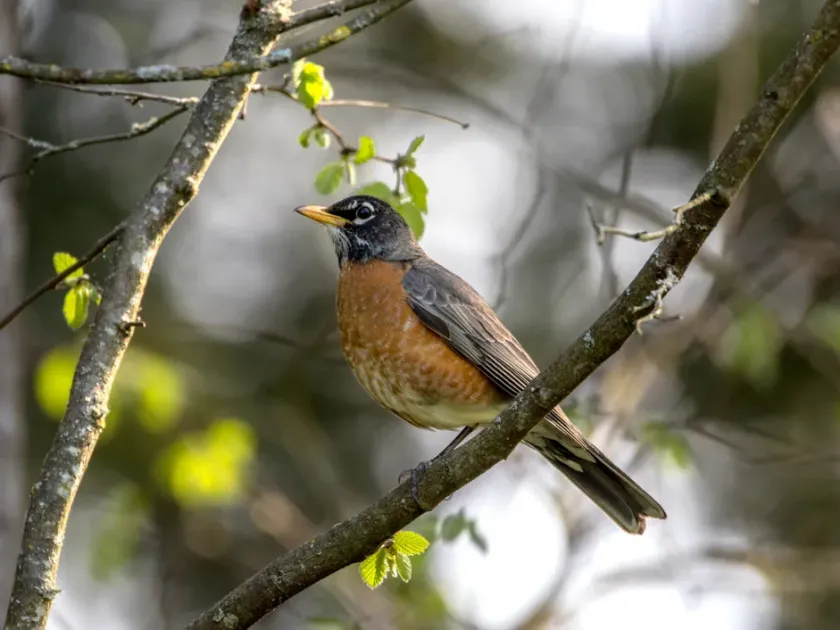
The American Robin (Turdus migratorius) is a migratory songbird of the Thrush family, belonging to the order Passeriformes. Adult birds are about 25 cm long, featuring a gray back and a distinct orange-red breast.
The birds possess a strong, yellowish bill designed for foraging both insects and fruits. Males often exhibit darker, almost black heads during the breeding season, making them distinct from females.
This species is highly adaptable to urban and agricultural environments. Their tendency to congregate in large flocks makes them particularly problematic for commercial fruit growers.
Biologically, they are very active during the day. They display a characteristic "run-stop-look" behavior when searching for food on the ground, which also applies when they move into trees and bushes.
They are known for their high mobility and intelligence, allowing them to learn which fields offer the best food sources and how to navigate around basic scare tactics.
What it damages
The primary economic damage is caused by the birds consuming ripening berries and fruits. They are notoriously voracious, capable of stripping a plantation of its yield in a short period.
Target crops include strawberries, raspberries, blueberries, cherries, and grapes. The birds peck into the flesh of the fruit, often destroying more than they actually eat.
Damaged fruit loses its market value and becomes highly susceptible to secondary fungal infections due to open wounds. This leads to increased post-harvest spoilage.
In commercial operations, yield losses due to Robin depredation can exceed 50% if protective measures are not implemented early in the season.
Furthermore, they contribute to the spread of invasive weed seeds, which they ingest in one area and deposit via droppings in the fruit orchards, complicating weed management.
When it appears
The threat level peaks during the fruit ripening season. In many regions, this activity begins in late spring and continues through the late summer harvest period.
The mid-summer window is especially critical, as it coincides with the rearing of the second brood of nestlings, leading to intensified foraging activity in berry patches.
Migratory flocks can cause late-season damage to autumnal crops like grapes or late-variety apples, as they build fat reserves for their southward migration.
Daily activity patterns show peak foraging in the early morning and late evening. During these times, flocks descend on orchards with high intensity.
Environmental factors, such as drought or a poor wild berry crop, can exacerbate the pressure on agricultural crops, as the birds seek reliable food sources in irrigated fields.
Signs of infestation
The most obvious sign of an infestation is the presence of partially eaten fruit scattered on the ground or left hanging on the plant stems.
Look for small, precise beak marks on the surface of the berries. Often, the flesh is hollowed out, leaving only the skin or the hard pit behind.
Vocalizations are a key indicator; American Robins are loud, and their sharp "tut-tut-tut" alarm calls are frequently heard when humans approach the area.
Presence of droppings on leaves, branches, and garden infrastructure is a clear indicator that a flock has been feeding in the immediate vicinity.
Regular visual monitoring of the orchard at dawn usually confirms the presence of these birds before they move on to other feeding sites during the heat of the day.
Control measures
Exclusion is the most effective control method. Installing high-quality bird netting over berry bushes or trellis systems is the only way to guarantee total protection.
- Utilizing acoustic deterrents, such as recorded distress calls or predator sounds, to create a zone of perceived danger.
- Deploying visual deterrents like flash tape, spinning reflective discs, or predator decoys to create erratic light and motion.
- Applying non-toxic, taste-aversion repellents to the crop, which make the berries unpalatable to birds.
- Sanitation practices, such as immediate removal of fallen or overripe fruit to eliminate easy food access.
- Rotating the location and type of deterrents every few days to prevent habituation.
Successful management requires a multi-faceted approach. Relying on a single tactic is rarely effective, as Robins are quick to adapt and ignore inanimate stimuli.
Deployment of control measures must occur before the fruit begins to change color, as once birds have established a successful feeding pattern, they are difficult to deter.
For large-scale agricultural operations, integrating netting with automated electronic repellent systems provides the highest level of yield protection and financial security.
Taxonomy
- Latin name
- Turdus migratorius
- Family
- Turdidae
- EPPO code
- TURDMI
Discussion
No discussions yet — be the first.