
Redwing
Turdus iliacus
Description
How to identify
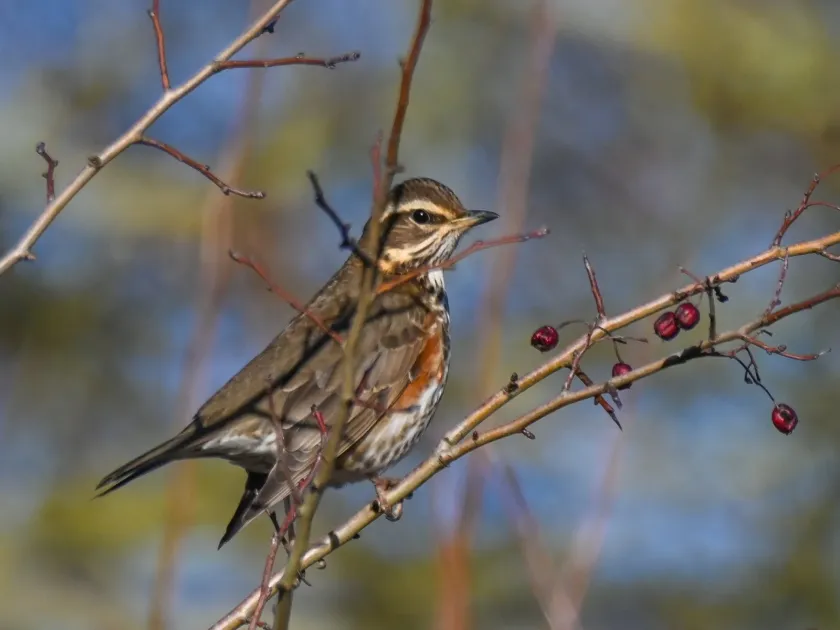
The redwing (Turdus iliacus) is a member of the thrush family (Turdidae), often found in orchards during migration and nesting periods. It is a small migratory bird that can become a significant pest when natural food sources are scarce.
The bird is easily identified by its prominent creamy-white "eyebrow" stripe. Its plumage is primarily brown, with a distinct rusty-red patch under the wings, which is a key diagnostic feature when in flight.
Redwings are highly social birds that travel in flocks. This gregarious behavior allows them to quickly locate and exploit ripening fruit crops across a garden or orchard.
Their life cycle involves breeding in northern latitudes, but during autumn migration, they frequently stop in agricultural areas, where they cause considerable damage to cultivated fruits.
Because these birds are intelligent and adaptable, they can quickly learn to ignore static deterrents, making consistent and varied management strategies essential for farmers.
What it damages
The redwing causes significant damage to fruit and berry plantations. Their ability to consume large amounts of produce in a short period makes them a serious threat to small-scale growers.
Commonly damaged crops include cherries, sweet cherries, serviceberries, honeyberries, and strawberries. In commercial settings, blueberries and currants are also frequently targeted.
On larger fruits like apples and pears, redwings peck into the soft skin, leaving holes that invite rot and secondary infections, rendering the fruit unsellable.
The intensity of the damage often spikes during years of poor wild berry harvests, forcing flocks to search for supplementary food sources in domestic and commercial gardens.
Financial losses are not only due to the weight of the lost fruit but also to the decrease in quality, as damaged produce cannot be sold on the fresh market.
When it appears
Bird activity in orchards peaks during the fruit ripening season, which typically lasts from June through August. This is the period of highest risk for the majority of berry crops.
Redwings are most active during the early morning hours, as they forage after the night, and again in the late afternoon. These are the peak times for monitoring damage.
Autumn migrations can also pose a risk for late-ripening varieties of apples and grapes. Flocks tend to remain in an area until the food supply is exhausted.
Environmental factors, such as droughts, increase the birds' need for juicy fruits as a source of hydration, making them even more persistent in their attacks on orchards.
Understanding the phenology of your specific crop is crucial, as the earliest-ripening varieties are almost always the first to attract the attention of redwing flocks.
Signs of infestation
The primary sign of a redwing presence is the discovery of pecked or partially eaten fruits left on the bushes or ground. Often, only pits or empty skins remain on the branches.
Bird droppings on leaves, branches, and the ground beneath trees are clear indicators of a flock's presence and may also harbor pathogens that affect plant health.
Damage is typically patchy; birds often start at the top of the canopy and work their way down, leaving broken twigs and damaged foliage in their wake.
The sound of a noisy, moving flock and their characteristic alarm calls are clear indicators that the orchard is currently being targeted by a group of birds.
The damage patterns—small, precise peck marks on the skin—are distinct from insect damage, helping growers accurately identify the pest responsible for the loss.
Control measures
The most effective physical defense is the use of high-quality protective bird netting, which physically prevents birds from reaching the fruit while allowing light and air circulation.
Visual deterrents, such as reflective tapes, old CDs, or hawk decoys, can be used. However, it is vital to move these objects frequently to prevent the birds from habituating to them.
In large-scale orchards, bioacoustic deterrents that play recordings of raptor calls or bird alarm signals are highly effective at discouraging flocks from settling.
- Installation of protective bird netting;
- Use of reflective visual deterrents;
- Implementation of bioacoustic systems;
- Regular harvesting of ripe fruit;
- Rotation of predator decoys.
A combination of methods is recommended for the best results. The goal is to create an environment that is uncomfortable or frightening enough to drive the birds elsewhere.
Taxonomy
- Latin name
- Turdus iliacus
- Family
- Turdidae
- EPPO code
- TURDMU
Discussion
No discussions yet — be the first.