
Brown babbler
Turdoides plebejus
Description
How to identify
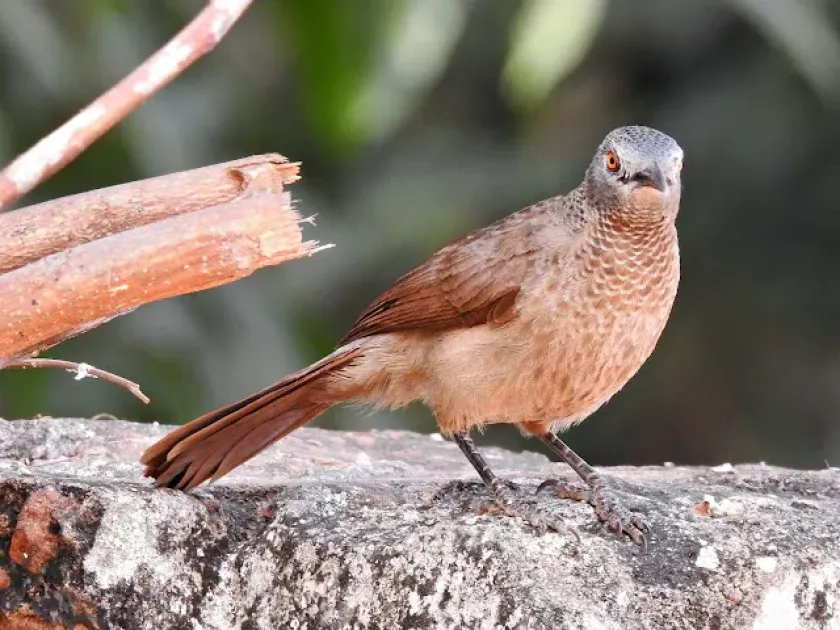
The brown babbler (Turdoides plebejus) is a social passerine bird belonging to the Leiothrichidae family. It is a medium-sized bird, typically measuring between 22 and 25 cm, characterized by its dull brown plumage with a distinct scaly pattern on the throat and breast.
The species is easily recognized by its robust, slightly curved bill and pale, almost whitish eyes. Its body appears bulky due to loose, soft feathers, which is a common trait among many babbler species in the African savannahs.
These birds are highly gregarious and are almost always seen in groups, known as "troops" or "parties," consisting of 5 to 15 individuals. They maintain constant social bonds and communicate through a variety of harsh, chattering, and screeching vocalizations.
In flight, they appear somewhat clumsy, often gliding with spread wings and a long tail. Their behavior is inquisitive and energetic, and they rarely stay in one spot for long, preferring to move through bushes and low canopy levels.
The brown babbler thrives in open woodlands, savannahs, and areas with dense scrub. They have successfully adapted to human-altered landscapes, making use of hedgerows, gardens, and farmland edges for both foraging and nesting.
What it damages
The brown babbler is considered a pest in agricultural settings, particularly during the ripening phase of cereal and pulse crops. They operate in groups, which allows them to cause significant localized damage to standing crops in a very short time.
Commonly targeted crops include sorghum, millet, and maize. During the milk stage of grain development, the birds use their strong bills to tear open husks or expose kernels, consuming a significant portion of the harvest.
Besides feeding on grains, these birds can damage young seedlings by pulling them out of the soil while searching for insects, which is a common foraging behavior. This results in poor plant stand density and the need for replanting.
The damage is not limited to the grains themselves; the birds' presence often leads to secondary issues, such as the introduction of molds and fungal infections through the wounds left on the plant tissues, reducing the overall market value of the produce.
The level of destruction depends on the group size and the duration of their foraging visits. In areas with high bird populations, the cumulative loss can be substantial, often affecting the harvest yields at the edges of fields adjacent to wild cover.
When it appears
The most intensive foraging activity on crops occurs during the grain-filling and ripening stages. Throughout this period, the babblers frequently visit fields to take advantage of the easily accessible, high-energy food source.
Seasonal patterns of crop infestation are often synchronized with the local agricultural cycle. Once the crops enter the vulnerable developmental phases, they attract groups of babblers from the surrounding wild areas.
During the breeding season, which can occur throughout the year depending on the climate, the need for food increases. This prompts groups to be more daring and persistent in their attempts to raid agricultural fields to feed their young.
Peak daily activity usually takes place in the early morning and late afternoon. During these times, the babblers are most active, moving through the fields in coordinated foraging parties to maximize their intake.
In the dry season, when natural food sources are scarce, the frequency of crop raids often increases. During these times, fields located near artificial watering holes are at the highest risk of attack by these birds.
Signs of infestation
The primary indicator of brown babbler presence is their distinctive, loud, and harsh chattering calls. These noises are usually constant when a group is active, serving as a reliable alert for farmers to detect their arrival.
Visible damage to maize ears, such as torn husks at the top of the cob, is a strong sign of babbler activity. The kernels are often pecked at or shredded, leaving behind a mess of debris that is susceptible to pests and disease.
On grain crops like sorghum or millet, one can observe broken stalks and heads that look partially consumed. The birds typically perch on the stalks, bending them down to reach the grains, leading to visible lodging in the field.
The presence of droppings on the foliage and soil throughout the field edges is another clear sign. This indicates that the birds have been congregating in the area for a significant amount of time during their feeding sessions.
Sparse patches or "bald spots" along the perimeter of the field are indicative of damage. Because babblers prefer to forage near protective cover, they often start at the edge of the field and gradually work their way further into the crop.
Control measures
Acoustic deterrents are the most effective method for managing babbler populations. Broadcasting alarm calls or the sounds of raptors can simulate a threat, causing the flock to abandon the field in search of a safer area.
For high-value plots, physical exclusion is the only sure way to protect the crop. Installing netting or bird-proof barriers over the plants during the vulnerable ripening period effectively prevents access.
Agronomic practices, such as ensuring uniform field planting and timely harvesting, are crucial. Minimizing the time the crop remains in the field after reaching maturity reduces the window of opportunity for bird attacks.
Visual scare tactics, including reflective tape, scarecrows, or models of predators, may provide temporary relief. To maintain effectiveness, these items must be moved regularly to prevent the intelligent babblers from habituating to them.
Habitat modification around the farm is essential for long-term control. Removing dense brush, weeds, or unnecessary trees near the edge of the fields reduces the available cover, making the area less attractive for the babblers to congregate.
Taxonomy
- Latin name
- Turdoides plebejus
- Family
- Timaliidae
- EPPO code
- TRDDPL
Discussion
No discussions yet — be the first.