
White-crested laughingthrush
Garrulax leucolophus
Description
How to identify
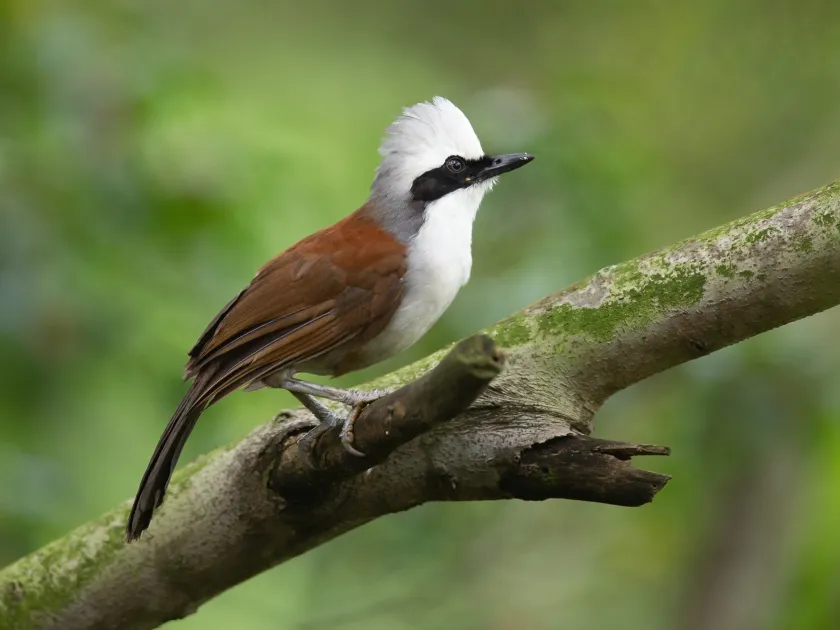
The white-crested laughingthrush (Garrulax leucolophus) is a passerine bird belonging to the Leiothrichidae family. It is distinctively characterized by a prominent white crest, a black mask across its eyes, and a robust, reddish-brown plumage.
These birds are highly social and are typically found in noisy, active parties that forage together. This gregarious behavior makes them a significant challenge to manage in agricultural environments where they congregate in large groups.
Adaptability is a key trait of this species, as it thrives in various habitats including secondary forests, scrublands, and increasingly in agricultural zones bordering human settlements.
Their life cycle includes seasonal breeding patterns that often align with the availability of fruit resources, leading to increased pressure on agricultural production during harvest seasons.
The bird's intelligence and ability to communicate within the flock allow them to navigate around static protection measures, making them persistent visitors to orchard sites.
What it damages
The white-crested laughingthrush causes agricultural damage primarily by foraging on ripening fruits, berries, and cereal crops. They are known for their destructive feeding habits, which go beyond simple consumption.
Affected crops include tropical fruits such as papaya and guava, as well as coffee beans and grains. The birds often damage more fruit than they actually eat, piercing the skin and rendering the produce unmarketable.
In addition to fruit damage, they can break small branches and damage delicate vegetation while moving through the canopy in search of food or insects.
Large flocks are capable of stripping an entire tree of its harvest in a very short amount of time, resulting in substantial financial losses for farmers.
The economic impact is heightened due to the birds' preference for high-quality produce, often targeting the most mature and valuable fruits in an orchard.
Signs of infestation
Key signs of a laughingthrush presence include jagged, pecked edges on hanging fruits and half-consumed produce remaining on the trees.
The presence of large amounts of fruit debris on the orchard floor is a clear indication that a flock has been feeding in the immediate vicinity.
Loud, raucous vocalizations are characteristic of these birds, and their persistent calling while moving through the trees is the most common auditory sign of infestation.
Accumulated fecal matter on branches and leaves beneath feeding sites serves as a visual indicator of a flock's sustained activity in a specific area.
Damage to new shoots and buds, resulting from the birds' energetic searching behavior, can also indicate their active presence in the plantation.
Control measures
Netting of individual trees or entire orchard sections is the most effective physical barrier against the white-crested laughingthrush.
The use of acoustic deterrents, such as devices that mimic predator calls or distress signals of the species, can be effective if used inconsistently to prevent habituation.
Visual deterrents, including hawk decoys or reflective tapes, can be utilized, provided that their positions are changed frequently to maintain the element of surprise.
Good orchard sanitation practices, such as the rapid removal of fallen fruit, can help reduce the attractiveness of the site to foraging flocks.
Integrated pest management strategies are recommended, combining multiple deterrent techniques to protect crops effectively without relying on a single method.
Taxonomy
- Latin name
- Garrulax leucolophus
- Family
- Timaliidae
- EPPO code
- GARXLE
Discussion
No discussions yet — be the first.