
Parrotbills
Paradoxornis
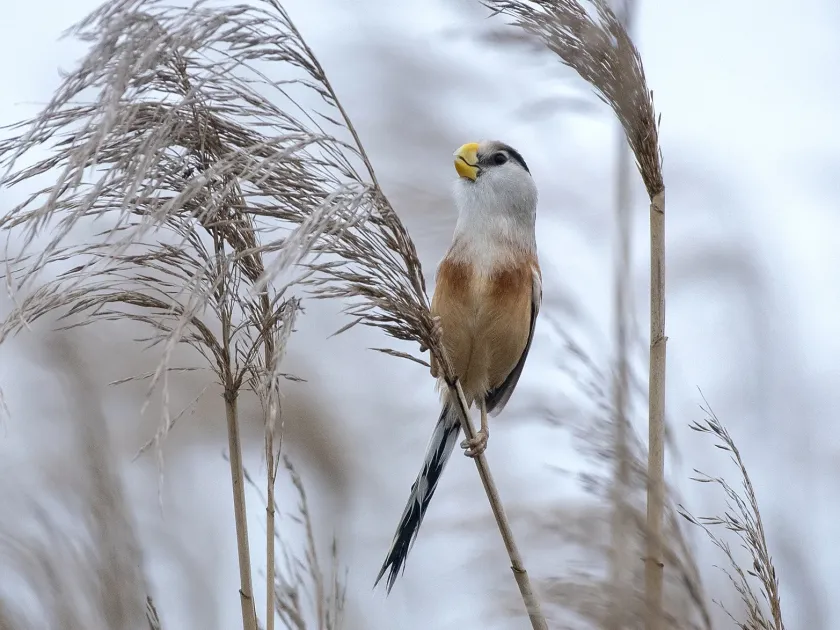
Description
How to identify
Parrotbills (genus Paradoxornis) are a group of birds in the family Paradoxornithidae, characterized by their unique, short, and extremely sturdy bills. This specialized anatomy allows them to crack open hard seeds and tough plant stems with remarkable efficiency.
Physically, these birds typically display buff or brownish plumage, providing effective camouflage within their natural habitats, such as reed beds and tall grasses. They are small, usually ranging from 15 to 20 cm in length, with long, graduated tails.
Parrotbills are social and highly active birds, moving in small flocks through the dense vegetation. Their cautious nature makes them difficult to spot, often remaining hidden from sight while foraging in agricultural or wild areas.
They are primarily found in Eastern and Southeast Asia. Their habitat often overlaps with agricultural land, especially where fields are adjacent to wetlands, riverbanks, or dense shrubbery.
In an agricultural context, they are categorized as potential pests because they can rapidly feed on grain crops, causing localized damage that impacts yield quality and overall production.
What it damages
The primary damage caused by parrotbills occurs during the milk and dough stages of grain development, particularly in crops like millet, sorghum, and barley. This is when the grains are soft and nutrient-rich.
These birds feed on the heads of the grain, either consuming the kernels entirely or tearing the outer husks. Such damage leaves the plant vulnerable to subsequent fungal infections, mold, and secondary pests.
Beyond direct grain loss, the physical activity of a flock landing on crops often results in broken stems, which complicates mechanical harvesting and reduces the overall efficiency of combine operations.
In regions with high parrotbill populations, the cumulative damage can lead to significant yield losses, potentially reducing the market value of the grain due to both quantity reduction and compromised quality.
The severity of the damage is often highest in fields bordering their natural habitats, where birds can quickly move between the safety of dense shrubs and the abundant food source of the crop field.
When it appears
The period of peak vulnerability for crops coincides with the grain-filling stage, typically during the second half of summer. This is when parrotbills are most active in transitioning from wild vegetation to cultivated fields.
The breeding season and the fledgling period often overlap with the maturation of early-season grain varieties, leading to increased pressure as flocks become more mobile and numerous.
In autumn, as wild food sources become scarce due to cooling temperatures, parrotbills may persist in fields containing late-maturing crops, continuing to feed on the harvest until it is cleared.
The impact of these birds is highly dependent on environmental conditions. In drought years, when natural vegetation dries out prematurely, parrotbills show an increased tendency to forage on agricultural fields.
Outside of the grain-ripening season, parrotbills pose minimal threat to crops, as they revert to their natural diet of weed seeds and insects found within their preferred wild habitats.
Signs of infestation
The most reliable sign of parrotbill infestation is the presence of damaged grain heads, characterized by missing kernels and shredded husks. These mechanical marks are distinct from the damage caused by insect larvae.
A high density of broken stems or flattened patches, especially along the field margins adjacent to trees or thickets, indicates that a flock has been actively foraging in the area.
Observing flocks during the early morning or late evening hours, combined with characteristic chirping and movement in the upper canopy of the plants, provides clear evidence of their presence.
Secondary signs include the proliferation of mold or decay on the damaged grain heads, which becomes evident upon close inspection during pre-harvest surveys.
The presence of bird droppings on the upper leaves and stalks of the crop in concentrated patches indicates the preferred feeding zones of the flock within the field.
Control measures
The most effective strategy for managing parrotbill damage is the use of visual and auditory deterrents, such as reflective tape, wind-activated scarecrows, or specialized acoustic alarm systems.
Removing tall weeds, reeds, and dense shrubbery from the edges of fields serves as a long-term preventive measure by eliminating the protective cover that these birds rely on.
For high-value plots, covering crops with protective netting is the most reliable, albeit labor-intensive, method to prevent birds from accessing the grain heads entirely.
Integrated management should also include the selection of crop varieties that exhibit denser or more protective husks, making them less susceptible to the cracking power of the parrotbill's bill.
Monitoring field activity throughout the grain-filling stage is crucial for timing deterrent interventions, as prompt action can significantly minimize total harvest loss.
Taxonomy
- Latin name
- Paradoxornis
- Family
- Timaliidae
- EPPO code
- PRXOSP
Discussion
No discussions yet — be the first.