
Truxalis nasuta
Truxalis nasuta
Description
How to identify
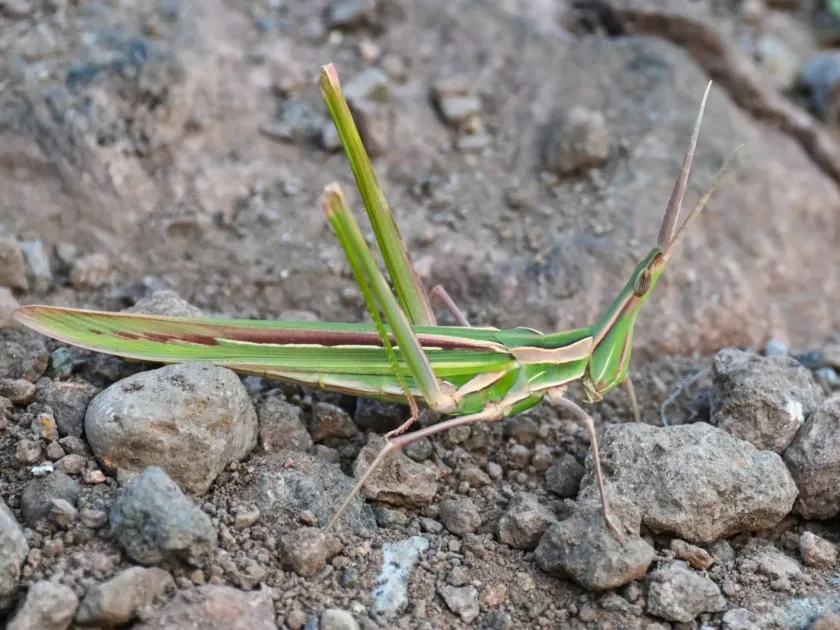
Truxalis nasuta belongs to the family Acrididae (short-horned grasshoppers), order Orthoptera. This species is easily recognizable by its elongated, conical head and long, sword-shaped antennae, which make it look like a dry blade of grass.
The coloration of the insect varies from bright green to brown or straw-yellow, providing excellent camouflage within vegetation. Females are significantly larger than males, reaching lengths of 60-80 mm, while males usually do not exceed 40-50 mm.
The structure of the hind legs allows the insect to perform sharp and long jumps. The unique head shape and specific wing venation are key morphological features that distinguish this species from other grasshoppers.
In their natural habitat, they lead a cryptic lifestyle, preferring areas with dense foliage or cereal crops. Adults have well-developed wings, which facilitates their dispersal over long distances.
The life cycle undergoes incomplete metamorphosis. After mating, the female lays eggs in the soil, forming an egg pod (ootheca) protected by special secretions that harden in the ground, ensuring the survival of the offspring during the winter.
What it damages
The primary damage is caused by nymphs and adults that feed on the vegetative mass of plants. The preferred food sources are members of the Poaceae (grass) family.
Under favorable conditions for reproduction, the pest can damage crops of wheat, barley, oats, and millet. It is also found on wild forage grasses that often grow adjacent to agricultural fields.
The chewing mouthparts allow the pest to completely consume leaf blades, leaving only coarse veins. At high densities, complete defoliation of plants is observed, leading to a sharp decrease in yield.
In addition to eating leaves, the pest damages reproductive organs such as ears and panicles, which directly affects grain quality and quantity. Mass infestations are particularly dangerous during drought periods.
Damage occurs mainly during the daytime when the insects are most active. Amid water scarcity, they exhibit increased appetite, which places additional stress on agricultural lands.
When it appears
The life cycle of the species is synchronized with the regional temperature regime. Nymphs begin to hatch in late spring or early summer, once the soil has warmed up sufficiently for egg incubation.
Peak adult activity occurs in the second half of summer, when the maximum population of mature individuals is observed. This period involves intensive feeding and subsequent reproduction.
The life cycle is univoltine (one generation per year). In autumn, following the onset of cold weather, adult individuals die, leaving behind egg pods that overwinter in the soil.
The rate of development is heavily dependent on weather conditions: hot and dry summers promote faster population maturation and increased pest pressure. In cooler seasons, the growth rate of nymphs slows down.
Monitoring for the pest is recommended in the first half of the summer, while nymphs are still in the pre-fledging stage, which allows for timely assessment of the threat to the crop.
Signs of infestation
The first sign of the pest's presence is the appearance of characteristic jagged edges on the leaves of cereal crops. Upon inspection, one may notice the insects themselves, which freeze when threatened, blending into the background of the plants.
A mass appearance of excrement on the leaf surface and on the soil under the plants indicates intensive colony feeding. Damaged areas often exhibit yellowing and premature drying of the foliage.
During visual inspections of fields early in the morning, adult individuals can be found on the tops of stems. The specific sound signals produced by males during the mating period can also serve as an indicator of the species' presence.
- Presence of holes through leaves
- Stripped plant stems
- Characteristic eating of ears/panicles
- Damage to central leaves during the tillering phase
- Observation of a large number of individuals while walking through the field
A sharp drop in crop productivity in specific areas of the field is often a consequence of localized population outbreaks.
Control measures
Agronomic control methods include deep autumn plowing, which destroys egg pods by bringing them to the surface, where they perish from frost or are eaten by birds.
Regular elimination of weeds on field margins and roadsides deprives the pest of reservoir and feeding sites. This is one of the most effective ways to suppress the population early in the season.
Chemical control involves the use of systemic and contact-stomach insecticides when the economic threshold is exceeded. Applications are most effective during the nymph hatching period.
Biological control agents, such as the use of entomopathogenic fungi or natural enemies (birds, insectivorous animals), can significantly reduce the pest population over the long term.
It is crucial to monitor crops during critical plant growth stages. Timely application of products at early stages allows for the preservation of the majority of the yield and prevents the pest's migration to adjacent areas.
Taxonomy
- Latin name
- Truxalis nasuta
- Order
- Orthoptera (locusts)
- Family
- Acrididae
- EPPO code
- TRUXNA
Discussion
No discussions yet — be the first.