
Acrida bicolor
Acrida bicolor
Description
How to identify
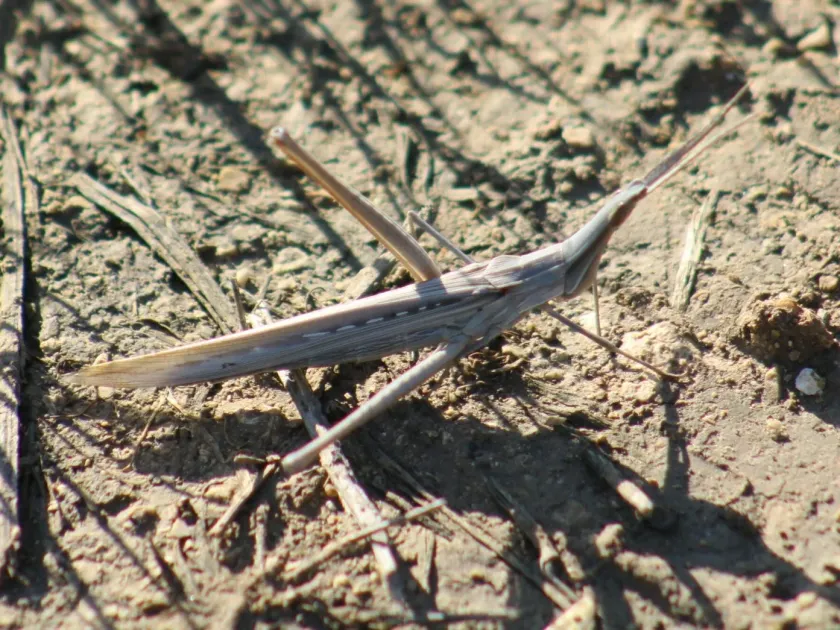
Acrida bicolor is a member of the order Orthoptera and the family Acrididae. This insect is characterized by an elongated body shape, which allows it to camouflage efficiently among grass stems and cereal crops.
The insect is distinguished by a conical head and long hind legs adapted for powerful jumping. Body coloration varies from green to brownish-yellow, providing excellent mimicry in thick vegetation.
Sexual dimorphism is evident in size, as females are significantly larger than males, which is typical for many species of the Acrididae family.
The chewing mouthparts allow the insect to effectively grind tough plant tissues during feeding.
Acrida bicolor prefers dry, open areas including meadows, pastures, and the edges of agricultural fields, where it finds optimal conditions for survival.
What it damages
Both adults and nymphs cause damage by actively feeding on the vegetative parts of various agricultural plants.
The primary damage is observed in cereal crops such as wheat, barley, and rye, where the insects consume leaves and stems.
In addition to cereals, this pest can damage forage grasses, pastures, and certain vegetable crops located near their breeding sites.
High population densities can lead to the complete destruction of leaf blades, leaving only the tough veins, which significantly reduces the plant's photosynthetic capacity.
Damaged plants show stunted growth, reduced grain quality, and increased susceptibility to secondary infections and other pests.
When it appears
The life cycle of Acrida bicolor is closely tied to temperature conditions, with one generation produced per year.
Eggs overwinter in the soil within protective capsules called egg pods, deposited a few centimeters below the surface.
Nymph hatching occurs in spring as the soil warms up, typically during the period from May to June.
The development of nymphs involves several molts throughout the summer months, coinciding with the active growth stage of most crops.
Adults emerge in the second half of the summer and remain active until the onset of the first significant autumn frosts.
Signs of infestation
The primary sign of the pest's presence is the occurrence of characteristically chewed leaf edges with clear markings from the insect's mandibles.
During daylight hours, a field inspection will often reveal the presence of insects jumping away rapidly as one approaches.
When population density is high, mass defoliation of stems can be observed, particularly on the edges of the fields adjacent to wild vegetation.
During morning and evening hours, one might hear the specific stridulation associated with the mating behavior of adults.
Patches of thinned vegetation, where feeding has been particularly intense, are frequently recorded in infested areas.
Control measures
Agrotechnical methods are crucial for controlling Acrida bicolor populations by disrupting their breeding environments.
Deep autumn plowing is the foundation of management, as it destroys egg pods and exposes eggs to unfavorable environmental factors.
Regular weeding and vegetation management on field margins, roadsides, and uncultivated land are necessary to prevent population buildup.
In cases of critical population spikes, chemical control using broad-spectrum insecticides is applied during the peak nymph hatching period.
The use of biological preparations based on fungal pathogens can effectively reduce population density without harming beneficial entomophages.
Taxonomy
- Latin name
- Acrida bicolor
- Order
- Orthoptera (locusts)
- Family
- Acrididae
- EPPO code
- ACRIBI
Discussion
No discussions yet — be the first.