
Truxalis
Truxalis
Description
How to identify
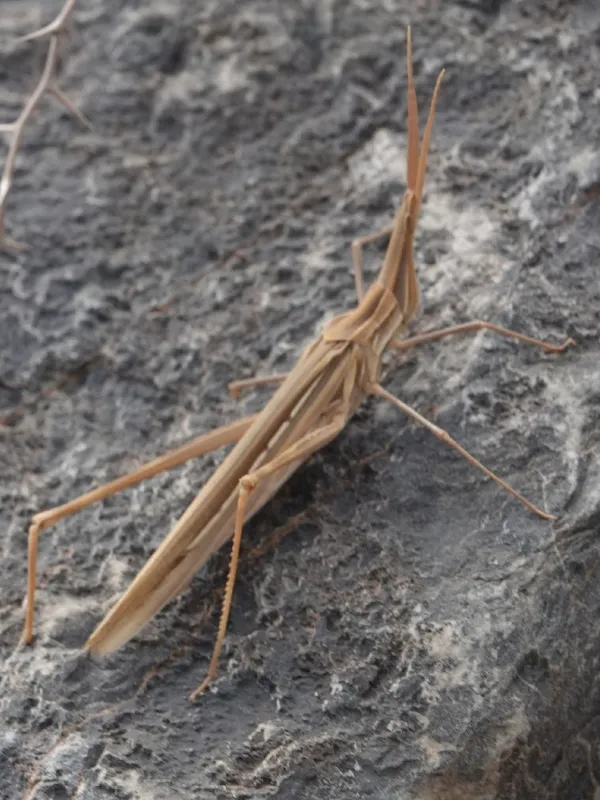
Truxalis is a genus of insects belonging to the family Acrididae, within the order Orthoptera. These insects are easily recognized by their elongated bodies and distinctly conical heads, which allow them to camouflage perfectly among stems of grasses and cereals.
The coloration of Truxalis species ranges from vibrant green to brownish-yellow, providing excellent concealment within the foliage. Some species exhibit brightly colored hind wings, which become visible primarily when the insect jumps or takes flight.
Females are typically larger than males, a common trait among many grasshopper species. Their powerful hind legs allow for rapid movement and effective escape mechanisms when threatened in their feeding grounds.
Taxonomically, they are closely related to other slant-faced grasshoppers. Their specialized morphology enables them to inhabit specific ecological niches, primarily in grasslands and agricultural areas with dense vegetation.
Correct identification requires examining the shape of the antennae and the pronotum. Understanding these morphological characteristics is essential for entomologists and agronomists to effectively monitor populations and manage potential outbreaks.
What it damages
Truxalis primarily feeds on various cereal crops, including wheat, barley, millet, and oats. In warmer climates, these pests can become numerous enough to cause significant economic damage to young crops.
Both nymphs and adults contribute to damage by feeding on leaf blades. They often consume the edges of leaves, leaving behind jagged patterns, or in severe cases, skeletonize the entire leaf down to the main veins.
Beyond cultivated crops, these insects frequently feed on wild grasses found on field margins, fallow lands, and irrigation ditches. During periods of high population density, they often migrate into cultivated fields.
Heavy feeding during critical growth stages, such as tillering or stem elongation, can stunt plant development. Weakened plants are more susceptible to secondary fungal infections and exhibit reduced tolerance to environmental stress.
Overall damage reduces the total photosynthetic area of the crop, directly impacting grain filling and final harvest yields. Monitoring these pests is crucial for preventing localized outbreaks from spreading across larger areas.
When it appears
The activity of Truxalis is heavily influenced by climatic factors, particularly temperature and moisture levels. In most regions, the life cycle begins in spring as the ground warms up, where eggs have successfully overwintered.
Peak damage generally occurs during mid-summer when nymphs reach later developmental stages and become increasingly voracious. This period is when adult populations are most active and mobile.
Hot and dry weather conditions are ideal for the reproduction and development of Truxalis. Such climates accelerate their life cycle, reducing the time between nymphal molts and allowing for faster population growth.
Activity gradually declines in late summer and autumn as individuals prepare for the reproductive phase and egg-laying in the soil. Overwintering occurs at the egg stage, which serves as a strategy for survival against cold winters.
Scouting should commence as soon as seedlings emerge. Early detection allows agronomists to assess population density and determine if intervention is necessary before thresholds of economic injury are exceeded.
Signs of infestation
The primary sign of a Truxalis infestation is the presence of irregular, notched feeding patterns along the margins of leaf blades. Unlike sap-sucking pests, these grasshoppers leave clear evidence of physical leaf consumption.
In the field, the most direct sign is the sudden movement of insects that jump away as one walks through the crop. Observing adult or nymphal grasshoppers in the foliage confirms their presence.
Large populations often lead to visible thinning of the crop stand and a yellowing effect on damaged leaf tips. These symptoms are easily spotted when inspecting the crop canopy from a short distance.
In calm, early morning or evening conditions, the distinct stridulation (chirping) of these insects may be audible. This acoustic sign can assist in locating infestations within dense crop rows.
Using sweep nets for sampling is a standard method for quantifying pest density per square meter. These data points are essential for deciding whether to implement chemical control measures based on local threshold guidelines.
Control measures
Effective management begins with sound agricultural practices, such as deep autumn plowing (tillage). This practice destroys egg masses located in the topsoil and disrupts the life cycle of the pest.
Sanitation of field borders and non-crop areas is critical to prevent colonization. Removing tall weeds and clearing irrigation ditches reduces the habitat available for the insects to multiply before migrating to fields.
If population numbers exceed the economic threshold, targeted application of contact-stomach insecticides may be required. Timing applications for early morning, when insects are less active, often increases treatment efficiency.
Biological control methods include encouraging natural predators, such as insectivorous birds and parasitic wasps. Maintaining hedgerows can support populations of these natural enemies, providing a layer of sustainable pest management.
Integrated Pest Management (IPM) is the most reliable approach. By combining cultural practices, regular field monitoring, and judicious insecticide use, farmers can protect their crops effectively while minimizing ecological impact.
Taxonomy
- Latin name
- Truxalis
- Order
- Orthoptera (locusts)
- Family
- Acrididae
- EPPO code
- TRUXSP
Discussion
No discussions yet — be the first.