
Troilus luridus
Troilus luridus
Description
How to identify
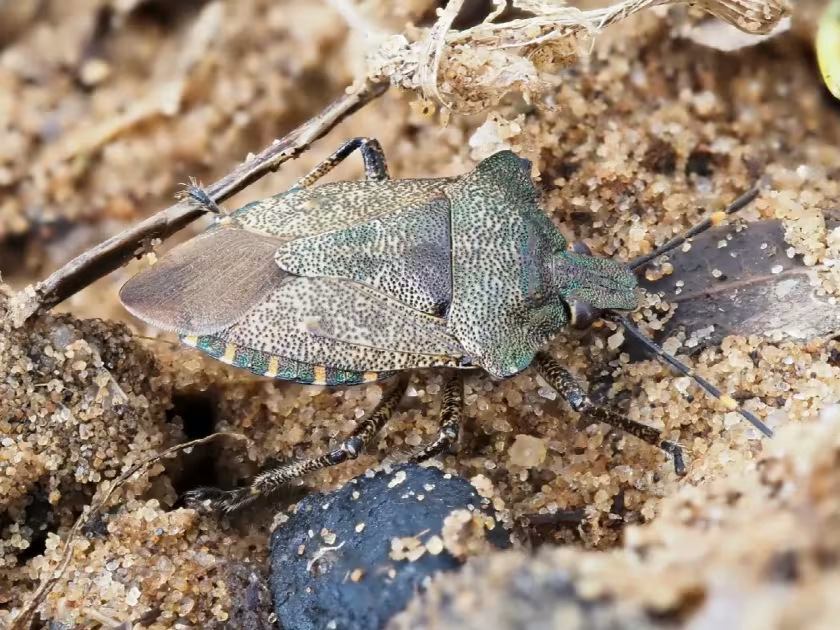
Troilus luridus is a large predatory stink bug belonging to the Pentatomidae family, order Hemiptera. Adults typically measure between 10 to 13 millimeters in length and exhibit a color range from yellowish-brown to olive-brown with a distinct metallic sheen.
A key identifying feature of this species is the sharp, pointed projections on the sides of the pronotum and a robust, thick proboscis, which is specially adapted for piercing the body walls of its prey. The scutellum is large and triangular, covering a significant portion of the abdomen, a common trait for the family.
The nymphs of Troilus luridus undergo several developmental stages, during which their coloration changes, becoming increasingly distinct. They are active hunters, moving across vegetation to locate their prey, making them observable during the active growing season.
Unlike many phytophagous species, this insect does not rely on bright warning colors, as it prefers to camouflage itself within the foliage of trees and shrubs. The shield-like body shape is a hallmark of this species, making it easier to distinguish from leaf-eating bugs during garden inspections.
It is crucial to distinguish this predatory bug from herbivorous stink bugs that damage crops. The primary diagnostic sign is the thickness of the rostrum (proboscis): predatory species have much sturdier mouthparts compared to those that feed exclusively on plant sap.
What it damages
Although Troilus luridus does not damage crops directly as it is a predator, it is included in agronomic guides due to its vital role in ecosystem management. It preys upon the larvae of many harmful insects that inhabit deciduous trees and ornamental shrubs.
Its prey spectrum includes various leaf beetles, butterfly caterpillars, sawfly larvae, and other insects that can cause significant damage to orchards and decorative plants. The predator actively hunts insects with soft-bodied cuticles.
The efficacy of Troilus luridus in reducing pest populations has been observed in its control of specific leaf beetle species. The predator injects saliva containing enzymes into the prey, liquefying internal tissues, which the bug then consumes.
In agricultural ecosystems, Troilus luridus is regarded as a valuable entomophagous insect. Its presence in a garden indicates a healthy ecosystem capable of natural pest suppression, reducing the need for intensive chemical applications.
Despite its utility, a sudden surge in the predator population can be an indirect sign of a high availability of prey, suggesting that an infestation of pests might be present nearby. Therefore, agronomists often use their presence as a bio-indicator for orchard health.
When it appears
The lifecycle of Troilus luridus is synchronized with seasonal temperature changes and prey availability. Adults hibernate during the winter, seeking shelter under leaf litter, in bark crevices, or other protected niches.
In spring, as temperatures remain consistently warm, the bugs emerge from their hibernation sites. Their activity period starts in May and extends through late summer, culminating in the generation that will prepare for the next winter cycle.
Females deposit eggs in small clusters on the undersides of leaves or tree bark. Each clutch typically contains several dozen barrel-shaped eggs, which are identifiable during careful monitoring of the orchard or garden canopy.
Nymphal development proceeds through several instars, during which they constantly require protein-rich food. During this time, the predator's activity is at its peak, as the young insects need fuel for rapid growth and metamorphosis.
By autumn, the number of active adults declines as they prepare for diapause. The complete developmental cycle of a single generation may vary based on local climatic conditions and the abundance of available prey species.
Signs of infestation
A common sign of Troilus luridus presence is the discovery of empty, dried-out shells of pest larvae or caterpillars. This is a clear indicator of the predator's work, as it leaves behind only the exoskeleton after extracting the internal fluids.
The bugs themselves are frequently encountered during visual monitoring of tree canopies, particularly on the underside of leaves. Adult bugs react quickly to vibrations or movement and may attempt to hide by crawling to the opposite side of a branch.
The presence of egg clusters on foliage is another vital diagnostic feature. The grouped egg masses of Troilus luridus are quite distinctive and recognizable, allowing for identification even in the early stages of their development.
Occasionally, one can observe the bug in the act of feeding, holding the prey with its rostrum. This provides direct evidence of the predatory function this insect performs in that specific part of the tree canopy.
The absence of severe leaf damage despite the presence of leaf-eating pests can indirectly indicate that Troilus luridus is effectively keeping the infestation under control. In such cases, the predator acts as a natural sanitation agent for the plants.
Control measures
As a beneficial predator, Troilus luridus should be protected rather than eradicated. A competent agronomist aims to create conditions that support its survival and attract it to agricultural plots and commercial orchards.
The primary method for maintaining its population is avoiding the use of broad-spectrum insecticides. These chemicals kill not only the target pests but also beneficial predators, which often leads to a resurgence of pest numbers later on.
It is recommended to maintain natural hedgerows, shrub strips, and patches of wild vegetation near cultivated fields. Such areas provide crucial refugia for Troilus luridus when the main prey population on crops is low.
If chemical pest control is necessary, it is advised to prioritize selective insecticides that target specific groups of pests while minimizing toxicity to predatory bugs.
Integrating biological pest management practices allows for an effective balance between agronomic techniques and natural population control. When managed correctly, Troilus luridus serves as a reliable ally for any producer in protecting their harvest.
Taxonomy
- Latin name
- Troilus luridus
- Order
- Hemiptera (bugs, aphids, leafhoppers)
- Family
- Pentatomidae
- EPPO code
- TOILLU
Discussion
No discussions yet — be the first.