
Smooth newt
Triturus vulgaris
Description
How to identify
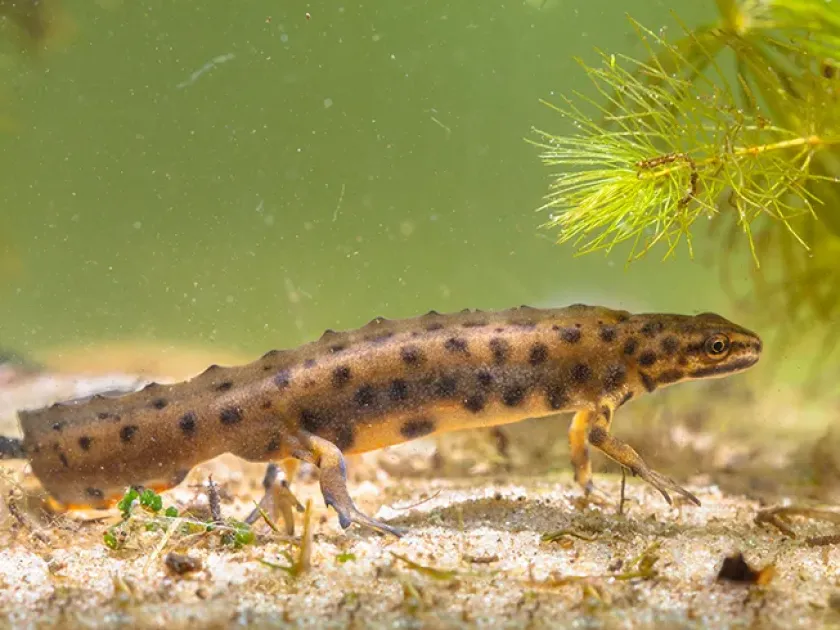
The smooth newt (Triturus vulgaris) is a small urodele amphibian belonging to the family Salamandridae. Adults typically reach lengths of 8 to 11 centimeters and possess a distinct, sleek body shape.
During the breeding season, males develop a prominent, wavy crest along their backs, making them easily distinguishable. Their skin color ranges from olive-brown to greyish, often decorated with dark spots, providing excellent camouflage.
The species relies on freshwater ponds for reproduction, where they lay their eggs on aquatic vegetation. After the breeding season, they transition to a terrestrial life, inhabiting moist forests, meadows, and gardens.
The smooth newt is a biological indicator of high environmental quality. Its presence usually signifies that the local ecosystem is stable and free from heavy synthetic chemical contamination.
In many jurisdictions, the species is protected by law due to declining populations in the wild. As a result, farmers are encouraged to preserve their natural habitats rather than eliminate them.
What it damages
The smooth newt is not an agricultural pest. There is no agronomic evidence to suggest that it causes any damage to crops, vegetables, or fruits. It lacks the anatomy and behavior associated with plant consumption.
Instead, these amphibians function as natural pest controllers. Their diet consists primarily of small invertebrates, including spiders, insect larvae, slugs, and snails, which can otherwise damage garden crops.
Any perceived damage attributed to newts is often a case of misidentification. Gardeners may mistakenly blame these amphibians for destruction actually caused by mollusks or insects that thrive in the same moist environments.
The only minor nuisance they may cause is entering containers used for water storage, which requires simple mechanical solutions rather than aggressive pest control measures.
Therefore, from an agronomic perspective, the smooth newt is a beneficial organism that contributes to maintaining a healthy balance in a garden ecosystem by preying on potential garden pests.
When it appears
The activity cycle of the smooth newt begins in early spring, as soon as water temperatures in ponds rise to a suitable level for spawning. This usually occurs between March and April depending on the climate.
During the summer months, adults lead a nocturnal terrestrial life. They remain hidden during the day in damp, shaded areas and emerge at dusk or after rainfall to hunt for food.
As temperatures drop in autumn, newts seek out frost-free sites for hibernation. These locations include deep burrows, piles of rotting wood, or stone crevices, where they enter a state of torpor.
They remain inactive throughout the winter season. Consequently, they do not interfere with agricultural or horticultural activities during the colder months of the year.
Their highest activity level on the surface of the land typically coincides with humid, wet conditions, making them most visible during the peak of the growing season when moisture levels are high.
Control measures
Since the smooth newt is not a pest and often enjoys protected status, there are no control measures recommended. The goal of integrated pest management is to protect and encourage these natural predators.
If newts are found in irrigation tanks, the simplest solution is to cover the openings with a fine-mesh net. This prevents them from falling into the containers without harming them.
Avoid the use of broad-spectrum pesticides, as these chemicals are highly toxic to amphibians and can disrupt the natural biological control agents already present in your garden.
Maintaining natural cover and moist zones in the periphery of your garden will satisfy the newts' habitat requirements, keeping them away from highly managed crop areas while they continue to hunt pests.
- Use mesh covers on water reservoirs.
- Eliminate the use of toxic pesticides.
- Preserve natural garden debris and logs as shelters.
Taxonomy
- Latin name
- Triturus vulgaris
- Family
- Salamandridae
- EPPO code
- TTURVU
Discussion
No discussions yet — be the first.