
Great crested newt
Triturus cristatus
Description
How to identify
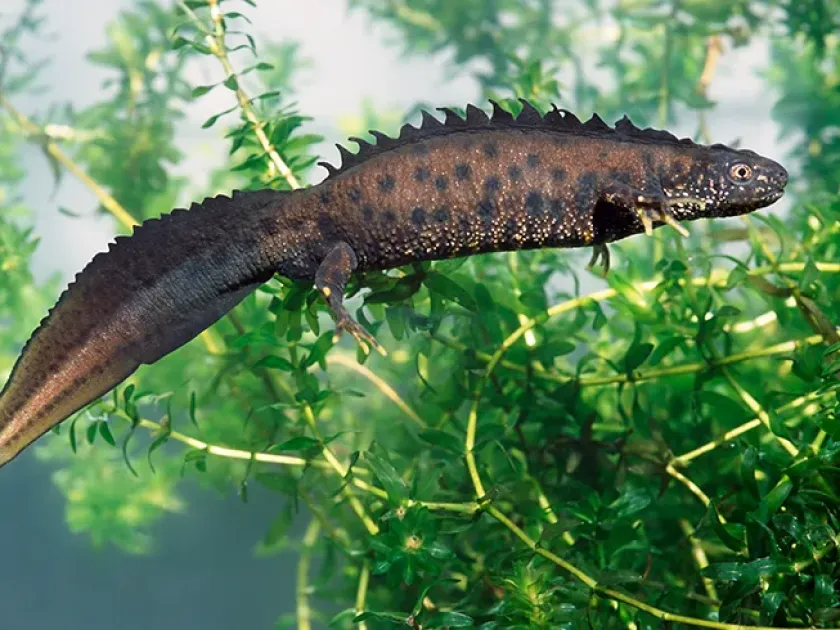
The great crested newt (Triturus cristatus) is a prominent species of the salamander family, known for its distinct physical appearance.
Adults typically grow up to 18 centimeters in length and possess a characteristic dark, warty skin texture.
Their dorsal coloration ranges from dark brown to charcoal black, often marked with small, darker spots across the body.
The underbelly is a striking yellow or orange, featuring a unique pattern of large black spots that acts like a fingerprint for each individual.
During the breeding season, males develop a prominent, jagged crest along the back that terminates near the tail base.
What it damages
It is crucial to note that the great crested newt is not a pest of agricultural crops and does not harm plants.
As a carnivorous amphibian, its diet consists exclusively of small invertebrates such as mosquito larvae, worms, and small insects.
They do not feed on plant tissues, roots, leaves, or vegetables, meaning they pose zero threat to garden yields or commercial farming.
They actually serve as beneficial predators, helping to manage populations of potentially harmful insect pests within the garden ecosystem.
The presence of these newts indicates a healthy, toxin-free environment, making them an asset rather than a liability to the land.
When it appears
The active life cycle of the great crested newt begins in early spring when water temperatures rise sufficiently.
They spend the spring and early summer in aquatic environments, which serve as essential breeding grounds for spawning.
Once the breeding period concludes in mid-summer, the adults transition to a terrestrial lifestyle, seeking out damp and shaded habitats.
As autumn approaches, they migrate toward hibernation sites, hiding beneath log piles, stone crevices, or deep within the soil.
They remain in a state of hibernation throughout the winter months, emerging only when the warmth of spring triggers the cycle again.
Signs of infestation
You can identify their presence by the existence of clean, undisturbed ponds or drainage ditches featuring natural aquatic vegetation.
Sightings usually occur during the evening or immediately after rainfall when the amphibians emerge to hunt for prey on damp ground.
Finding aquatic larvae with visible external gills is a definitive sign of an active, breeding population of newts in your vicinity.
The absence of these amphibians in suitable habitats often acts as a bio-indicator for the use of heavy pesticides or excessive water pollution.
Since they do not consume plants, there are no characteristic damage patterns or physical signs of feeding on crops to be found.
Control measures
Since the great crested newt is a beneficial species and not a crop pest, no control measures are necessary or recommended.
This species is protected under strict environmental laws in many regions, reflecting its importance to the health of the ecosystem.
Gardeners are encouraged to preserve their habitats, such as ponds or wet woodland areas, to help maintain regional biodiversity.
The application of chemical pesticides to eradicate these animals is harmful, illegal in many areas, and counterproductive to soil health.
Embracing these amphibians as part of your garden's biological pest control strategy is the most sustainable approach to modern agriculture.
Taxonomy
- Latin name
- Triturus cristatus
- Family
- Salamandridae
- EPPO code
- TTURCR
Discussion
No discussions yet — be the first.