
Eastern newt
Notophthalmus viridescens
Description
How to identify
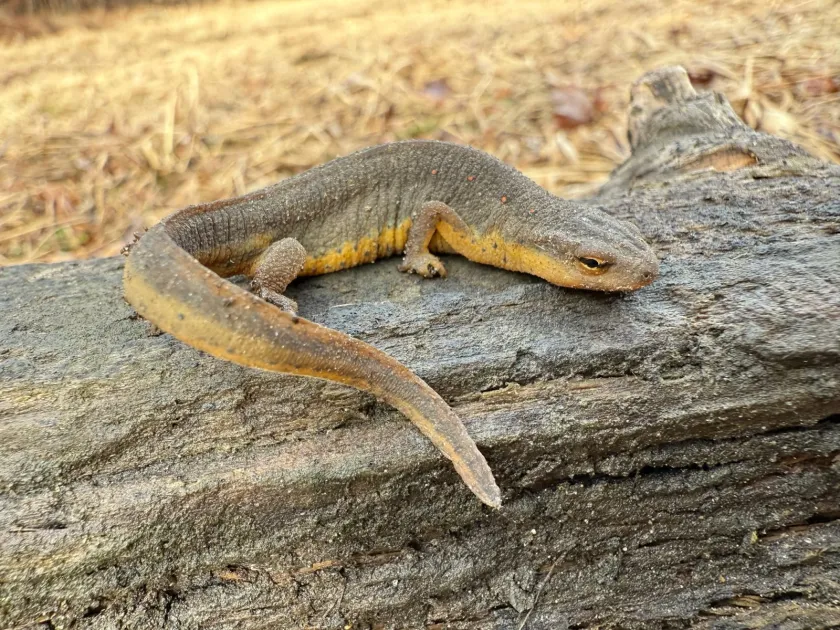
The Eastern newt (Notophthalmus viridescens) is a member of the Salamandridae family. It is a semi-aquatic amphibian known for its complex life cycle, which includes three distinct stages: aquatic larva, terrestrial juvenile (eft), and aquatic adult.
Adults typically measure 7 to 12 cm in length and possess an olive-green dorsal coloration with a series of small, black-bordered red spots along their sides, making them easily identifiable.
The terrestrial juvenile stage, known as the "eft," is characterized by bright orange or reddish skin. This coloration serves as an aposematic signal, warning potential predators of the skin's toxic secretions.
These amphibians inhabit moist environments such as forest floors, wetlands, and areas with dense vegetation, which are essential for maintaining the hydration of their sensitive skin.
Biologically, the Eastern newt is a carnivore. Its morphology is evolved to hunt small invertebrates, such as worms, insects, and mollusks, rather than to feed on plant tissues or agricultural crops.
What it damages
The Eastern newt is not a crop pest. There is no evidence in agricultural literature to suggest that this species causes damage to crops, vegetables, or fruits, as it lacks the physiological capability to consume plant matter.
On the contrary, the presence of newts is generally considered beneficial. As predators of small invertebrates, they help regulate populations of slugs and soil-dwelling pests within the farm ecosystem.
Any perceived damage to seedlings is likely caused by actual agricultural pests like cutworms, wireworms, or rodents that share the same moist habitats rather than by the newts themselves.
The economic impact of the Eastern newt on agriculture is non-existent. Farmers are advised not to view this amphibian as a threat, as it does not compete for resources with cultivated crops.
Encouraging or maintaining a population of newts on the farm borders can contribute to integrated pest management by naturally reducing the density of harmful insect populations.
When it appears
Activity patterns of the Eastern newt are strictly regulated by ambient temperature and soil moisture levels. They are most active during the warmer months, especially following rainfall.
During prolonged dry spells or periods of drought, newts retreat into underground burrows, rotting logs, or thick ground cover to survive by conserving moisture, rendering them invisible to farmers.
Seasonal migrations between terrestrial habitats and breeding ponds occur in spring, which may occasionally result in individuals crossing agricultural land while traveling.
In winter, newts enter a period of hibernation, burying themselves in soil or hiding in sheltered locations to escape freezing temperatures, thereby removing any chance of interaction with agricultural operations.
Since they are nocturnal, these amphibians are rarely encountered during peak farming hours, further emphasizing that they have no practical interaction with standard horticultural activities.
Signs of infestation
Signs of presence are limited to visual observations of the animals themselves in sheltered, humid areas like compost heaps, damp woodpiles, or shaded irrigation channels.
There are no specific signs of "infestation" or crop damage associated with newts, as they do not feed on plant foliage, roots, or stems, making diagnostic surveys for these signs impossible.
The presence of newts can serve as an indicator of high soil moisture, which might require management to prevent fungal growth, though the amphibians themselves are not the cause of the disease.
The absence of biting marks, tunnels, or necrotic spots on plants is a clear indication that no pest activity from these animals is occurring on the farm.
Because they do not cause any harm, there is no diagnostic threshold or management requirement for the Eastern newt in any agricultural system.
Control measures
No control measures are recommended for the Eastern newt. Using pesticides or other eradication efforts is unnecessary and counterproductive, as it disrupts local biodiversity and beneficial predator-prey relationships.
If their presence is undesirable in enclosed greenhouse environments, the most effective approach is to manage moisture levels by improving drainage and ventilation rather than targeting the animals.
Physical barriers such as fine mesh screens over drains and ventilation gaps are sufficient to exclude amphibians from production areas without the need for toxic substances.
Farmers are encouraged to protect natural habitats around their fields, as newts provide valuable ecological services by controlling insects that would otherwise require chemical intervention.
If an individual newt is found within a sensitive work area, it should be manually removed and relocated to a nearby wooded or aquatic habitat where it can continue its natural life cycle unharmed.
Taxonomy
- Latin name
- Notophthalmus viridescens
- Family
- Salamandridae
- EPPO code
- NOTPVI
Discussion
No discussions yet — be the first.