
Newt
Triturus
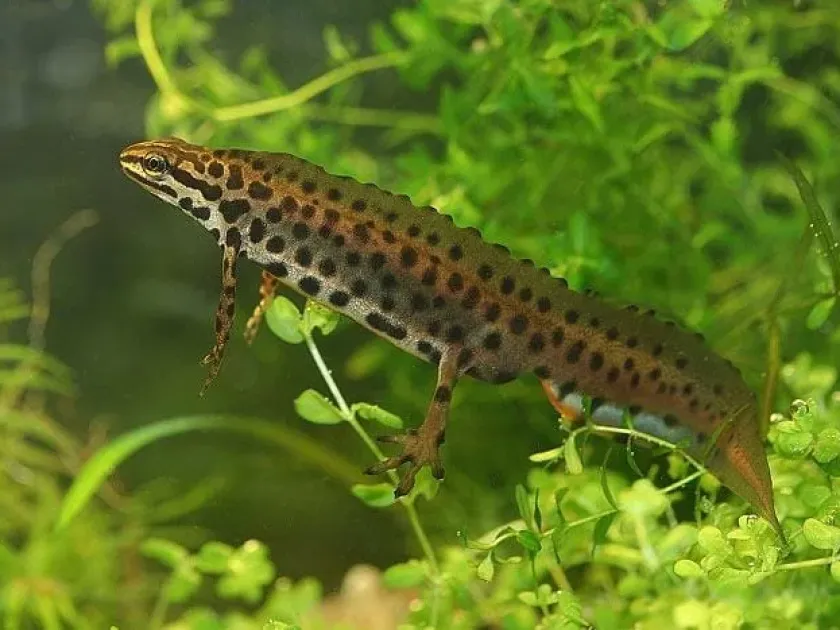
Description
How to identify
Newts (genus Triturus) belong to the order Caudata (salamanders and newts). They are amphibians with an elongated body, a tail, and distinct legs, often mistaken for pests due to their mysterious behavior.
In terms of systematic classification, they are vertebrates, specifically amphibians. They are entirely unrelated to insects, mollusks, or other common agricultural pests that damage plants.
They possess a moist, glandular skin that makes them highly susceptible to environmental changes, meaning they thrive only in stable, healthy, and pesticide-free ecosystems.
Their life cycle typically involves a transition between aquatic environments for breeding and terrestrial environments for hunting and overwintering.
Recognizing them is simple: they are small, slender animals, often found in damp, dark corners or near water sources, behaving cautiously and moving slowly.
What it damages
Newts cause absolutely no damage to agricultural crops. They are obligate carnivores that feed exclusively on small invertebrates, such as insects, worms, and slugs.
There is no mechanism in their biology that allows them to consume plant matter. They do not possess chewing mouthparts suitable for feeding on foliage, roots, or fruit.
Labeling a newt as a "pest" is scientifically inaccurate. They do not feed on crops, nor do they physically damage plants through movement or habitation.
On the contrary, they act as natural predators of many garden pests, providing a form of biological pest control that is highly beneficial for organic farming.
Because they do not cause yield reduction or plant stress, there is no agronomic rationale for managing them as a threat to cultivation.
When it appears
Newt activity is highly seasonal, dictated by ambient temperature and moisture levels. They emerge from hibernation in early spring when the air and water begin to warm.
During the spring breeding season, they migrate to water bodies to lay eggs and complete the aquatic phase of their life cycle.
As summer progresses, they move onto land, shifting their habitat to humid, shaded areas under leaf litter, garden debris, or damp stone piles.
Autumn triggers the search for suitable overwintering sites. They require protected areas that remain frost-free, such as deep soil crevices or sheltered underground burrows.
Throughout the winter, they remain in a state of brumation, a low-energy metabolic state, waiting for the return of spring conditions.
Signs of infestation
Visual sighting is the only "sign" of a newt. You will not find chewed leaves, stem girdling, or root damage that is characteristic of real agricultural pests.
If you encounter a newt, it is a positive environmental indicator. It suggests that your garden water sources are clean and that your soil is free from harmful chemical contaminants.
There are no symptoms of infection or infestation because these amphibians do not carry plant pathogens and are not herbivorous.
Any perceived "trouble" from newts is usually a matter of human discomfort rather than any actual damage to agricultural production or plant health.
Monitoring their presence can actually provide insights into the overall biodiversity of your garden ecosystem and the effectiveness of your ecological practices.
Control measures
Newts do not require control measures as they are not pests. In fact, many species of Triturus are protected by regional and national wildlife conservation laws.
If their presence is undesirable in specific areas, such as near house foundations, simply removing their habitat — such as clearing wood piles or improving drainage — will naturally encourage them to move elsewhere.
The most effective strategy is to encourage them as allies in the garden. They help maintain balance by consuming various garden pests that would otherwise damage your plants.
Avoiding synthetic chemical pesticides is the best way to maintain the health of your garden, which incidentally also protects the amphibians that help you manage insect populations.
- Maintain tidy garden boundaries to prevent amphibians from congregating near active crop zones.
Taxonomy
- Latin name
- Triturus
- Family
- Salamandridae
- EPPO code
- TTURSP
Discussion
No discussions yet — be the first.