
Fire salamander
Salamandra salamandra
Description
How to identify
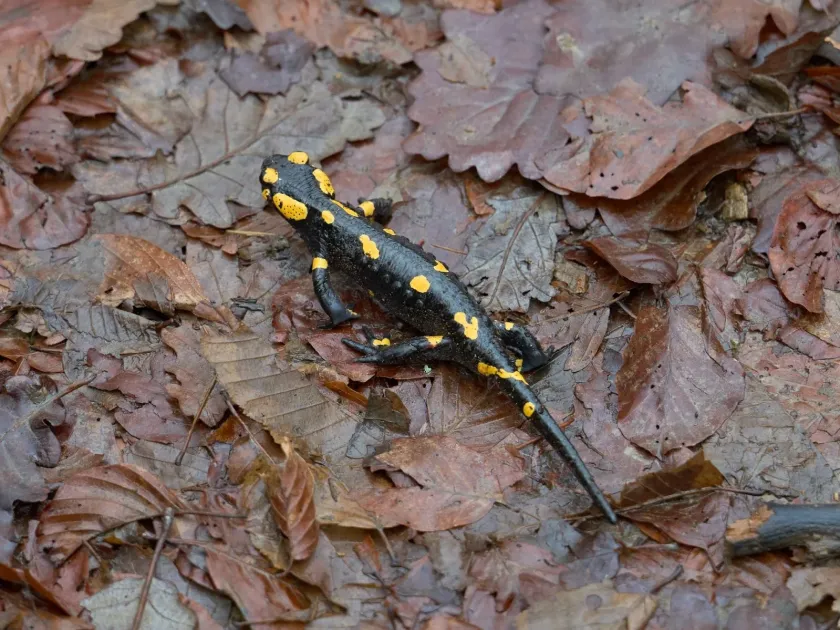
The fire salamander (Salamandra salamandra) belongs to the order Caudata and the family Salamandridae. It is a striking amphibian known for its black body with vivid yellow or orange spots.
These animals possess specialized skin glands that secrete toxins as a defense mechanism against predators. They are strictly terrestrial as adults but require water bodies for reproduction.
Biologically, the fire salamander is a predator. It spends most of its time in damp forest litter, under logs, or in burrows, emerging primarily at night to hunt.
Its lifecycle includes the birth of live larvae that develop in aquatic habitats. After metamorphosis, they transition to a life on land, becoming part of the forest floor ecosystem.
The fire salamander is a protected species in many regions and plays a crucial role in maintaining the balance of healthy forest and garden environments.
What it damages
The fire salamander is not an agricultural pest. It does not feed on vegetation, roots, leaves, or fruits of any agricultural crops.
There is no evidence of the species causing economic damage to farmers or home gardeners. Its biological requirements make it entirely disinterested in crops.
The animal is a beneficial predator that feeds on slugs, snails, earthworms, and various small insects, which are often considered pests in agricultural fields.
It does not construct tunnels that damage plant roots, nor does it carry pathogens that would threaten plant health in a commercial or domestic greenhouse.
In conclusion, the species has zero impact on crop yield, and classifying it as a pest is scientifically incorrect and contrary to ecological observation.
Control measures
No control methods exist or are recommended for the fire salamander because it is a protected, beneficial animal that does not harm plants.
Efforts should focus on habitat conservation rather than control, as these amphibians serve as natural pest controllers in the garden environment.
Farmers are encouraged to avoid the use of harsh chemicals, as these are toxic to amphibians and can disrupt the natural biological control they provide.
There is no regulatory framework or agronomic guideline for "protection against" the fire salamander, as it is a natural ally of the gardener.
Education is the best approach to ensure that farmers recognize the fire salamander as a harmless and beneficial part of the ecosystem, not as a target for eradication.
Taxonomy
- Latin name
- Salamandra salamandra
- Family
- Salamandridae
- EPPO code
- SALASA
Discussion
No discussions yet — be the first.