
Triops longicaudatus
Triops longicaudatus
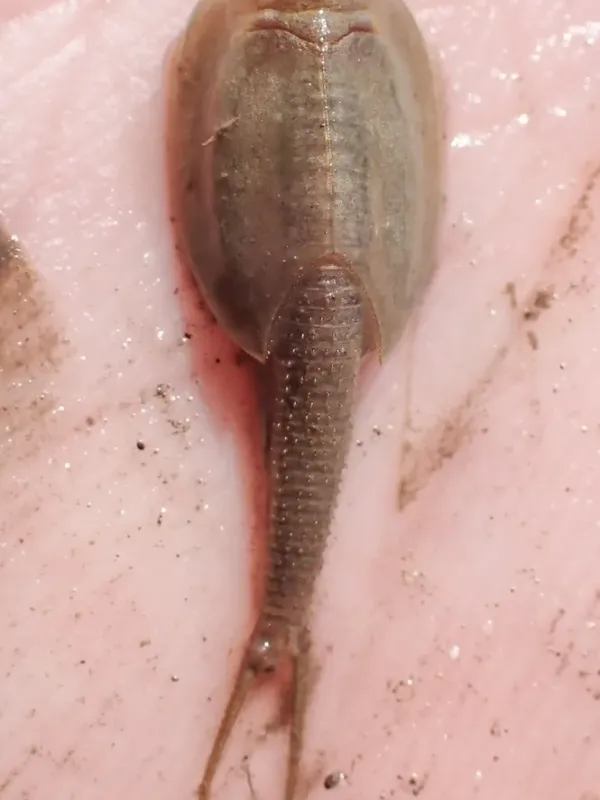
Description
How to identify
Triops longicaudatus, commonly known as the tadpole shrimp, is a crustacean belonging to the order Notostraca and the family Triopsidae. It possesses a prehistoric appearance, featuring a large, shield-like carapace covering the anterior part of its body and a long, forked tail.
Adult individuals typically grow to lengths of 5 to 10 centimeters. They utilize numerous pairs of appendages not only for locomotion but also for respiration and gathering food within the water column.
Their color ranges from grayish-brown to olive, providing excellent camouflage against the muddy bottoms of rice paddies and flooded agricultural fields.
The biology of this species is remarkable due to its ability to enter diapause. Their eggs, or cysts, can withstand long periods of desiccation and extreme temperature fluctuations for many years.
When fields are flooded, these cysts hatch into nauplii, which rapidly molt into sexually mature adults within just a few weeks, allowing for quick population spikes.
What it damages
Tadpole shrimp are opportunistic feeders that consume organic matter, detritus, and, significantly, the tender young shoots of agricultural crops like rice.
The most severe damage occurs during the seedling stage of rice, just as the plants are establishing their roots in the flooded soil of the paddies.
As they forage, they actively burrow through the sediment, creating high turbidity in the water which interferes with the photosynthesis of emerging rice plants.
By grazing on the soil surface, they often uproot or sever the roots and stems of young seedlings, leading to high mortality rates in the crop.
Mass infestations can decimate large sections of a rice field, causing significant yield losses, especially in scenarios where flooding occurs early in the growing season.
When it appears
The period of peak activity for Triops longicaudatus is synchronized with the irrigation season and the initial flooding of rice paddies.
Nauplii emerge within days of field submersion, as the presence of water acts as the primary trigger for the hatching of dormant cysts.
The species completes its entire life cycle very rapidly, meaning multiple generations can occur within a single cropping season if water levels remain constant.
Water temperature is the most critical environmental factor; growth is optimal in warm conditions, typically ranging from 20 to 30 degrees Celsius.
As the season ends or fields are drained, the shrimp population declines, and newly laid eggs enter the soil to survive the dry dormant phase.
Signs of infestation
The most prominent sign of a tadpole shrimp infestation is persistent water turbidity in the paddies that does not clear over several days.
Floating plant fragments or shredded rice seedlings are often observed at the water surface as evidence of the shrimp's destructive feeding behavior.
Direct observation is possible, as these crustaceans can be seen swimming near the surface or scuttling along the bottom of the field.
A major symptom of damage is thinning or patchy rice stands, where young seedlings have been cut at the base and have subsequently floated to the surface.
Careful inspection of the substrate reveals numerous pits and furrows, indicating active digging and foraging by the tadpole shrimp population.
Control measures
Effective agronomic management includes drying out the fields before planting to promote the desiccation and death of the dormant egg bank in the soil.
Maintaining proper field leveling helps prevent stagnant water pockets where the shrimp can thrive and reproduce undisturbed.
If population levels exceed economic thresholds, growers may apply authorized insecticides specifically labeled for use in flooded rice cultivation.
Biological control methods include encouraging natural predators, such as specific fish species that inhabit rice paddies and feed on crustaceans.
- Drain fields briefly to disrupt the life cycle of the shrimp.
- Ensure rapid and uniform water warming to encourage fast crop establishment.
- Monitor field conditions immediately after flooding for early detection.
- Use appropriate seed treatments to enhance seedling vigor against herbivory.
Taxonomy
- Latin name
- Triops longicaudatus
- Family
- Triopidae
- EPPO code
- TRPSLO
Discussion
No discussions yet — be the first.