
Tadpole shrimp
Triops granarius
Description
How to identify
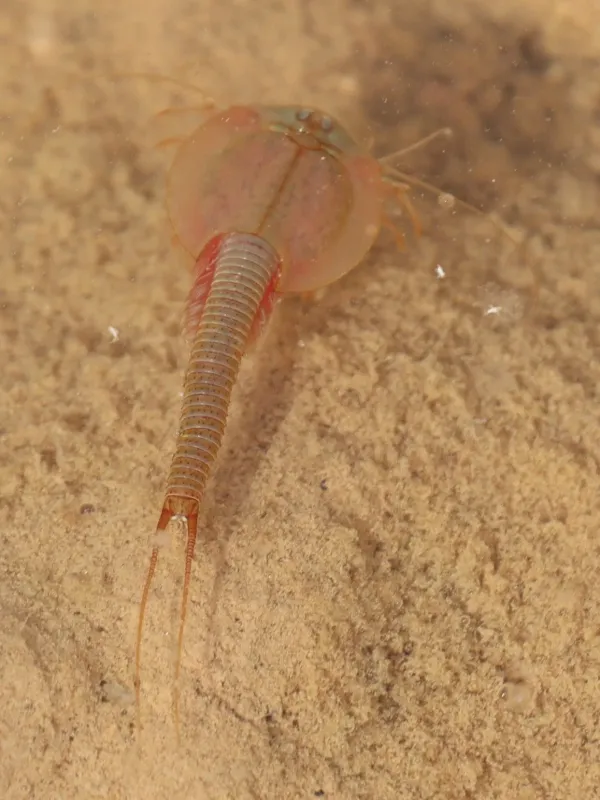
The tadpole shrimp is a primitive freshwater crustacean belonging to the order Notostraca, family Triopsidae. Physically, it resembles a small trilobite, featuring a large, broad dorsal shield.
Adult specimens typically range from 3 to 10 centimeters in length. Their coloration varies from grayish-brown to olive, providing effective camouflage against the muddy bottoms of their aquatic habitats.
A key biological feature is the presence of numerous pairs of appendages, which are utilized for both locomotion and filtering organic particles from the water column.
Reproduction occurs primarily in stagnant or slow-moving waters, where the eggs (cysts) can remain viable in dry soil for years, waiting for the return of favorable conditions.
The life cycle is remarkably rapid: once rice paddies are flooded, the cysts hatch quickly, and larvae can reach sexual maturity within two to three weeks.
What it damages
The tadpole shrimp poses a significant threat to rice cultivation, particularly during the initial growth stages. The pests inhabit the flooded rice paddies directly.
Larvae and adults cause the most damage during the seed germination and seedling emergence phase. They actively plow through the submerged sediment in search of food.
During their activity, they sever the roots and stems of young rice plants, which frequently results in total crop loss or severe growth suppression in the affected area.
Their movement causes intense turbidity in the water of the paddies. This significantly limits solar penetration, which is vital for the development of healthy rice seedlings.
- Damage to the root system of rice seedlings.
- Upending and uprooting young rice plants from the substrate.
- Increased water turbidity hindering essential photosynthesis.
Signs of infestation
A primary indicator of infestation is the visible presence of these crustaceans swimming near the surface or burrowing into the sediment.
Visually, infested fields display irregular patches of thin or missing stands, where seeds have been dislodged from the soil by the shrimp's burrowing activities.
The paddy water appears milky or turbid because the crustaceans continuously stir up the bottom sediments, creating a distinct visual difference from clean fields.
Floating remnants of damaged seedlings, severed from their roots, can often be observed on the water surface in areas with high pest density.
Using a net or a clear container to inspect the bottom of the paddy allows for the immediate identification of the active crustaceans moving through the water.
Control measures
The primary management strategy is agronomic control, focused on creating unfavorable conditions for the hatching of larvae from the cysts in the soil.
Draining the water from the fields shortly after the initial flooding is an effective measure, as it leads to the desiccation and death of newly hatched larvae.
Chemical control with specific insecticides is possible, though applications must be carefully regulated to prevent negative impacts on the local aquatic ecosystem.
It is recommended to adhere to optimal planting schedules and maintain consistent water levels that promote rapid rice growth, allowing plants to strengthen before mass hatching occurs.
Proper field leveling during soil preparation is essential to eliminate standing water pockets where the shrimp tend to proliferate most intensively.
Taxonomy
- Latin name
- Triops granarius
- Family
- Triopidae
- EPPO code
- TRPSGR
Discussion
No discussions yet — be the first.