
Trilophidia
Trilophidia repleta
Description
How to identify
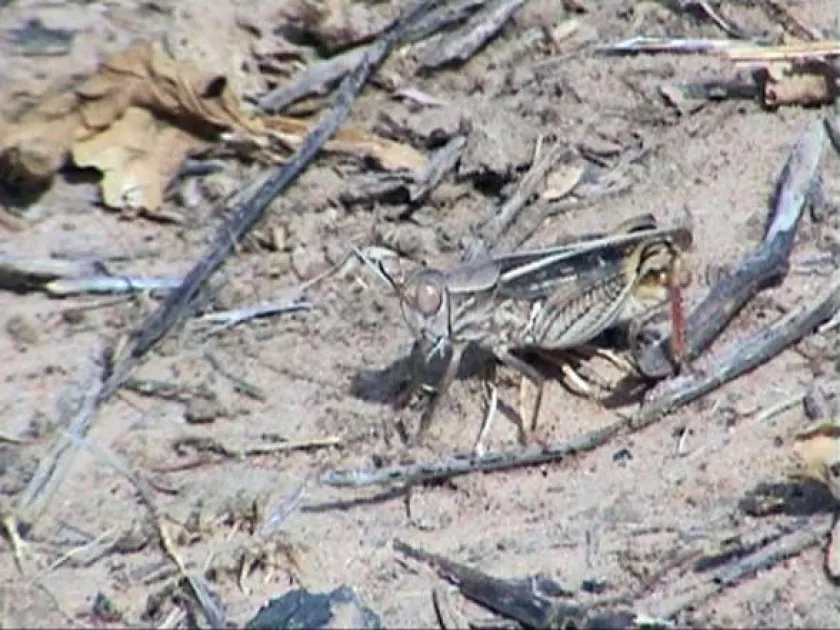
Trilophidia (Trilophidia repleta) belongs to the order Orthoptera and the family Acrididae. This insect has characteristic camouflage coloration, allowing it to blend in with dry soil and plant debris, which significantly complicates the detection of the pest in the early stages of field infestation.
Adult individuals possess developed wings that allow them to fly long distances in search of food sources. The body has a robust structure, and the hind legs are adapted for jumping, which is a typical species-specific trait for representatives of this family.
The life cycle includes incomplete metamorphosis: nymphs visually resemble adults but have smaller sizes and underdeveloped wings. The maturation process involves several molts, accompanied by a gradual increase in body size and the development of the reproductive system.
Females lay eggs in the soil layer, forming egg pods that protect the offspring from unfavorable weather conditions. Optimal conditions for the reproduction of this species are moderately humid and warm regions with a distinct growing season.
Identification of the species requires careful examination of the morphological features of the pronotum and wing venation, as visually the pest can be similar to other grasshopper species inhabiting the agroecosystem.
What it damages
The primary damage occurs during mass outbreaks of the population when insects begin to feed actively on the green parts of crops. Primarily at risk are cereal crops, including rice, wheat, and millet, on which the pest can concentrate.
Leaves, stems, and reproductive organs of plants are damaged, leading to a significant reduction in the assimilation surface area. The consumption of leaf blades weakens the general condition of the crop, preventing normal development of ears and panicles.
In cases of high infestation density, complete defoliation of the crops is possible, which leads to critical yield losses. Damaged tissues become entry points for secondary infections, including fungal and bacterial diseases, further stressing the plant.
The pest is not limited to cultivated cereals and is capable of feeding on weeds in fields and border areas. This contributes to the preservation of the pest population even in the absence of the main crop, creating a base for re-infestation in subsequent years.
The economic significance of the species is determined by its ability to move from wild plants to cultivated crops, creating hotspots of damage that can spread rapidly across the entire agricultural area.
When it appears
The pest's activity is directly dependent on temperature and rainfall during the spring and summer periods. The peak of abundance often occurs in the second half of summer when weather conditions become most favorable for the development of several insect generations.
Overwintering of the species occurs primarily in the egg stage, located in the soil at a depth of several centimeters. In spring, when the soil warms to certain temperature thresholds, nymph emergence begins, and they start active feeding on the vegetative parts of plants.
The flight of adults is spread over time, which requires regular monitoring of crops throughout the growing season. Favorable weather with moderate rains promotes nymph survival, leading to a sharp spike in pest abundance in the middle of the season.
Towards the end of the season, the pest concentrates on plots with late crops, consuming the remaining green biomass before unfavorable conditions arrive. During this same period, mating and egg-laying in the soil occur to ensure the survival of the next generation.
Monitoring seasonal dynamics allows for the forecasting of potential outbreaks and timely decision-making regarding the need for protective measures in specific areas.
Signs of infestation
The first sign of the pest's presence is the existence of characteristic gnawing on the edges of cereal leaves. Unlike caterpillars, grasshoppers leave jagged edges and often completely skeletonize the leaf blade, leaving only the central vein.
A mass appearance of jumping individuals is observed when machinery or people pass through the field. This is a clear indicator that the pest population has reached threshold levels and requires the attention of the agronomic service.
In areas where insects congregate, their excrement can be found, which accumulates on the soil surface or in leaf axils. The presence of a large number of young nymphs in the root zone also indicates the beginning of an active reproduction process.
When inspecting plants in the morning, the insects themselves can be noticed resting on stems, as their activity is closely linked to ambient temperature. Damage is often localized in spots, gradually expanding from the edges of the field toward the center.
Reduced plant productivity and changes in their appearance (growth stunting, wilting of damaged areas) confirm the negative impact of the pest's activity on the crop's physiological processes.
Control measures
The basis of population control is the agrotechnical method, which includes deep autumn plowing. This measure contributes to the destruction of egg pods and the death of eggs due to unfavorable conditions, which significantly reduces the starting population size in spring.
An effective technique is the destruction of weeds along the edges of fields and borders, where the pest often finds temporary shelter and a food base. Clean fields are less attractive for grasshopper colonization.
When economic damage thresholds (EDTs) are exceeded, the use of chemical plant protection products is advisable. Insecticides with contact and systemic action allow for the rapid containment of hotspots and prevent mass migration of the pest.
The biological method of control using entomopathogenic fungi or bacterial preparations shows good results in integrated pest management systems, reducing the pesticide load on the agroecosystem.
Systematic monitoring of fields using traps and counting insect populations on sample plots is a key element of the control strategy, allowing for timely responses to changing situations and minimizing yield losses.
Taxonomy
- Latin name
- Trilophidia repleta
- Order
- Orthoptera (locusts)
- Family
- Acrididae
- EPPO code
- TRLPRP
Discussion
No discussions yet — be the first.