
Australian spider beetle
Trigonogenius globulus
Description
How to identify
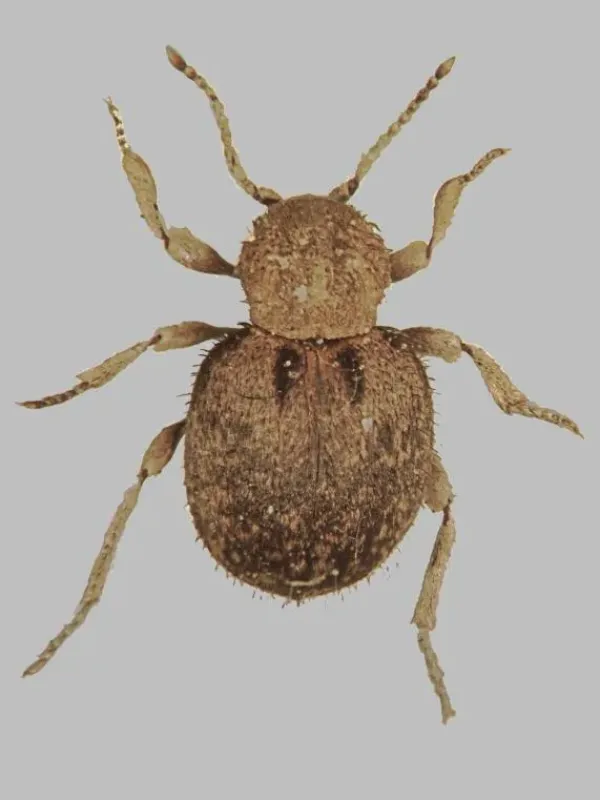
The Australian spider beetle, Trigonogenius globulus, is a small insect belonging to the family Ptinidae, order Coleoptera. Adult beetles are characterized by a distinct globular, spider-like body shape, typically measuring between 2 to 3 mm in length.
The body coloration ranges from dark reddish-brown to almost black, and the entire surface is covered with fine, dense hairs. The head is partially tucked beneath the pronotum, making the insect appear quite compact and rounded.
The larvae of this species are typical of the Ptinidae family, appearing as C-shaped, whitish grubs with a well-developed head capsule and three pairs of thoracic legs. They go through several larval instars, increasing in size as they feed.
A unique biological trait of this species is its ability to "play dead" when disturbed, tucking its legs tightly against the body. This defensive mechanism helps them remain unnoticed in the cracks and crevices of storage facilities.
As a cosmopolitan species, the Australian spider beetle can thrive in various indoor environments, provided there is a stable supply of food and suitable temperature conditions for continuous development.
What it damages
This pest primarily infests a wide range of stored products, including both plant and animal-based materials. Common targets include various grain crops, flour, cereals, dried fruits, and processed seed products.
Trigonogenius globulus is frequently found in areas with long-term accumulations of organic debris, dust containing grain remnants, and dry pet food. It is a common nuisance in warehouses, silos, and even residential pantries.
Unlike many other stored product pests, this beetle exhibits high dietary plasticity, allowing it to survive for extended periods on limited or low-quality food sources.
Both adults and larvae cause significant damage; larvae burrow into grains or other hard substrates, leaving behind tunnels filled with frass, larval skins, and debris, which degrades the overall quality of the product.
Severe infestations lead to substantial losses, as the contaminated material becomes unfit for human consumption or further industrial processing due to the presence of waste products and potential pathogens.
When it appears
While rarely found in outdoor environments, the Australian spider beetle remains active year-round in heated warehouses, granaries, and residential buildings. Breeding activity typically begins when temperatures exceed +15 degrees Celsius.
Optimal conditions for rapid larval development occur from spring to autumn, corresponding with rising temperatures inside storage structures. In climate-controlled granaries, the life cycle can continue uninterrupted throughout the winter.
The appearance of adults often peaks during the warmer months, as increased indoor humidity promotes the growth of mold and fungi, which can also serve as a secondary food source for the larvae.
In closed, heated facilities, there is no distinct seasonality, as the species can complete multiple overlapping generations per year under a stable microclimate.
Monitoring population levels should be a continuous process, regardless of the calendar season, particularly in areas where residues of products are kept in crevices that are difficult to sanitize.
Signs of infestation
The primary sign of an infestation is the presence of small, circular holes in the stored product, created by larvae as they feed and move. Accumulations of fine powdery dust (frass) are also common indicators.
Visually, the insects can be spotted by carefully inspecting the surfaces of bags or containers, especially during the evening hours or in environments with specific humidity levels where they emerge to wander.
- Presence of a distinct musty or moldy odor in the storage area.
- Cobwebs and dust clumps accumulating in corners or structural joints.
- Clustering of adult beetles near dim light sources during the night.
When opening damaged packaging, one may find the larvae hidden within the seeds or grain kernels, where they often remain shielded from view for extended periods.
Special attention should be paid to legacy stocks or rarely moved goods, as these often serve as the primary reservoirs for infestations that eventually spread throughout the warehouse.
Control measures
Sanitation is the cornerstone of population control. Regular cleaning of grain spills, dust, and flour residues from all corners, floor cracks, and wall joints in storage facilities is essential to limit food sources.
Surface insecticide treatments may be used if they are approved for food storage environments, ensuring that label instructions, application rates, and pre-harvest intervals are strictly followed.
An important preventive measure is controlling the ambient humidity and temperature in storage units. Keeping grain dry significantly reduces its attractiveness to Australian spider beetle larvae.
Using airtight storage containers, such as glass, metal, or high-density plastic, effectively isolates stocks and prevents the entry of pests from the surrounding environment.
In cases of severe infestation, professional fumigation of the warehouse space with approved gaseous agents is recommended, as these can penetrate deep into structural crevices where mechanical cleaning cannot reach.
Taxonomy
- Latin name
- Trigonogenius globulus
- Order
- Coleoptera (beetles)
- Family
- Ptinidae
- EPPO code
- TRGGGL
Discussion
No discussions yet — be the first.