
Dorcatoma
Dorcatoma
Description
How to identify
Dorcatoma is a genus of beetles belonging to the Ptinidae family, commonly known as death-watch or spider beetles, and is recognized as a significant storage pest.
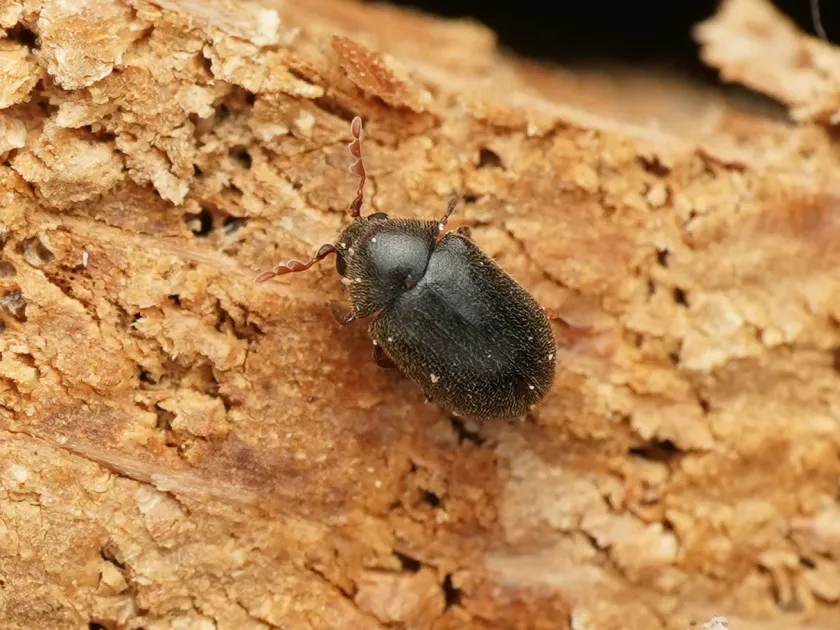
Adult beetles are small, typically measuring between 2 and 4 millimeters in length, with a globular or rounded body shape covered in fine hairs.
Their head is usually retracted into the prothorax, a defensive posture that makes the insect look like it has a hood, which is a hallmark of this group.
Larvae are white, C-shaped, and possess strong mandibles adapted for boring into tough materials like dry wood, dried fruits, or hard plant tissues.
The antennae are distinctive, ending in a three-segmented club that is clearly enlarged compared to the rest of the segments, aiding in scientific identification.
What it damages
Damage is primarily caused by the larvae, which tunnel extensively through the host material, creating a complex network of galleries that weaken the structure.
In natural settings, these insects consume dead wood and fungal fruiting bodies, playing a role in decomposition, but they become pests when they invade human resources.
They are particularly notorious for infesting dried herbs, spices, dried fruit, tobacco, and high-value museum collections containing wood or organic matter.
Infested goods are rendered useless due to the accumulation of larval excrement, silk, and pulverized material, leading to significant economic losses for producers.
Because the larvae remain hidden deep inside the material, early infestation is often invisible, making the damage difficult to detect until it becomes severe.
When it appears
The life cycle of Dorcatoma is heavily influenced by environmental conditions, with development rates accelerating in warm, humid settings.
In climate-controlled warehouses, the insect can remain active and continue reproducing throughout the entire year without a dormant period.
Adult emergence typically peaks during the warmer months, as the beetles fly to find suitable materials to lay their eggs in small crevices or cracks.
Temperature thresholds play a critical role; growth is significantly slower or stops entirely if the environment is kept cool and dry.
A single generation can take several months to complete, but in optimal conditions, multiple generations can occur annually, rapidly increasing the pest population.
Signs of infestation
The most reliable sign of an infestation is the appearance of small, circular exit holes on the surface of the infested product or wooden object.
Fine dust or "frass," resembling flour or sawdust, often accumulates beneath the infested items, indicating active tunneling by larvae inside the substrate.
Internal damage manifests as a network of tunnels that can be observed if the infested material is broken open, often showing signs of fecal pellets inside.
Adult beetles may be seen crawling on surfaces or trapped in light fittings near the storage area, particularly during the evening hours when they are most active.
In quiet rooms, a subtle clicking or rasping sound might be heard if the infestation is heavy, caused by the larvae consuming the hard material.
Control measures
Strict sanitation is the first line of defense, which includes the frequent removal of dust, debris, and spilled products that serve as breeding grounds.
Physical control measures such as heat treatment (exposure to 60°C) or freezing (below -18°C) are highly effective at killing all life stages of the beetle.
For large-scale infestations in warehouses, fumigation with approved gases is necessary to reach larvae hidden deep within stacks of products.
- Storing susceptible items in airtight glass or metal containers to prevent access.
- Inspecting incoming goods for signs of holes or frass before warehouse entry.
- Utilizing pheromone traps to monitor and reduce adult beetle populations.
- Maintaining low humidity levels to make materials less palatable for larvae.
Applying protective wood treatments or sealants can deter the beetles from laying eggs on timber surfaces, providing a layer of structural protection.
Taxonomy
- Latin name
- Dorcatoma
- Order
- Coleoptera (beetles)
- Family
- Ptinidae
- EPPO code
- DORMSP
Discussion
No discussions yet — be the first.