
Gibbium aequinoctiale
Gibbium aequinoctiale
Description
How to identify
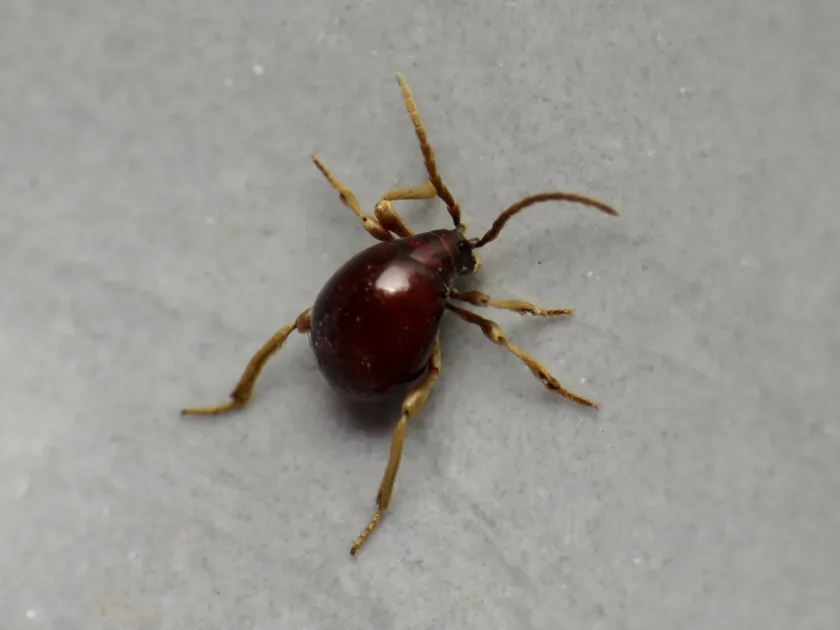
Gibbium aequinoctiale, commonly known as a type of spider beetle, belongs to the family Ptinidae within the order Coleoptera. It is easily identified by its unique globular body shape and long, thin legs that give it a spider-like appearance.
The adult insect has a smooth, shiny body, usually dark reddish-brown to black in color, and completely lacks hairs. Adults are small, measuring approximately 2–3 mm in length.
These beetles are flightless, which restricts their natural movement and often results in their distribution being linked to human activity, such as the transport of infested products. The larvae are white, curved, and covered with fine setae.
During development, the larva constructs a resilient, silk-like cocoon incorporating particles of the substrate. This protective casing makes the pupal stage particularly difficult to detect and eradicate.
The life cycle duration is heavily influenced by environmental factors. Under optimal temperature and humidity conditions, they can complete multiple generations per year, making them a persistent threat in heated warehouses.
What it damages
Gibbium aequinoctiale is a recognized stored product pest that feeds on a wide variety of plant and animal-derived materials. It commonly infests stored grain, flour, and cereal products.
Beyond human food, this beetle is highly versatile and capable of consuming dried vegetables, medicinal herbs, spices, and dried specimens in herbaria or museum collections. It can also damage book bindings due to the glue used.
The larvae and adults bore into the substrate, leaving behind fine debris, excrement, and silk webbing. This significantly degrades the quality of the products, rendering them unsuitable for consumption or commercial use.
Economic damage is most severe in facilities where hygiene standards are neglected and where humidity levels are consistently high, creating an ideal environment for population outbreaks.
- Stored grains and legumes
- Flour and bakery byproducts
- Dried fruits and vegetables
- Herbaria and museum specimens
- Archive papers and books
Signs of infestation
The primary sign of an infestation is the visual observation of small, globular beetles crawling on packaging or near bulk food stores, especially during the twilight hours when they are most active.
Clumped or webbed material within stored goods is a clear indication of larval activity. Larvae use silk to weave particles of food together, creating distinct structures that are visible upon close inspection.
A fine, powdery dust or accumulation of insect frass at the bottom of containers indicates that the population has established itself and is actively feeding on the stored material.
Infested products often develop a characteristic musty or stale odor, which serves as an early warning sign for warehouse managers to inspect the stock more thoroughly.
When populations become dense, adults may be seen on walls, ceilings, or near light sources, indicating that the infestation has spread beyond the immediate food source and requires immediate action.
Control measures
The most effective management strategy is rigorous sanitation. Regular cleaning of storage areas, including the removal of debris from cracks and crevices, is essential to deprive the beetles of food and shelter.
Maintaining environmental controls is critical: keeping temperatures below 10°C and relative humidity below 14% effectively halts the development and reproduction of the beetles.
In cases of confirmed infestation, professional fumigation using approved chemical agents is required to eliminate the insects effectively across all life stages, including eggs and larvae.
Proactive measures include sealing warehouse gaps, installing fine mesh on ventilation ducts, and conducting strict quality control inspections for all incoming materials to prevent initial contamination.
Severely infested stock should be disposed of through incineration or deep freezing to ensure complete eradication, as standard sifting techniques are insufficient to remove all larval stages from the product.
Taxonomy
- Latin name
- Gibbium aequinoctiale
- Order
- Coleoptera (beetles)
- Family
- Ptinidae
- EPPO code
- GIBMAE
Discussion
No discussions yet — be the first.