
Bee beetle
Trichodes apiarius
Description
How to identify
The Bee beetle (Trichodes apiarius) belongs to the order Coleoptera and the family Cleridae. It is a well-known cleptoparasite that specifically targets the nests of bees.
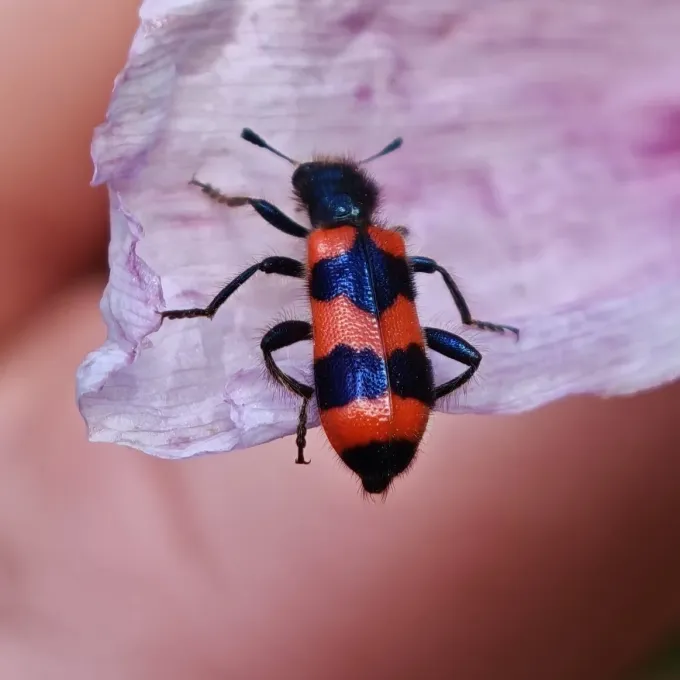
Adult beetles are easily identifiable by their vibrant appearance, measuring between 9 and 16 mm in length with a hairy, elongated body.
The elytra are bright red with three distinct black transverse bands and a black tip. The head and pronotum are also black, contrasting sharply with the red wings.
The larvae are reddish or pink, which allows them to blend in with the bee brood and wax structures within the hive, often escaping notice during inspections.
These beetles are commonly found on flowers during the day, where they feed on pollen and small insects before seeking out honey bee hives to lay eggs.
What it damages
The primary damage is caused by the larvae, which infiltrate the cells of the brood nest and feed on the bee larvae and pupae within.
In addition to consuming the brood, the larvae tunnel through the wax combs, destroying the structure and rendering the frames unusable for future use.
Infestations are most common in weak colonies that cannot effectively patrol the hive entrance or maintain internal hygiene to remove parasites.
A significant presence of Bee beetle larvae can weaken a hive, reducing the population of worker bees and decreasing honey production efficiency.
If left uncontrolled, the larvae cause hygiene issues, accumulation of waste materials, and potentially the collapse of the bee colony due to heavy brood loss.
When it appears
The flight activity of adult Bee beetles occurs during late spring and throughout the summer months, with peaks typically seen in June and July.
This period corresponds with the blooming of various floral sources, providing the beetles with food before they migrate toward apiaries to reproduce.
The lifecycle from egg to adult generally takes one year, although environmental factors like temperature and hive humidity can influence the duration of development.
Eggs are deposited in or near the hive, and after hatching, the larvae immediately seek access to brood cells to begin their parasitic feeding cycle.
Pupation typically takes place at the end of the summer, and the new generation of adults may overwinter within the hive environment if not removed.
Signs of infestation
The most direct sign of an infestation is the presence of the distinctively colored adult beetles on the alighting board or the exterior of the hive.
Inspection of the combs often reveals perforated wax cappings and damaged cells, which contain the remains of devoured bee pupae or larval feces.
Debris on the hive floor, consisting of wax fragments mixed with larval excrement, is a clear indicator that the colony is suffering from an infestation.
A decrease in hive strength and an increase in bee mortality, particularly in the brood area, are common symptoms associated with this type of parasitism.
In advanced cases, the hive may emit a foul odor due to decaying brood and the accumulation of waste products created by the beetle larvae.
Control measures
The best defense against the Bee beetle is maintaining strong, healthy, and hygienic bee colonies that are capable of self-policing and defending the hive.
Beekeepers should practice regular apiary hygiene, including the systematic removal and rendering of old, damaged, or dark wax combs where larvae might hide.
Trapping adult beetles using simple lure-based traps placed near the apiary can help reduce the population during the peak flight season.
- Regular inspection of frames and brood quality.
- Keeping hives well-ventilated to prevent excess moisture.
- Manual removal of observed beetles from the hive entrance.
Preventative management is crucial, as chemical treatments are rarely effective or safe to use directly on hives due to the high toxicity to the bees themselves.
Taxonomy
- Latin name
- Trichodes apiarius
- Order
- Coleoptera (beetles)
- Family
- Cleridae
- EPPO code
- TRCOAP
Discussion
No discussions yet — be the first.