
Enoclerus ichneumoneus
Enoclerus ichneumoneus
Description
How to identify
Enoclerus ichneumoneus, commonly known as a type of checkered beetle, belongs to the family Cleridae, order Coleoptera.
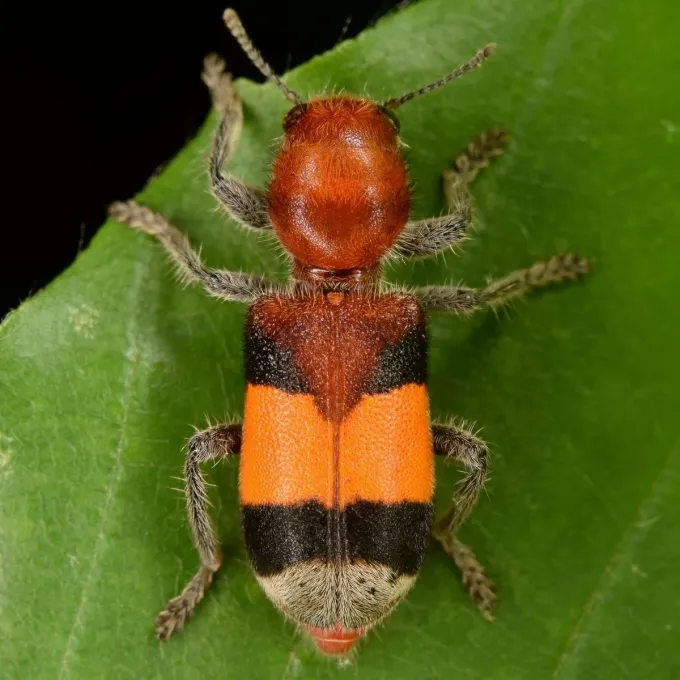
The adult beetle is distinguished by its mimics of ichneumon wasps, characterized by a bright red and black color pattern on its elytra.
They possess a robust, hairy body, typically measuring between 8 to 12 millimeters in length, making them easily identifiable in the field.
Their larvae are often found beneath the bark, exhibiting a soft, elongated body with a darkened head and well-developed mandibles for navigation.
Due to their unique appearance and behavior, they are a subject of interest in entomology, as they occupy complex niches within forest ecosystems.
What it damages
The primary concern regarding Enoclerus ichneumoneus is the damage caused by larvae tunneling beneath the bark of various tree species.
By disrupting the cambium layer, these larvae can interfere with the tree's ability to transport nutrients and water efficiently.
While some checkered beetles are predatory, this species can contribute to the decline of trees that are already stressed or compromised by other factors.
Tunneling facilitates the entry of secondary pathogens, such as fungi and bacteria, which can accelerate the decay of the affected tree.
High population densities in orchard or forest settings may result in branch dieback or the overall weakening of the host plant.
When it appears
Adult beetles are most active during the warmer months, specifically during late spring and early summer when mating occurs.
During the day, they can be spotted on tree trunks or surrounding vegetation, particularly on flower heads where they supplement their diet.
The life cycle is synchronized with the seasons, with larval development usually continuing through the summer months into autumn.
Overwintering typically occurs in the larval or pupal stage beneath the protective bark of the host tree to survive colder temperatures.
The emergence of the next generation in spring coincides with the tree's active growth phase, ensuring an immediate food source for newly emerged adults.
Signs of infestation
The most visible sign of an infestation is the presence of small, round emergence holes on the surface of the bark.
Frass, or wood dust, accumulating in bark crevices indicates that larvae are actively tunneling beneath the surface.
Yellowing of leaves and reduced vigor in branches often signify that the internal circulation of the tree is being compromised by larval activity.
Direct inspection under loose bark will reveal the presence of tunnels and, occasionally, the larvae or pupae of the insect itself.
An increased presence of beetles on nearby foliage or flowers during the summer months is a strong indicator of an active local population.
Control measures
Sanitation practices, such as the prompt removal and destruction of infested or dead wood, are the most effective ways to manage this pest.
Maintaining tree health through adequate irrigation and nutrient management makes trees less susceptible to infestation.
For ornamental or fruit trees, applying sticky barriers to the trunk can help catch crawling adults during their peak activity season.
Encouraging natural predators, including insectivorous birds and parasitic wasps, can help keep the population in check.
Chemical intervention should be considered a last resort and should be performed only when precise monitoring confirms a severe threat to the trees.
Taxonomy
- Latin name
- Enoclerus ichneumoneus
- Order
- Coleoptera (beetles)
- Family
- Cleridae
- EPPO code
- ENOCIC
Discussion
No discussions yet — be the first.