
Checkered beetle
Enoclerus
Description
How to identify
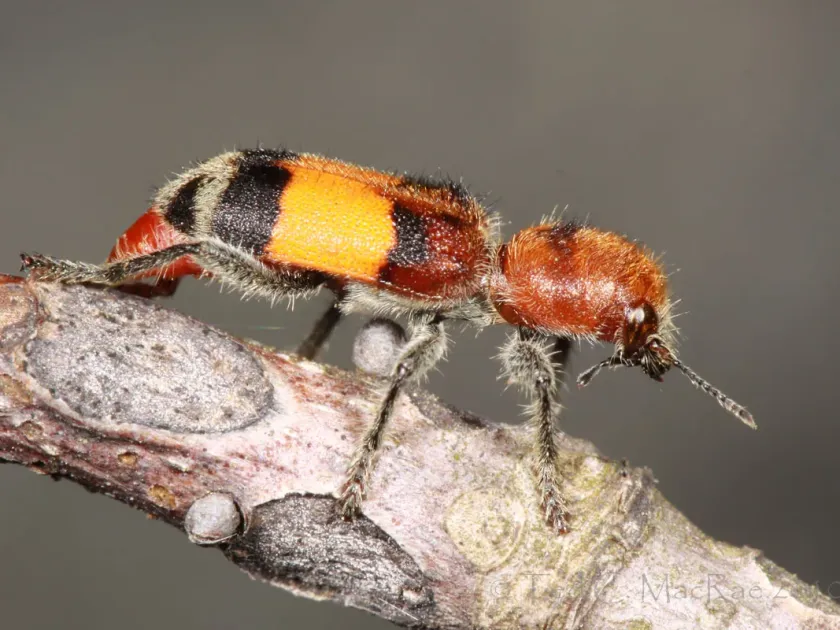
Checkered beetles (genus Enoclerus) belong to the family Cleridae of the order Coleoptera. They are small beetles known for their bright, contrasting color patterns, often featuring combinations of red, black, and white spots.
The adult body is typically dense and covered in thick hairs, making them highly visible on tree bark. They have large heads and well-developed mandibles specialized for predatory feeding.
Larvae are elongated and often pink or orange. They are highly mobile and evolutionarily adapted to hunt prey within narrow galleries underneath the tree bark.
Most species in this genus live as predators during both the larval and adult stages, actively hunting other insects, particularly wood-boring species.
The biology of Enoclerus is deeply interconnected with the lifecycle of bark beetles and other wood-boring pests, playing a crucial role in forest insect communities.
What it damages
In agronomy and forestry, Enoclerus species are primarily considered beneficial entomophages rather than primary pests, as they prey on bark beetles and wood borers.
Despite their role as predators, some species may occasionally feed on weakened plant tissues under extreme conditions, although this is rare compared to their predatory impact.
The main negative impact is indirect: when the checkered beetle population is insufficient to control primary pest outbreaks, significant tree damage occurs from bark beetles.
In nurseries and ornamental landscapes, the presence of these beetles on trunks often indicates an underlying health issue or an active infestation of wood-boring pests.
Assessing damage requires professional analysis, as the galleries created by predatory larvae are often intermingled with those of the wood-boring pests they hunt.
When it appears
The lifecycle of Enoclerus is synchronized with the activity of their prey — stem-boring insects. Adult activity peaks in late spring and early summer.
During the summer, adults roam tree trunks in search of mating opportunities and sites to lay eggs near the galleries of bark beetles.
The larval stage occurs under the bark throughout the warm season, where they actively feed on the eggs and larvae of other wood-dwelling insects.
Pupation typically occurs in late summer or autumn within specialized chambers constructed under the bark of the host tree.
Overwintering usually takes place in the adult stage, sheltered within bark crevices or in the leaf litter near the base of the tree.
Signs of infestation
The most reliable sign of their presence is direct observation of the brightly colored adults on the bark of trees already infested by wood-boring pests.
Upon inspection, one can see these beetles moving rapidly across the bark, reacting quickly to vibrations or the movement of the observer.
Under-bark gallery examination may reveal signs of predatory activity, such as irregular pathways that deviate from standard bark beetle patterns.
A reduction in the bark beetle population in a specific area is often a positive indicator of the efficacy of these predatory beetles.
Exit holes made by Enoclerus when they emerge from under the bark are distinct, usually circular or slightly oval-shaped.
Control measures
Because Enoclerus species act as beneficial predators, targeted eradication in forest ecosystems is strictly discouraged and counterproductive.
The primary management strategy is to maintain forest health and perform timely sanitary logging of trees that are heavily infested by bark beetles.
In ornamental gardens where chemical control is necessary, contact insecticides should be used with extreme caution to avoid killing non-target beneficial insects.
Biological control is preferred: fostering a habitat that supports natural enemies of pests and maintains high biodiversity is the most effective long-term strategy.
Monitoring using pheromone traps allows for the evaluation of both pest population dynamics and the natural predatory pressure exerted by checkered beetles.
Taxonomy
- Latin name
- Enoclerus
- Order
- Coleoptera (beetles)
- Family
- Cleridae
- EPPO code
- ENOCSP
Discussion
No discussions yet — be the first.