
White-banded clerid
Denops albofasciatus
Description
How to identify
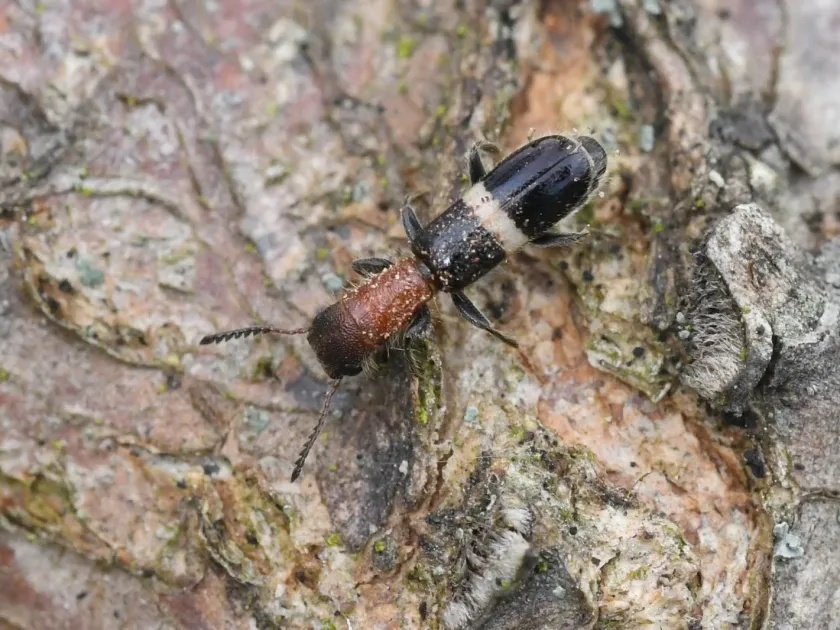
The white-banded clerid (Denops albofasciatus) is a beetle belonging to the family Cleridae, order Coleoptera. The adult insect features an elongated body, typically 5–8 mm in length, with a distinct appearance: dark blue or black elytra adorned with a prominent white transverse band in the middle.
The body is covered with fine hairs, and the head and pronotum are dark, often exhibiting a metallic sheen. Like many members of the Cleridae family, it leads a predatory lifestyle, but it is frequently found in galleries created by secondary wood-boring pests.
Unlike many other tree pests, adult beetles are actively seen crawling on tree trunks during sunny days. Their appearance is easily recognizable due to the sharp contrast of the white band against the dark background.
The larvae are generally elongated and cream-colored, typically living within the galleries excavated by other wood-boring insects. The development follows a complete life cycle: egg, larva, pupa, and adult.
While primarily a forest dweller, this species can infiltrate orchard settings if nearby trees are already weakened by drought or other primary pest infestations.
What it damages
The primary damage is caused by the larval stage, which lives concealed beneath the bark. The white-banded clerid often colonizes galleries created by bark beetles and longhorn beetles, feeding on their larvae, though it can also damage the tree tissues itself.
Affected plant species include mainly hardwood trees such as oak, hornbeam, and beech, as well as several species of fruit-bearing trees. It poses a specific threat to orchards located near woodland boundaries.
The beetle contributes to the spread of fungal pathogens by penetrating deep into the bark layers and damaging the cambium, which is essential for tree health. This results in progressive dieback of branches and reduced fruit production.
Affected trees often show premature yellowing and dropping of leaves, which occurs due to the impairment of the vascular system caused by the pest's burrowing activity.
In forest management, it is often classified as a secondary pest that prefers to attack trees already compromised by environmental stress, mechanical injuries, or initial bark beetle attacks.
When it appears
The active period for adults begins in late spring and continues throughout the summer, peaking during the warm and dry weather of June and July.
Reproduction takes place during the summer months, after which females deposit eggs into bark crevices or existing galleries of other insects. Larvae develop slowly and often remain under the bark until the following spring.
The insect typically overwinters in the larval or pupal stage, finding shelter deep within the wood or beneath loose bark on mature trees.
With the onset of spring warmth, pupal development accelerates, and by the time the sap starts flowing, new adults emerge, ready for mating.
Seasonal patterns depend heavily on regional climate; in warmer southern latitudes, the life cycle is completed much faster than in cooler northern regions.
Signs of infestation
Key indicators of white-banded clerid presence include entry holes in the bark, which appear as small, round openings often accompanied by fine wood dust or "frass."
On tree trunks, one might notice bark detachment, revealing winding galleries chewed by the larvae. Peeling back a fragment of bark may reveal larvae or characteristic waste products.
Symptoms such as crown thinning, dry branches, and general stunted growth of the tree are common signs that the tree has been colonized by wood-boring pests, including the white-banded clerid.
Spotting adults on the tree surface during the daytime in sunny weather is a clear confirmation of an active infestation within the local area.
The presence of woodpeckers and other insectivorous birds on trunks is a strong indicator that larvae are present, as these birds actively forage for the pests beneath the bark.
Control measures
Sanitary pruning and the removal of severely infested trees are the most effective methods to prevent the spread of the beetle to healthy parts of the orchard.
It is crucial to keep the orchard clean by removing wood debris and old bark, which provide ideal hiding and breeding spots for the beetles.
Applying systemic insecticides during the peak adult emergence period is recommended to prevent egg-laying and further damage to the tree trunks.
Maintaining tree vitality through consistent fertilization and proper irrigation reduces the risk of infestation, as healthy trees are better equipped to resist pest colonization.
Biological control methods, such as encouraging the presence of beneficial entomophages and insectivorous birds, can help suppress the population of the pest to a manageable level.
Taxonomy
- Latin name
- Denops albofasciatus
- Order
- Coleoptera (beetles)
- Family
- Cleridae
- EPPO code
- DNOPAL
Discussion
No discussions yet — be the first.