
Pale Eggar
Trichiura crataegi
Description
How to identify
The Pale Eggar (Trichiura crataegi) is a moth belonging to the family Lasiocampidae. It is a nocturnal species often found in orchards, woodland edges, and hedges across the temperate regions.
Adult moths are characterized by a wingspan of approximately 35–40 mm. Their wings have a greyish-brown coloration with a prominent cross-band, providing excellent camouflage against tree bark.
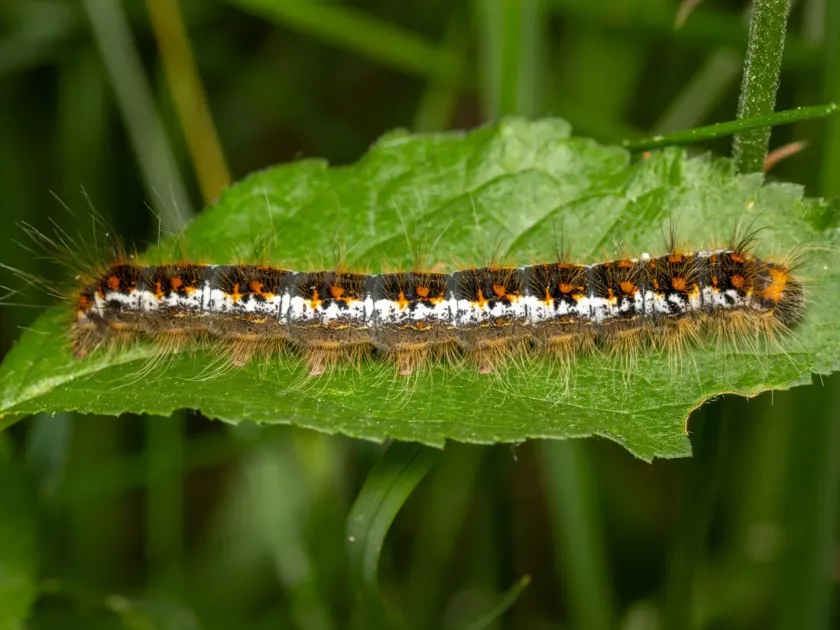
The larvae, or caterpillars, are the primary stage of concern for gardeners. They are densely covered in hair and feature distinctive markings, often with orange spots along their bodies.
Pupation occurs within a tough, parchment-like cocoon. These cocoons are typically attached to branches or tucked into crevices of the bark, where they remain until the moth emerges.
Females deposit eggs in small, orderly batches on the twigs of host plants. These eggs are often covered with fine hairs shed from the female's abdomen to provide insulation and protection.
What it damages
The Pale Eggar is a polyphagous pest, meaning it feeds on a wide variety of host plants, particularly those within the Rosaceae family which includes most orchard fruits.
Common host species include apple, pear, plum, cherry, and hawthorn trees. The larvae are voracious eaters capable of consuming large amounts of leaf tissue in a short period.
Feeding damage typically starts with the younger leaves, but as the larvae grow, they can defoliate entire branches, leading to a significant loss of photosynthetic surface area.
Heavy infestations weaken the trees, making them susceptible to secondary stresses such as drought, frost, and infections from pathogens like fungi or bacteria.
Consistent annual damage can lead to reduced fruit yield, stunted growth in young trees, and an overall decline in the health and vitality of the orchard plantation.
When it appears
This species is univoltine, meaning it completes only one generation per year. Adult moths are primarily active during the late summer and early autumn months.
The egg stage serves as the overwintering mechanism for the species. Eggs remain dormant on the host plant's twigs throughout the harsh winter months.
In spring, as host plants break dormancy, the eggs hatch into larvae. This synchronization ensures that the caterpillars have immediate access to succulent new foliage.
The caterpillar feeding phase is concentrated in late spring, specifically May and June, when the insects grow rapidly to prepare for the pupation phase.
Pupation occurs in early summer. Once the transformation is complete, the adult moths emerge in late summer to mate and lay eggs, resetting the annual biological cycle.
Signs of infestation
The most noticeable sign of a Pale Eggar infestation is the presence of large, hairy caterpillars crawling on the foliage or trunk of fruit trees during spring.
Leaf damage is characterized by irregular notches and holes. In severe cases, you may observe complete defoliation where only the midribs of the leaves remain.
Cocoons can often be spotted in the bifurcations of branches or hidden under loose pieces of bark, appearing as small, brownish, oval structures.
Stunted development of foliage and poor growth of terminal shoots are often indicators that a hidden population of larvae has been feeding on the plant tissue.
- Ragged leaf margins.
- Visible hairy caterpillars in late spring.
- Small parchment-like cocoons on branches.
Control measures
Cultural control involves winter pruning of trees, which allows for the inspection and physical removal of twigs bearing egg batches, effectively lowering the pest population.
Manual collection of larvae is a highly effective method for small-scale gardens. Because they are relatively large and slow-moving, they are easy to handpick.
Biological control agents, such as formulations containing Bacillus thuringiensis, provide a selective and environmentally safe way to target the larvae during their feeding stage.
In cases of high population density, chemical insecticides can be applied during the early larval stages, ensuring that the chemicals are used before the larvae reach maturity.
Maintaining a healthy garden environment that supports natural predators, such as birds and parasitic wasps, can help keep the Pale Eggar populations under control naturally.
Taxonomy
- Latin name
- Trichiura crataegi
- Order
- Lepidoptera (butterflies)
- Family
- Lasiocampidae
- EPPO code
- TRIICR
Discussion
No discussions yet — be the first.