
Siberian silk moth
Dendrolimus sibiricus
Description
How to identify
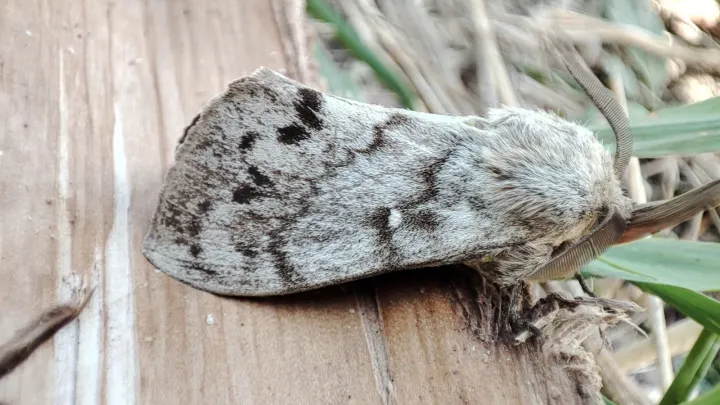
The Siberian silk moth is a large moth belonging to the Lasiocampidae family, with a wingspan ranging from 60 to 90 mm. Their coloration is highly variable, ranging from light gray to dark brown, providing excellent camouflage against tree bark.
The forewings feature distinct dark transverse stripes and a characteristic crescent-shaped white spot in the center. Larvae go through five to six instars, reaching lengths of up to 80 mm, and are identifiable by their brownish color with velvety black gaps between body segments.
The life cycle of this insect lasts from one to three years, depending on regional climatic conditions. In harsher environments, development often takes two years, which ensures population survival during extreme temperature fluctuations.
Adult moths are nocturnal and crepuscular; during the day, they remain motionless on tree trunks, perfectly blending with the texture. Eggs are laid in clusters on needles, branches, or bark and darken in color just before the larvae emerge.
Pupation occurs inside spindle-shaped cocoons attached to branches or hidden within bark crevices. These cocoons vary in color from light to dark brown, making them difficult to detect during routine forest surveys.
What it damages
The primary host plants for this pest are coniferous species, including larch, cedar, fir, and spruce. During mass outbreaks, the Siberian silk moth can devastate vast forest areas in a very short period.
Young larvae start by feeding on tender needles, while mature larvae consume entire needles, including older growth. Heavily defoliated trees become weak and highly susceptible to secondary pests, such as bark beetles.
After being defoliated for several consecutive years, trees lose their ability to photosynthesize and eventually die. This leads to the creation of extensive areas of standing deadwood and permanently alters the forest ecosystem.
The pest is highly adaptive; if preferred tree species are scarce, it can switch to other conifers. This poses a significant threat not only to natural forests but also to plantations and tree nurseries.
The economic impact of Siberian silk moth outbreaks is measured in millions of hectares of lost timber, which also increases the risk of catastrophic forest fires due to the accumulation of dry material.
When it appears
Adult moths emerge during the summer months, with activity peaking in June and July. This period is dedicated to mating and egg-laying on the needles and twigs of host trees.
Larvae overwinter in the forest litter, tucked under layers of fallen needles and leaves to protect themselves from low temperatures. As the weather warms in spring, typically at temperatures around 5–10 degrees Celsius, they migrate back to the canopy.
The larval feeding period spans the entire warm season, reaching maximum intensity in mid-summer. As they grow, they undergo several molts, continuously increasing the volume of needles they consume.
Pupation usually occurs in the first half of the summer, followed by the emergence of adults a few weeks later. The life cycle is strictly synchronized with the length of the growing season and local environmental conditions.
In years with an unusually cold spring, larval development slows down, shifting the pupation timeline. This feature must be considered when planning monitoring efforts and timing control operations.
Signs of infestation
The primary indicator of an infestation is a thinned or "eaten" crown, which takes on a rusty hue due to massive defoliation. A large accumulation of larval frass (excrement) under the trees is a clear sign of infestation.
The presence of larvae in the canopy during the summer is a direct confirmation of active feeding. Additionally, one might observe silk webbing used by larvae to bundle needles together.
Finding cocoons in bark crevices or among branches indicates the final stages of development. During mass outbreaks, the sound of thousands of larvae feeding can even be heard from a distance.
Secondary signs include the infestation of weakened trees by wood-boring beetles, whose entry holes and bore dust become visible on the bark. This indicates that the tree is already critically exhausted.
When inspecting young plantations, it is crucial to look for egg clusters, which appear as small, shiny, pearl-like beads arranged in tight groups on the needles or twigs.
Control measures
Management is based on an integrated approach, starting with population monitoring using pheromone traps. This allows for the timely identification of outbreaks and the scheduling of control measures.
Biological control involves the use of Bacillus thuringiensis-based products, which are effective against early-instar larvae while remaining environmentally safe for the surrounding ecosystem.
In cases of critical population levels, broad-spectrum insecticides are applied via aerial spraying of forest areas. This method allows for the rapid suppression of pest populations over large, inaccessible territories.
Forestry preventive measures include the timely removal of weakened or diseased trees and the clearing of forest debris to reduce the moth's habitat and breeding success.
- Encouraging natural predators, such as parasitoids and birds.
- Sanitary logging in infested areas.
- Regular forest pathology surveys.
- Monitoring the health of the stand after winter.
Taxonomy
- Latin name
- Dendrolimus sibiricus
- Order
- Lepidoptera (butterflies)
- Family
- Lasiocampidae
- EPPO code
- DENDSI
Discussion
No discussions yet — be the first.