
Larch moth
Tolype laricis
Description
How to identify
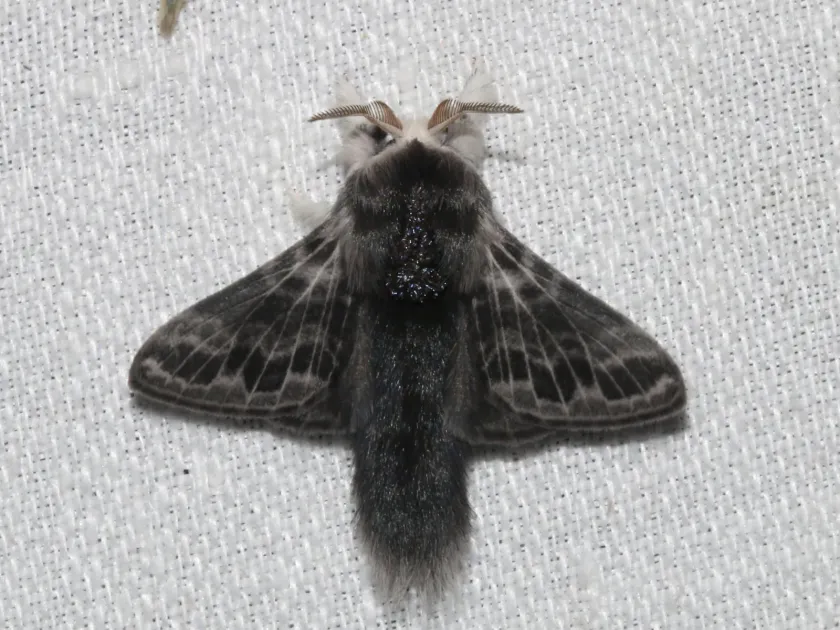
The Larch moth (Tolype laricis) belongs to the Lasiocampidae family within the order Lepidoptera. This nocturnal moth has evolved excellent camouflage, resembling dead leaves or pieces of bark when at rest on a tree trunk.
Adult moths feature a dense layer of hairs on their body and wings, ranging in color from gray to dark brown with distinct white transverse bands. Females are generally larger, while males possess prominent feathery antennae used to locate mates.
The larvae are covered in fine, dense hairs that can cause skin irritation in humans upon contact. Their cryptic coloration allows them to blend in seamlessly with the larch needles or twigs they inhabit.
Their life cycle consists of complete metamorphosis: egg, larva, pupa, and adult. They typically overwinter as eggs, which are deposited in small groups on branches and covered with protective fuzzy scales.
Adult moths are non-feeding, as their mouthparts are vestigial; their sole purpose is to mate and lay eggs, typically occurring during the late summer and early autumn months.
What it damages
The primary host for this species is the Larch (Larix), though it can occasionally be found on other conifers such as spruce or pine trees when populations are dense.
The pest causes damage in both mature forest stands and young plantations, where defoliation can significantly hinder the growth and vigor of nursery stock.
Larvae consume needles aggressively, which reduces the tree's photosynthetic capacity and ultimately leads to severe weakening of the host plant.
Chronic infestations over multiple seasons can cause crown dieback, reduced timber increment, and make trees more susceptible to secondary pests and various pathogens.
In cases of high population density, the Larch moth can cause significant economic losses by damaging large tracts of coniferous forests and plantation areas.
When it appears
The flight period for adult Larch moths generally occurs from late summer through early autumn, which is when egg-laying activity is at its peak.
The eggs overwinter and hatch in the spring, coinciding precisely with the bud burst and the commencement of the larch's new growing season.
The larval feeding stage spans the entire spring and early summer period, during which the larvae grow rapidly through several instars.
Pupation takes place in mid-to-late summer, inside tough, silk-lined cocoons that are securely anchored to branches or within the crevices of the tree bark.
Developmental timing is highly dependent on climatic conditions, with warmer and drier seasons often leading to more frequent and intense outbreaks of the population.
Signs of infestation
A primary indicator of an infestation is the presence of partially eaten needles and accumulated larval frass beneath the tree canopy during the spring.
Closer inspection of the branches often reveals the presence of cocoons, which are grey or brownish, oval-shaped structures firmly attached to the bark.
Visible thinning of the foliage, loss of needles, and yellowing of the branch tips are clear signs that larvae are actively feeding on the tree.
Egg masses, which are covered in hairs from the female moth's abdomen, can be detected during the dormant season, serving as an early warning for potential spring outbreaks.
During massive outbreaks, one might observe clusters of larvae resting in the forks of branches during the day to avoid direct exposure to sunlight.
Control measures
The most effective method for large-scale forest management is the application of biological insecticides based on Bacillus thuringiensis, which target young larvae.
In ornamental landscapes and nurseries, systemic insecticides may be employed to disrupt the feeding and development of the larvae effectively.
Silvicultural practices, such as the removal of dead bark and cleaning of infested branches, can help reduce the overwintering population density of the pest.
Encouraging natural predators, such as insectivorous birds and parasitic wasps, is a key component of long-term biological control in forest ecosystems.
- Use of sticky bands on trunks to trap migrating larvae.
- Monitoring adult populations with light traps to predict outbreaks.
- Improving tree vigor through proper site selection and balanced fertilization.
Taxonomy
- Latin name
- Tolype laricis
- Order
- Lepidoptera (butterflies)
- Family
- Lasiocampidae
- EPPO code
- TLYPLA
Discussion
No discussions yet — be the first.