

Mealy plum aphid
Hyalopterus pruni
Description
How to identify
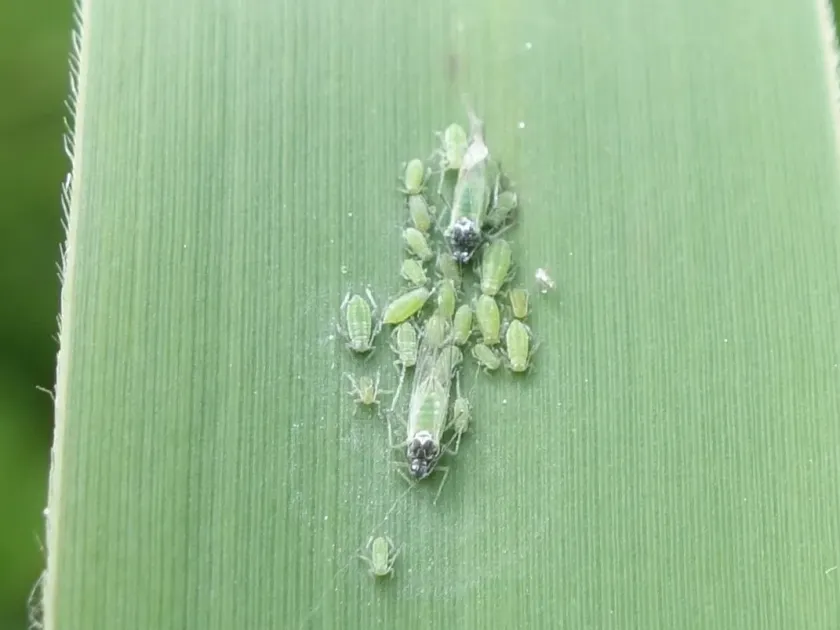
The mealy plum aphid (Hyalopterus pruni) belongs to the family Aphididae, order Hemiptera. Adult aphids are elongated, pale green, and covered with a distinct white, waxy secretion that gives them a floury or "mealy" appearance.
This species is migratory. It alternates between primary hosts, such as plum and other stone fruits, and secondary hosts, typically grasses like reeds, throughout the growing season to optimize its survival and reproduction.
Reproduction is primarily parthenogenetic, allowing for exponential population growth. Winged forms develop during the season to disperse the colony to new hosts, ensuring the species spreads across orchards and surrounding vegetation.
The insect overwinters as eggs, which are deposited near buds on the twigs of host trees. In the spring, these eggs hatch into fundatrices (stem mothers), which initiate the colonization of emerging leaves.
Colonies form dense mats on the underside of leaves. This white waxy cover acts as a physical shield, making them less susceptible to contact-based pesticide treatments compared to other aphid species.
What it damages
The primary hosts include plum, apricot, peach, and blackthorn. While they may occasionally be found on crops like onions, cucumbers, tomatoes, or potatoes, Hyalopterus pruni is not a specialized pest for these, primarily affecting the Rosaceae family.
The aphids feed on phloem sap from young leaves and shoots. This feeding process results in the stunting of growth, leaf curling, and chlorosis, which significantly weakens the overall vigor of the fruit tree.
Infested trees suffer from reduced productivity. The fruit produced is often undersized, poorly colored, and lacks sugar content, which reduces its commercial value and the tree's overall winter hardiness.
Heavy infestations lead to early leaf drop, which prevents the tree from storing sufficient energy for the next year's growth. In severe cases, multiple years of damage can lead to the decline of the entire tree.
The honeydew secreted by the aphids covers the foliage, facilitating the growth of sooty mold. This fungus blocks photosynthesis, further stress-inducing the tree and reducing its ability to recover from the aphid infestation.
When it appears
The seasonal cycle begins in early spring when the fundatrices hatch and start feeding on developing buds. This is the most critical stage for intervention before the population explodes.
Peak population levels typically occur during late spring and early summer. During this time, multiple generations of wingless females are produced, rapidly colonizing the entire canopy of the host trees.
In mid-to-late summer, winged individuals migrate to secondary hosts such as wetland grasses. This natural migration reduces the pressure on fruit trees but does not eliminate the risk, as return migration occurs in autumn.
During the autumn migration, sexual forms return to the primary host trees. They mate and deposit overwintering eggs in crevices on the bark, ensuring the survival of the species until the following spring.
The population growth is highly dependent on weather conditions. Warm, dry spring weather accelerates development, while periods of heavy rainfall can provide some natural control by dislodging aphids from the foliage.
Signs of infestation
Leaf curling is the most prominent symptom. When the leaves are examined, the undersides reveal large, crowded colonies of pale green aphids concealed beneath a white, powdery wax layer.
A noticeable presence of ants moving along the trunk and branches is a strong indicator. Ants actively tend to the aphid colonies to harvest the honeydew, often protecting them from natural predators.
The presence of sticky honeydew on the leaves below the colonies creates a glossy sheen. Over time, this sticky substance turns black as sooty mold begins to colonize the surface, giving the tree a sickly appearance.
Distorted growth of terminal shoots and yellowing of the leaves indicate high feeding pressure. If the infestation is not addressed, the growth rate of the current year's shoots will be severely hampered.
Early leaf senescence and premature leaf drop are definitive signs that the aphid colony has been established for a significant period and is causing critical physiological stress to the tree.
Control measures
Effective control requires a combination of early-season intervention and ongoing monitoring. Dormant oil sprays applied before bud break are effective in destroying overwintering eggs.
Cultural practices are essential to minimize habitat for the aphids. Removing water sprouts and suckers from the base of the tree is a simple but effective way to reduce the areas where aphid colonies start.
Systemic insecticides are the preferred chemical method. Because the aphid is covered in a protective waxy layer, contact sprays are often less efficient than systemic products that travel within the tree's sap.
Encouraging natural predators such as ladybugs, lacewings, and hoverflies can help suppress aphid numbers in the summer. Planting a variety of nectar-producing flowers around the orchard encourages these beneficial insects.
- Monitor buds and young leaves early in the season.
- Apply systemic insecticides based on professional thresholds.
- Use sticky bands on trunks to deter ant movement.
- Remove weeds that can serve as secondary hosts.
In brief
8
Damages crops
Content graph
Damages crops · 8
Content graph
Connections · Mealy plum aphid
Most often together:
Marketplace
Products · 4


Biology
Taxonomy
- Latin name
- Hyalopterus pruni
- Order
- Hemiptera (bugs, aphids, leafhoppers)
- Family
- Aphididae
- EPPO code
- HYALPR
Community
Discussion
No discussions yet — be the first.