
Rice stalk stink bug
Tibraca limbativentris
Description
How to identify
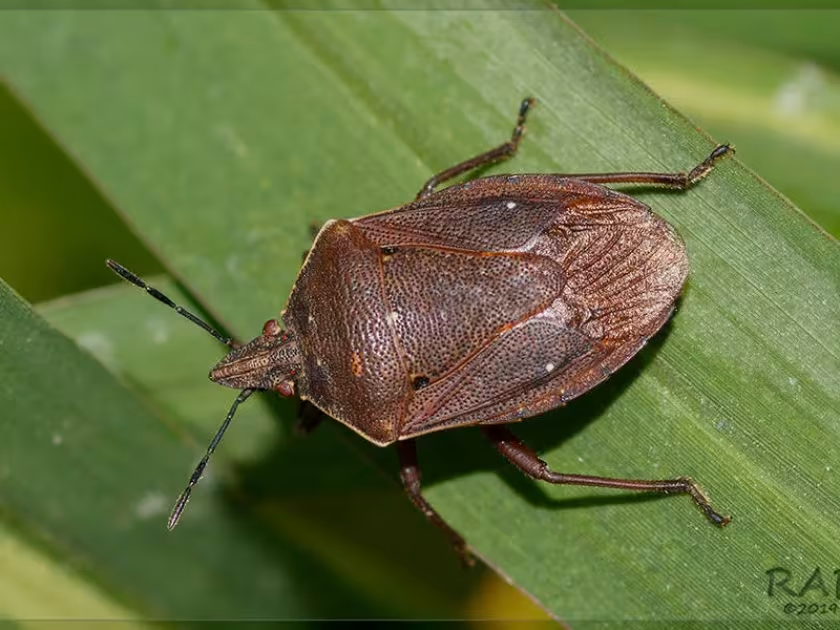
The rice stalk stink bug, Tibraca limbativentris, is a member of the order Hemiptera and the family Pentatomidae. The adult bug is characterized by an oval-shaped body, typically measuring 10–12 mm in length, with a brownish or tan coloration.
The insect possesses a hardened, shield-like exoskeleton that protects its internal organs. It is equipped with specialized piercing-sucking mouthparts, which are designed to penetrate the tough outer layers of rice stems to access plant sap.
Diagnostic features include distinct lateral spines on the pronotum, which serve as a reliable method for distinguishing this species from other pentatomids present in rice ecosystems.
Nymphs, or juvenile stages, closely resemble the adults but are smaller and lack fully developed wings. They transition through several instars, changing color and markings as they grow toward maturity.
As a specialized pest, it is well-adapted to the humid, semi-aquatic environments provided by flooded rice fields, making it a persistent threat in many subtropical and tropical agricultural regions.
What it damages
The primary host plant for Tibraca limbativentris is rice (Oryza sativa). Both adults and nymphs feed by extracting phloem sap from the stems, which disrupts the physiological functions of the host plant.
While rice is the preferred target, the bug can also survive on various wild grasses surrounding the fields. These alternative hosts allow the pest population to persist even when rice is not in a susceptible growth stage.
The most severe damage occurs during the tillering and stem elongation stages. Feeding activity often targets the main stem, leading to a condition commonly known as "dead heart," where the central leaf dies prematurely.
Severe infestations cause a significant reduction in tillering capacity, resulting in stunted plant growth and a decrease in the number of productive panicles per hill.
In addition to direct plant death, the bug's feeding can introduce pathogens into the stem, further weakening the crop and leading to increased rates of empty grains and reduced grain weight at harvest.
When it appears
The seasonal life cycle of the rice stalk stink bug is governed by temperature and the availability of host plants. Activity typically peaks during the warm, wet months that coincide with the active rice growing season.
Adults overwinter in protected areas such as crop debris, field margins, or under the bark of trees. As temperatures rise in the spring, they emerge to colonize available host plants.
The species may complete multiple generations within a single year if environmental conditions remain favorable. Egg-laying usually occurs on the underside of leaves or directly on stems to shield the eggs from desiccation.
The developmental period from egg to adult is relatively short, allowing populations to surge rapidly. This rapid turnover necessitates proactive monitoring to prevent exponential growth within the field.
As the season progresses and temperatures drop, adults move to dormancy sites to survive the winter, effectively ending the active feeding phase of their biological cycle.
Signs of infestation
The primary visual symptom of a Tibraca limbativentris infestation is the yellowing and subsequent necrosis of the youngest central leaf, known as the "dead heart" symptom.
Upon closer examination of the stem base, one can identify tiny dark punctures where the bug has inserted its stylet. These punctures may show minor exudation or necrotic spotting due to the insect's salivary enzymes.
- Premature yellowing of the central leaf.
- Presence of bug colonies at the base of the rice hill.
- Reduced tillering and inhibited plant height.
- Failure of the panicle to emerge correctly.
- High percentage of empty or unfilled grain at harvest.
Affected fields often exhibit irregular patches of stunted plants. These patches serve as early warning signs for scouts, indicating areas where localized control measures may be required.
Because the bugs are often hidden near the water line or inside the leaf sheath, detection may require carefully parting the foliage to inspect the lower stem sections during the early morning hours.
Control measures
Integrated pest management (IPM) for this pest relies on a combination of cultural, biological, and chemical interventions. Field sanitation is the most critical first step to reduce overwintering populations.
Cultural practices, such as deep plowing after harvest, destroy the niches where adults survive during the off-season. Furthermore, maintaining weed-free field margins minimizes secondary host availability.
Biological control plays a significant role in limiting pest numbers. Egg parasitoids, particularly tiny wasps, are effective in suppressing populations if natural enemies are preserved through reduced broad-spectrum insecticide use.
Chemical control is warranted when the population exceeds established economic thresholds. Insecticides should be applied during the early morning or late evening when the bugs are most active and exposed on the stems.
Regular field scouting and the use of pheromone traps are essential tools for monitoring population trends, ensuring that insecticide applications are timed precisely to provide maximum crop protection.
Taxonomy
- Latin name
- Tibraca limbativentris
- Order
- Hemiptera (bugs, aphids, leafhoppers)
- Family
- Pentatomidae
- EPPO code
- TIBRLI
Discussion
No discussions yet — be the first.